
IBM
IBM · AI / ML · Filed May 16, 2025 · USPTO published Nov 19, 2026 · This week's release
IBM Patents an AI That Turns Written Problems Into Math, Then Checks Its Work
Ask an AI to find the cheapest or fastest way to do something and it may simply guess. IBM's patent application has the AI write the problem out as math, check that math, and then let several versions vote on the answer.
- Publication number
- US 2026/0368275 A1(US20260368275A1)
- Applicant
- International Business Machines Corporation
- Filed · Published
- May 16, 2025 · Nov 19, 2026
- Inventors
- Dzung Tien Phan, Vinicius Lima Silva, Dhavalkumar C. Patel, Ali Koc, Nianjun Zhou, Pavan Kapanipathi Bangalore, Luis A. Lastras-Montano, Jayant R. Kalagnanam
- Status when we published
- Waiting for an examiner
- Document
- 20 claims
- US classification
- 704/2
- Examiner
- LEVENTAL, YUVAL HAIM (Art Unit 2659)
What IBM's problem-to-math translator does
Every time a business tries to cut costs, boost profit, or find the shortest route, someone has to turn a paragraph of plain English into a math problem a computer can solve. That translation is slow, and it is easy to drop a rule along the way, like a limit on how much you can spend.
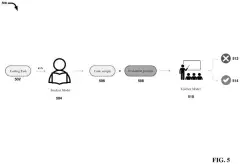
IBM's patent application has an AI do the translating, but it does not trust the first try. The AI pulls out the pieces of the problem, then writes the math, then writes working code. Each stage gets checked before the next one begins.
At the end, a standard solver program runs the code, which is written in several different programming languages. If most versions land on the same answer, that answer wins. It works like asking several careful students to solve the same puzzle and trusting the result they agree on.
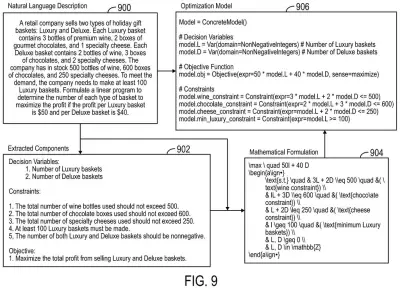
processing a natural language description of an optimization problem to generate extracted components comprising decision variables and constraints of the optimization problem; …
Translation: The system reads plain text and pulls out the key moving parts and rules.
How IBM checks each step before moving on
The system takes a written description of an optimization problem (a puzzle where you want the best result, like the lowest cost, while following rules). It asks a generative AI model, such as a large language model (the technology behind chatbots), to work in three separate prompts:
- Extract: pull out the decision variables (things you can change), the constraints (the rules), and the objective (the goal).
- Formulate: write those pieces as a mathematical formulation.
- Code: turn the formulation into optimization models, which are programs in different modeling languages. The filing names Pyomo, DOcplex and AMPL.
Between steps, a mathematical proof assistant (software that tests logical claims, with Lean tools named as an example) derives assumptions from the original text. It checks whether the extracted pieces and the formulation respect them, for instance by spotting a missing constraint. A failed check raises an error instead of moving on.
An optimization solver (a program such as IBM's CPLEX that searches for the best answer) then runs every model. If one model errors out, the error goes back to the AI to regenerate it. Finally, a code evaluator checks whether most models agree.
The filing also describes training the AI on synthetic problems, built by mixing subsets of 145 seed problems. It says that can yield about 500 million combinations.
The mathematical formulation is processed to generate optimization models implementing the mathematical formulation in different optimization modelling languages.
Translation: It translates the math into several different coding languages to run tests.
Why a majority vote matters for AI answers
If you have ever asked a chatbot for a schedule, budget or route, you know the weak spot: it can sound confident while ignoring one of your rules. This design tries to catch that by checking the problem at every stage and refusing to answer when the checks fail or the models disagree.
The filing frames this for businesses that already run optimization software, and it names IBM's own CPLEX solver and DOcplex tools as examples. The pitch is that people describe a problem in ordinary language and skip the specialist who would hand-write the model. The training idea also matters: the checked outputs become training data, so the AI can learn from problems that have no known correct answer.
That makes this IBM's 25th filing we've tracked since May in our AI teams working together watchlist, following its work on picking the best AI per task and grading a small AI's code.
Source: US 2026/0368275 A1 at the USPTO (PDF). Full patent text and figures are in the official publication.
Get our take in your Top Stories
Liked this breakdown? Add Patentlyze as a preferred source on Google, and our plain-English take shows up more often in your Top Stories the next time IBM patent news breaks.
Add Patentlyze on Google
One click.
There are more where this came from
We read every patent application Big Tech publishes and send you the ones worth knowing. Plain English, free, every week.
The drawings · 9 sheets
9 drawing sheets from US 2026/0368275 A1 · click any drawing to enlarge


Show the other 1 sheets

More from IBM
All 481 IBM patents →
More in AI / ML
All 2,738 AI / ML patents →
Sony
Sony Patent Targets AI That Selects Optimal Solvers for Complex Optimization Problems
Adobe
Adobe Wins a Patent for Two AIs That Take Turns Editing and Critiquing Your Video
Adobe
Adobe's New Patent Turns a Single Description Into a Finished, Ready-to-Use Page
Salesforce
No comments yet