
IBM Files Patent for Mainframe AI That Studies Only the Jobs That Repeat
IBM's mainframe software uses AI to predict rushes of work, but a bloated model answers too slowly to help. This filing fixes that by training the AI only on the job types whose patterns are strong enough to matter.
What IBM's job-sorting filing actually does
You run the computer room for a big company, and every day at 11:00 AM a wave of jobs hits at once. If your system only reacts, the line grows long before extra workers show up. An AI that spots the 11:00 rush ahead of time can get those workers ready early.
The catch is that the AI has to answer fast, and the more kinds of jobs it studies, the bigger and slower it gets. IBM's filing handles this by scoring each type of job on how reliably it repeats, how big the rush is, and how long it lasts. Types that follow no pattern, or barely matter, get left out of the training.
The result is a smaller AI that learns from the jobs that count, trains faster, and answers in time to be useful. The existing scheduler still makes the final call.
determining, for a service class among a plurality of service classes in a computing system, that a workload pattern exists for the service class, wherein the workload pattern is based on a previous execution of one or more work items included in the service class …
Translation: The system checks past job runs to see if a certain group of tasks follows a predictable routine.
How IBM scores each job type for AI training
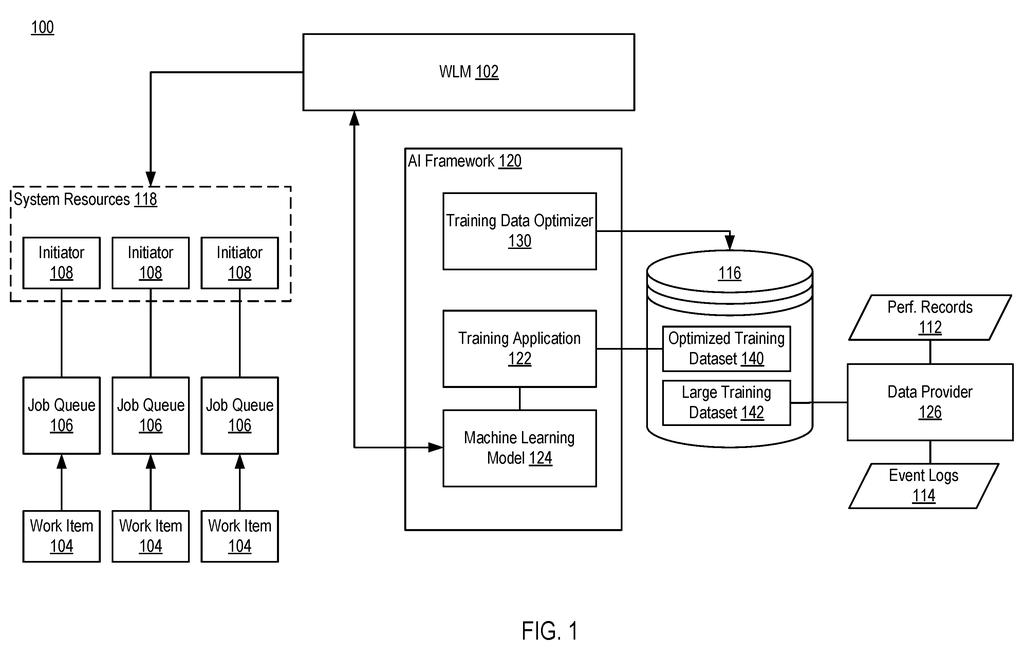
The patent covers a step that happens before an AI model is trained. In IBM's mainframe setup, a workload manager (the software that decides which jobs get computer resources and when) sorts work into service classes, which are named groups of jobs that share a goal, such as finishing within a set time. The AI predicts how much capacity is coming, so the manager can start extra job runners (called initiators) before a rush.
A training data optimizer first checks whether a service class shows any repeating pattern in its past runs. No pattern means the class is dropped. If there is one, it counts the peaks, meaning moments when resource use rises above a set threshold, and builds a score from three things:
- Peak count: how often the surge happens
- Peak height: how many resources it takes
- Peak duration: how long it lasts
In the filing's example, the three numbers are multiplied. Class A scores 200, class B scores 240, and class C scores 45. With a cutoff of 100, class C is dropped. The score can be scaled up when the system is already busy (a 90 percent CPU load counts for more than 30 percent) or when a class is marked important.
Instead of a fixed cutoff, the system can keep only the top k classes, and a cost-benefit check can also decide who gets in. The smaller training set makes a smaller model that loads faster, uses less memory, and predicts seconds or minutes before new work arrives.
… optimizing AI model training and inferencing performance through service class prioritization includes detecting one or more patterns in a plurality of service classes previously executed on a computing system …
Translation: By focusing training on repetitive tasks rather than everything, the AI learns faster and runs better.
Why a smaller model helps mainframe schedulers
If you never touch a mainframe, you still depend on what runs on one: the batch jobs, transactions and database queries that large organizations run every day. Predicting a rush a few minutes early lets the system start extra workers sooner, so queues stay shorter. The filing's pitch is that a leaner AI answers fast enough to help, since a late prediction is worth nothing to a scheduler.
The background section also admits something rarely said out loud: the computing cost of AI can exceed the benefit it provides. This patent is about spending AI effort only where it pays off. That budget-your-AI logic is easy to picture in other systems that run a model nonstop to guide their own operations.
IBM's 40th filing we've tracked in AI training and infrastructure since May follows earlier work on crash recovery for training and teaching AI to query stored data.
The path to shipping this is short. Nothing here needs new hardware. It is a software step that sits in front of an AI model the workload manager already uses, and it reads system logs the machine already keeps.
What has to exist first is the prediction setup itself, the manager plus the AI framework that forecasts rushes, and the filing treats both as part of the existing system. The new piece is a scoring formula (how often, how high, how long, multiplied together) plus a cutoff. A software team could fold that into an update on IBM Z systems running z/OS, the environment the filing names.
The verdict: a modest, sensible efficiency fix. The math is simple, so the hard part is tuning the cutoffs on real systems, which the filing leaves to users or to a fixed model size. Customers would notice it only as jobs that start a little sooner.
Get our take in your Top Stories
Liked this breakdown? Add Patentlyze as a preferred source on Google, and our plain-English take shows up more often in your Top Stories the next time IBM patent news breaks.
There are more where this came from
We read every patent application Big Tech publishes and send you the ones worth knowing. Plain English, free, every week.
The drawings
10 drawing sheets from US 2026/0311043 A1 · click any drawing to enlarge


Want this weekly breakdown for a company we don't cover? Patentlyze Pro →
Be the first to weigh in