
Hyundai & Kia
Hyundai & Kia · Automotive · Filed Sep 23, 2025 · USPTO published Nov 19, 2026 · This week's release
Kia Patents a Car Seat That Cleans Up Its Own Spills
Kia has filed a patent for a car seat with a robot arm hidden underneath. It finds a spill on its own, then scrapes, sprays, wipes and vacuums it away.
- Publication number
- US 2026/0364652 A1(US20260364652A1)
- Applicant
- Kia Corporation
- Filed · Published
- Sep 23, 2025 · Nov 19, 2026
- Inventors
- Baek Hee Lee, Yo Seob Lee, Sang Ji Moon, Won Seok Lee, Soong Un Choi, Min Hyuk Kwak, Kang Yen Lee
- Status when we published
- Waiting for an examiner
- Document
- 20 claims
- US classification
- 134/57R
What Kia's self-cleaning car seat actually does
You hop out after a drive-through lunch, and a blob of ketchup is sitting on your light-colored seat. You head inside, and by the time you're back the stain has started to set. Kia's patent is about taking that chore off your hands.
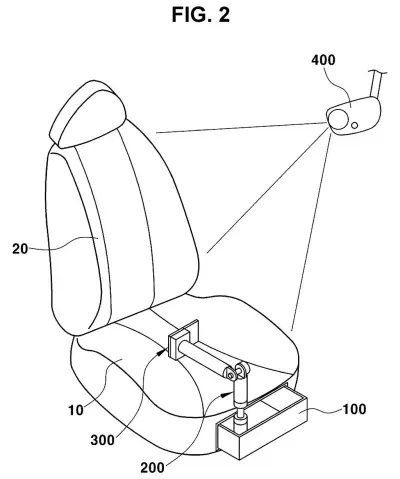
A camera inside the cabin spots the mess. Once the car is off and you've left, a small robot arm tucked under the seat slides out, reaches the spot, and gets to work. It can scrape, spray cleaning liquid, wipe with a cloth towel, and vacuum, depending on whether the mess is a liquid, a goopy sauce, or crumbs.
Kia's own filing says the problem is worst with light-colored seats and shared cars, where a stain left alone can soak in and discolor the fabric for good.
… a robot arm configured to deploy to the contaminant location on the seat cover in response to a control signal from the controller; and a cleaning tool mounted on a front end portion of the robot arm …
Translation: A mechanical arm automatically reaches the mess with a specialized cleaning head attached to the end.
How the arm picks scrape, spray, wipe or vacuum
Kia's system has four main parts: a camera, a controller (the car's onboard computer), a robot arm, and a cleaning tool on the tip of the arm. The camera watches the seat. The controller uses image analysis trained on example photos (deep learning) to work out where the mess is and whether it is a liquid like coffee, a thick fluid like ketchup or toothpaste, or a solid like crumbs. To pinpoint the spot, it sets up a map using two landmarks the camera can see: the top of the seatback and the front of the seat cushion.
It also measures how different the stain's color looks from the seat, using a standard color-difference formula, and treats a score of 0.5 or more as worth cleaning. If a spot keeps growing over time, the controller reads that as a thick fluid and scrapes it first so it doesn't spread. Cleaning runs only when the car is off and a passenger has left, a signal that can come from the seat belt reminder.
The filing describes a different routine for each type of mess:
- Liquid: spray cleaning solution, then wipe with the towel.
- Solid: vacuum first, then spray and wipe the leftover stain.
- Thick fluid: scrape and gather, vacuum, then spray and wipe.
The arm rides in a drawer under the seat cushion that slides forward on rails. It has three motors for lifting and swiveling. The tool head has spring-loaded pins that release liquid when pressed against the seat, a folding second head with a vacuum, and a cloth towel on two rollers that feeds out clean fabric and winds up the dirty part.
Why shared cars are the real test for this seat
If a car can clean its own seats, the first person to benefit is whoever drives a light-colored interior and hates the thought of a spilled drink. The bigger payoff is in shared vehicles, where the filing says a stain left unattended can adhere to the seat cover and discolor it. A car that handles spills right after each rider leaves keeps the next passenger from sitting on someone else's lunch.
This is a patent application, so it describes an idea and not a product you can buy. The filing also shows the practical limits: owners would still need to refill the cleaning liquid and empty the dust container by hand. Any real version would have to fit all this hardware under a seat without costing legroom or adding much weight.
Hyundai's second robotics patent we've tracked since November follows a wheel-hidden charging plug from Kia, showing the group exploring new ways machines might move and power themselves.
Source: US 2026/0364652 A1 at the USPTO (PDF). Full patent text and figures are in the official publication.
Get our take in your Top Stories
Liked this breakdown? Add Patentlyze as a preferred source on Google, and our plain-English take shows up more often in your Top Stories the next time Hyundai & Kia patent news breaks.
Add Patentlyze on Google
One click.
There are more where this came from
We read the new patents from Big Tech, carmakers and more and send you the ones worth knowing. Plain English, free, every week.
The drawings · 13 sheets
13 drawing sheets from US 2026/0364652 A1 · click any drawing to enlarge


Show the other 5 sheets


More from Hyundai & Kia
All 15 Hyundai & Kia patents →
More in Automotive
All 432 Automotive patents →
Samsung
Samsung Patents a Robot Mop That Drops Its Own Dirty Cloth
Samsung
Samsung Files Patent for an AI Chip That Double-Checks a Car's Warning Alerts
Google
Google Patents a Robot Planner That Checks the Room Before Each Step
Wing (Google)
No comments yet