
Hyundai & Kia
Hyundai & Kia · Automotive · Filed Nov 18, 2025 · USPTO published Nov 19, 2026 · This week's release
Kia Files Patent for a Live Road Map Its Cars Draw From Their Own Sensors
Kia describes a car that sketches its own lane map as it drives, and throws out any sensor reading that jumps further than physics allows.
- Publication number
- US 2026/0365199 A1(US20260365199A1)
- Applicant
- Kia Corporation
- Filed · Published
- Nov 18, 2025 · Nov 19, 2026
- Inventors
- Woo Joong KIM
- Status when we published
- Waiting for an examiner
- Document
- 20 claims
- US classification
- 701/23
- Examiner
- HUTCHINSON, ALAN D (Art Unit 3661)
What Kia's self-drawn lane map actually does
Imagine you're driving through a tunnel on a rainy night, and the lane paint is half worn off. Your car's camera sees a line that seems to leap sideways, and GPS has dropped out. A self-driving system that believes every reading would swerve. One that believes none of them would be blind.
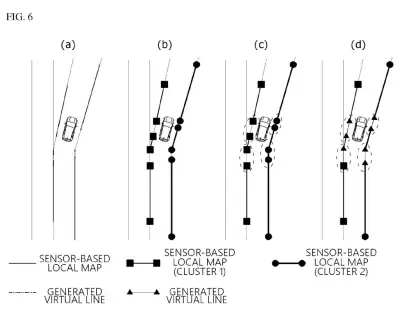
Kia's patent application describes a middle path. The car draws a small, live map of the lanes and road edges around it, using its own cameras, laser scanners and motion sensors. Each new reading gets checked against what the car already trusts. If a lane line suddenly shifts farther than is physically plausible, that reading is thrown out.
Gaps get patched too. When a truck blocks the view or the paint has faded, the car connects the broken pieces of lane line with a best-guess curve, so the map never has holes.
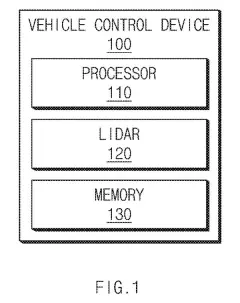
generate, based on the object recognition information and the vehicle traveling information, first map information on an area in which the vehicle is traveling …
Translation: The car builds its own local map using its onboard sensors and travel data.
How Kia's car checks each new lane reading
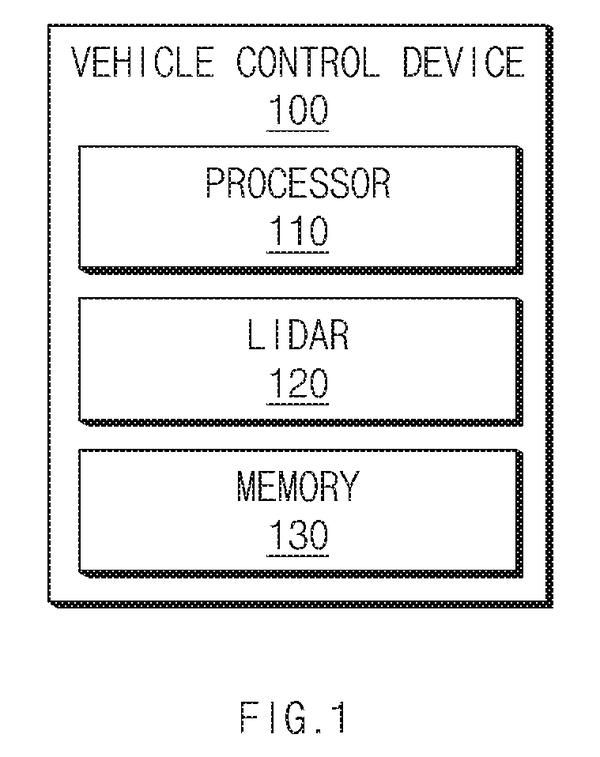
The filing covers a vehicle that builds a short-range local map of lane lines and road edges from its own sensors, then uses that map to pick a route and steer. Cameras read the color and shape of lane lines, and lidar (a laser scanner that measures distance) pins down where they sit. Wheel, speed and turning sensors track how far the car has moved, a method called dead reckoning (estimating position from motion alone).
Every new reading goes through a check before it touches the map:
- Validate: the new reading is compared with a reference built from earlier, already-approved data. In the filing's example, a lane line that shifts more than about 0.2 meters within 0.1 seconds is treated as sensor noise.
- Correct: where new and old data overlap, the difference is split using weights. The example trusts the stored map 70 percent and the new reading 30 percent, so a 0.2 meter gap moves the map only 0.06 meters.
- Extend and fill: stretches of road never seen before are added as new map. Gaps from blind spots or faded paint are bridged by grouping lane-line points into clusters and drawing a virtual line between clusters that fit together.
Each lane line also gets a reliability score from 0 to 3, based on image quality and on how consistently its color and style (solid or dashed) are read. If a sensor fails, the system stops building the map and falls back to a stored HD map or a navigation map.
… obtain and validate new object recognition information, generate second map information, output a signal indicating a traveling route, and control driving of the vehicle.
Translation: It constantly checks new surroundings against old data to update the map and steer.
Why a self-made map matters for Kia's cars
Many driver-assist and self-driving systems lean on detailed pre-made maps that are costly to build and go stale the moment a lane is repainted or a construction zone appears. A car that keeps its own corrected map could cope better with exactly those moments, using sensors already on the vehicle.
The filing also says the map could feed back into how the car behaves: lowering the autonomy level when readings look shaky so you have to pay closer attention, easing off before a curve, or hugging one side of the lane when a big truck is beside you. It is a patent application with no test results, so how well it works on real roads is unproven.
Hyundai's second filing we've tracked since November follows our Hyundai coverage that began with Kia's laser sensor double-check system.
Source: US 2026/0365199 A1 at the USPTO (PDF). Full patent text and figures are in the official publication.
Get our take in your Top Stories
Liked this breakdown? Add Patentlyze as a preferred source on Google, and our plain-English take shows up more often in your Top Stories the next time Hyundai & Kia patent news breaks.
Add Patentlyze on Google
One click.
There are more where this came from
We read the new patents from Big Tech, carmakers and more and send you the ones worth knowing. Plain English, free, every week.
The drawings · 10 sheets
10 drawing sheets from US 2026/0365199 A1 · click any drawing to enlarge


Show the other 2 sheets


More from Hyundai & Kia
All 15 Hyundai & Kia patents →
More in Automotive
All 432 Automotive patents →
Google
Google Files Patent for Cars That Notice When Road Construction Moves the Lane Lines
Mobileye (Intel)
Mobileye Files Patent for a Map That Grades the Quality of Lane Paint
Amazon
Amazon Unit Zoox Files Patent for Maps That Draw Their Own Lane Lines
Nvidia
No comments yet