
Hyundai & Kia
Hyundai & Kia · Automotive · Filed Jan 26, 2026 · USPTO published Nov 19, 2026 · This week's release
Kia Patents a Method to Clean Its Hydrogen Car's Cooling System While Idling
Hydrogen cars need their coolant scrubbed of stray metal to stay electrically safe, and Kia's filing does that scrubbing only when the fuel cell is resting.
- Publication number
- US 2026/0365029 A1(US20260365029A1)
- Applicant
- Kia Corporation
- Filed · Published
- Jan 26, 2026 · Nov 19, 2026
- Inventors
- Wang Sik JUNG, Jong Ik JEONG, Min Taek KIM, Sung Hyeon OH
- Status when we published
- Waiting for an examiner
- Document
- 20 claims
- US classification
- 701/22
- Examiner
- MILLER, PRESTON JAY (Art Unit 3661)
What Kia's coolant-cleaning patent does
You're idling at a red light in a hydrogen car, and under the hood the cooling system is doing a chore you'll never notice. Over time, the liquid that cools the fuel cell picks up tiny bits of metal, and that makes it better at conducting electricity. That matters because the car relies on good electrical insulation to keep high voltage from leaking out and causing shocks or fires.
A filter can pull the metal back out, but running coolant through it while you drive steals cooling when the car needs it most, and hot coolant wears the filter out faster. Kia's patent filing waits until the fuel cell stops making power, then sends the coolant through the filter. It even picks the pump speed based on how much cleanup is needed and how fast you were going, so the pump doesn't run harder, or louder, than it has to.
measuring an insulation resistance value of a fuel cell system of the vehicle; determining, based on the insulation resistance value, whether insulation resistance recovery control is necessary; determining a rotational speed of a pump …
Translation: The system checks the hydrogen fuel cell to see if cleaning is required.
How Kia picks the coolant pump speed
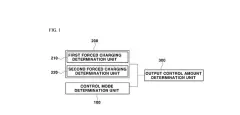
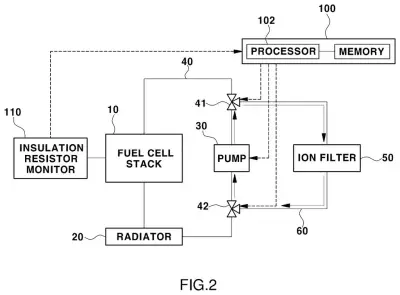
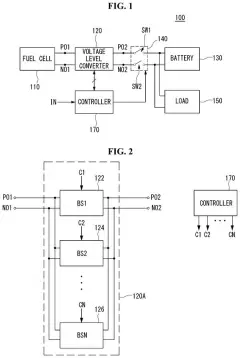
The system watches the car's insulation resistance (a measure of how well the high-voltage parts are electrically isolated) while the fuel cell is running. When a reading, averaged over several recent measurements, falls below a lower limit, the car flags that a cleanup is needed. Until then, the coolant stays pointed at the fuel cell stack.
Once the fuel cell enters its stop mode (when the car idles or the battery is doing the driving), the controller checks that the coolant is cool enough to protect the filter. Then it fully opens the valves toward the ion filter, which uses a resin to catch metal ions, and runs the pump.
Pump speed comes from a quadratic equation (a simple curve) fitted to test data. It uses how far the recent readings sit below the upper limit, then adjusts for a vehicle speed factor that runs from 0 under 30 kph to 1 at 100 kph or more. The filing gives examples: recovering 500 kOhm took about 60 liters of coolant, and 300 kOhm about 30 liters. Cleaning ends when the car starts running again or a set time passes, and the reading is then checked against the upper limit.
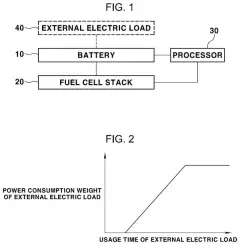
If the car never idles, a forced version kicks in after a waiting period. It first lowers the target coolant temperature (the example drops it from 60 to 50 °C) to build a cooling cushion, and uses that cushion to set how long the forced cleaning lasts.
opening a valve, of the fuel cell system, that directs a coolant in the fuel cell system to an ion filter; and operating the pump at the determined rotational speed.
Translation: Coolant is routed through a special filter to clean the system while the car is parked.
Why this matters for hydrogen car owners
For a hydrogen car driver, the pitch is full cooling when you're pushing the car. Coolant stays pointed at the fuel cell stack while it makes power, and the cleanup happens in the gaps when the stack isn't generating heat. A car that loses cooling can end up limiting its own output, which the filing lists as a downside of earlier setups.
There's an ownership angle too. The filing says the approach keeps the ion filter within its safe temperature range so it can last to its target lifespan, which avoids early replacement costs. Sizing the pump to the job also avoids wasted energy and noise. It's a reliability and maintenance idea, the sort of thing you'd feel only as a car that simply keeps working.
Hyundai's 15th filing since November in our Hyundai coverage adds to a run that includes a self-cleaning car seat and a hydrogen fuel-line cabin heater.
Source: US 2026/0365029 A1 at the USPTO (PDF). Full patent text and figures are in the official publication.
Get our take in your Top Stories
Liked this breakdown? Add Patentlyze as a preferred source on Google, and our plain-English take shows up more often in your Top Stories the next time Hyundai & Kia patent news breaks.
Add Patentlyze on Google
One click.
There are more where this came from
We read the new patents from Big Tech, carmakers and more and send you the ones worth knowing. Plain English, free, every week.
The drawings · 6 sheets
6 drawing sheets from US 2026/0365029 A1 · click any drawing to enlarge


More from Hyundai & Kia
All 15 Hyundai & Kia patents →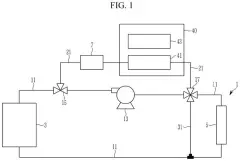
More in Automotive
All 432 Automotive patents →
Honda
Honda Files Patent for Parked Cars That Light Up Gaps Big Enough for Your Car
Nvidia
Nvidia Files Patent for a Car Camera That Spots Drowsy Drivers by Their Blinks
Sony
Sony Patents a Radar Check That Spots Interference From Oncoming Cars
Qualcomm
No comments yet