
LG
LG · Quantum · Filed Apr 22, 2024 · USPTO published Nov 19, 2026 · This week's release
LG Patents a Simple Division Step to Keep Calculation Errors From Corrupting Results
Quantum computers are fragile, and stray noise can scramble their answers. LG's fix for one common kind of noise comes down to dividing the raw results by a number worked out in advance.
- Publication number
- US 2026/0368603 A1(US20260368603A1)
- Applicant
- LG ELECTRONICS INC.
- Filed · Published
- Apr 22, 2024 · Nov 19, 2026
- Inventors
- Gaurav SAXENA, Thi Ha KYAW, Ahmed SHALABI
- Status when we published
- Examiner raised objections; the company can respond
- Document
- 20 claims
- US classification
- 706/62
- Examiner
- CHEN, KUANG FU (Art Unit 2143)
- Parent application
- Claims priority from a provisional application 63460933 (filed Apr 21, 2023)
What LG's quantum error-fixing patent does
Imagine a kitchen scale that always reads a little low, by the same percentage every time. Once you know that percentage, you don't need a new scale. You just divide each reading by it and get the true weight.
That is the spirit of this LG patent application about quantum computers. These machines are powerful but fragile, and heat, hardware flaws and the surrounding environment can scramble their answers. LG describes a way to fix one common kind of noise, the kind that slowly blurs everything toward random static, by dividing the results by a correction number calculated ahead of time.
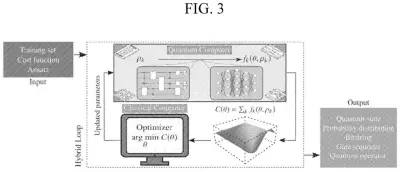
The quantum chip does its calculations, a regular computer chip applies the division, and the corrected numbers guide the next round. The loop repeats until the answer settles. LG says this beats other error-fixing methods that eat up time and computing power.
… performing, via a processor that is transistor based, an error mitigation operation by dividing the state evolution matrix based on a first mitigation component to generate a compensated state evolution matrix and dividing the Hamiltonian based vector based on a second mitigation component to generate a compensated Hamiltonian based vector …
Translation: A standard computer cleans up the quantum math by dividing it with correction factors.
How the division step corrects the results
A quantum computer working on this kind of problem runs in a loop with a regular computer. You feed the quantum chip starting numbers, such as rotation angles for its gates (the basic operations applied to its qubits, the quantum version of bits). The chip runs its circuit and produces two sets of numbers: a state evolution matrix (a grid showing how the circuit's adjustable settings relate to each other) and a Hamiltonian based vector (a list tied to the energy of the system being studied).
Here is the new step. A regular, transistor-based processor divides every number in the grid by one correction factor and every number in the list by another, producing a compensated version of each. In the filing's main example, the factors are (1-p)2N and (1-p)N, where p is the chance of mixing in white noise (random, information-free static) and N is the number of adjustable settings in the circuit.
The regular processor then solves an equation with the corrected numbers to get updated rotation angles. If the answer has settled (converged), it outputs a final result, often the lowest-energy state of the system, called the ground state. If not, the new angles go back to the quantum chip and the loop runs again.
The filing also describes:
- Skipping the correction when noise is very low (an example threshold is p below 0.0001).
- Comparing noisy results against ideal ones when the noise type is unknown, to decide whether a run is worth trusting.
… in response to reaching convergence, outputting a final result, and in response to nonconvergence, inputting the updated parameters to the quantum processor and running the quantum circuit again.
Translation: The system repeats the calculation over and over until the results finally stabilize.
What this means for quantum chemistry research
Quantum computers are still lab machines, so you won't see this in a product soon. The target is practical, though: simulating molecules and materials, which the filing ties to drug discovery and new materials. Those simulations are only useful if the answers can be trusted, and noise can make them unusable. A fix that is just division is cheap for a regular chip to run, so the cleanup doesn't eat the time quantum machines are meant to save.
The method covers one type of noise, called depolarizing noise, which the filing describes as a major source of errors in modern small, error-prone quantum machines. The examiner's first review rejected the claims as filed, which is routine at this stage and usually followed by amendments, so the final scope may change.
LG's fifth filing we've tracked since November in our LG coverage follows a spinning airport kiosk and encrypted computing idea.
Source: US 2026/0368603 A1 at the USPTO (PDF). Full patent text and figures are in the official publication.
Get our take in your Top Stories
Liked this breakdown? Add Patentlyze as a preferred source on Google, and our plain-English take shows up more often in your Top Stories the next time LG patent news breaks.
Add Patentlyze on Google
One click.
There are more where this came from
We read the new patents from Big Tech, carmakers and more and send you the ones worth knowing. Plain English, free, every week.
The drawings · 7 sheets
7 drawing sheets from US 2026/0368603 A1 · click any drawing to enlarge


More from LG
All 7 LG patents →
More in Hardware
All 2,375 Hardware patents →
IBM
IBM Patents Technology That Loads the Next Computing Job Before the Current One Finishes
IBM
IBM Patents a New System for Finding and Fixing Quantum Computer Mistakes
Microsoft
Microsoft Patents a Way to Shrink the Math Behind Quantum Computer Simulations
IBM
No comments yet