
LG
LG · Security · Filed Jan 6, 2026 · USPTO published Nov 19, 2026 · This week's release
LG Files Patent for Faster Computing on Data That Stays Encrypted
Doing math on locked data is so slow that one example in LG's filing balloons to 4 to the 365th power possible routes through a single program. LG's patent describes a way to throw almost all of them out before the work starts.
- Publication number
- US 2026/0370448 A1(US20260370448A1)
- Applicant
- LG ELECTRONICS INC.
- Filed · Published
- Jan 6, 2026 · Nov 19, 2026
- Inventors
- Hajoon KO, Jaeky OH, Byoungwoo YOON, Minwook JEONG, Sunim LEE, Jongho SHIN
- Status when we published
- Waiting for an examiner
- Document
- 20 claims
- US classification
- 380/28
What LG's locked-data shortcut actually does
You're a small business owner uploading a year of daily sales and expenses to a cloud service that will total them up. You'd like the service to do the math without ever seeing a single figure. A special kind of encryption makes that possible, and it has a big downside: it can run thousands of times slower than ordinary computing.
Much of the slowdown comes from if-this-then-that decisions. When the server can't see the locked numbers, it can't tell which way a decision goes, so it works through every possible route. Over 365 days, that adds up to an absurd pile of routes.
LG's patent lets you mark some inputs as fine to share, like which days you want counted. The server uses those open inputs to rule out nearly every route up front and does the encrypted math on just the one that applies. Your dollar amounts stay locked.
… classify variables in the source code as plaintext input variables or ciphertext input variables; generate code fragments corresponding to execution paths in the source code, excluding execution paths in which branch conditional statements include the variables classified as ciphertext input variables …
Translation: The system sorts program variables into unencrypted and encrypted types, then skips code paths where encrypted data controls decisions.
How LG sorts locked inputs from shareable ones
The system starts with the source code of an ordinary program and sorts its inputs into ciphertext (encrypted, hidden from the server) and plaintext (readable by the server). A user can make that choice on screen.
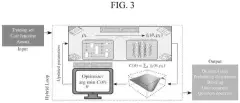
Next it runs dynamic symbolic execution, a testing technique that runs the program with stand-in values to map every route, or execution path, through the code. Any decision that depends only on plaintext inputs gets settled ahead of time: each route becomes its own code fragment with that decision stripped out. A standard encryption-aware compiler turns the fragments into homomorphic encryption binary fragments (ready-to-run pieces that compute on locked data). The decisions themselves are stored separately and never compiled.
When a request arrives, the system checks the plaintext inputs against the stored decisions and runs only the matching fragment. The filing also covers some edge cases:
- If a decision depends on a locked input, the system prunes what it can before that point and keeps the rest as ordinary multi-route code.
- If a math solver can't work out a decision in time, the user can be asked to keep searching or type in a solution.
- A screen can show a computational load reduction rate. In the filing's example, freeing one input shows 12%, and encrypting everything shows 0%.
In the filing's bookkeeping example, 4 to the 365th power routes shrink to one.
… compile the generated code fragments to obtain homomorphic encryption binary fragments.
Translation: It turns the processed pieces of code into binary files that can run calculations on encrypted data without ever decrypting it.
Why faster encrypted math matters for cloud privacy
If encrypted services get faster without giving up privacy, more of them can run in the cloud instead of on your device. The filing points to smart home gadgets and home health services, where sensitive readings leave your house and you'd rather the server never see them. Faster encrypted processing also means less waiting for you and less strain on the company's servers.
There is a tradeoff. The server learns whatever inputs get marked as shareable, such as which days were selected in the example, so the savings depend on how much can be safely opened up. The filing describes a developer tool that shows that tradeoff with a readout of the computing saved. It does not tie the idea to a specific LG product.
LG's third filing we've tracked since November in our LG coverage follows the flip-text see-through screen and the anti-haze foldable cover.
Source: US 2026/0370448 A1 at the USPTO (PDF). Full patent text and figures are in the official publication.
Get our take in your Top Stories
Liked this breakdown? Add Patentlyze as a preferred source on Google, and our plain-English take shows up more often in your Top Stories the next time LG patent news breaks.
Add Patentlyze on Google
One click.
There are more where this came from
We read the new patents from Big Tech, carmakers and more and send you the ones worth knowing. Plain English, free, every week.
The drawings · 16 sheets
16 drawing sheets from US 2026/0370448 A1 · click any drawing to enlarge


Show the other 8 sheets


More from LG
All 7 LG patents →
More in Security
All 354 Security patents →
IBM
IBM Files Patent for Training AI on Data It Never Reads in Plain Text
Google
Google Patents a Shared Speaker That Knows Whose Calendar to Read Out
Google
Google Files Patent for Counting App Installs From Ads Without Seeing Who You Are
Apple
No comments yet