
LG
LG · Hardware · Filed May 29, 2025 · USPTO published Nov 19, 2026 · This week's release
LG Files Patent for a Vacuum Dock With a Hatch for Stuck Dust
Self-emptying vacuum docks pull dust uphill, and heavy dust can sit at the bottom of that climb. LG's filing adds a small hatch so you can reach in and clear it.
- Publication number
- US 2026/0363500 A1(US20260363500A1)
- Applicant
- LG Electronics Inc.
- Filed · Published
- May 29, 2025 · Nov 19, 2026
- Inventors
- Hyeonhak CHAE, Yeonhui YANG
- Status when we published
- Waiting for an examiner
- Document
- 13 claims
- US classification
- 15/304
- Parent application
- National Stage Entry of PCT/KR2023/019658 (filed Dec 1, 2023)(PCTKR2023019658)
What LG's vacuum dock hatch actually does
Ever had a kitchen drain slow to a trickle because something got stuck where you can't reach? Self-emptying vacuum docks can run into a version of that. The dock sucks dust out of your vacuum's bin, and for a robot vacuum parked at the bottom, that dust has to travel uphill through a tube before it drops into a bag.
Heavy dust doesn't always make the climb. It can settle at the bottom of the tube, and the filing says buildup like that cuts into airflow. LG's patent application adds a cleaning hole in that tube, sealed by a removable cover. Take the cover off and you can reach in and clear the clog.
The cover plugs the hole snugly so air doesn't leak or snag on bumps while the dock runs. A second outer cover on the housing hides the whole thing, so the dock still looks tidy.
… a flow path unit which allows an internal space of the dust bin of the cleaner to communicate with an internal space of the dust collection unit and of which at least a part has a flow path flowing upward against gravity …
Translation: The tube system that sucks dirt out of the vacuum and upwards into the station.
How LG's dock hatch plugs the dust path
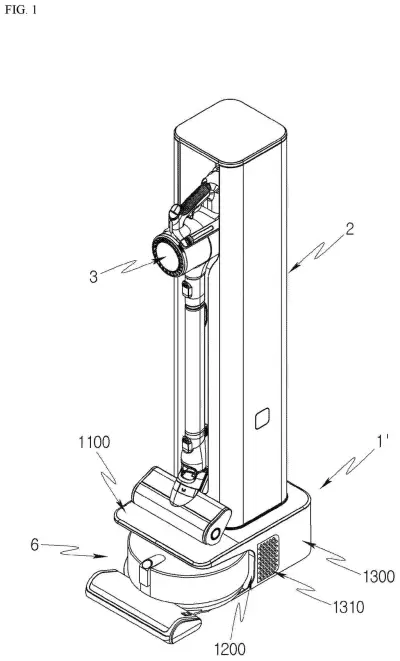
The claims describe a cleaner station, a dock that empties a vacuum's dust bin automatically. Inside the housing sit a dust collection unit (in the filing's example, a replaceable dust bag), a docking slot at the bottom where a cleaner connects, and a dust collection motor, also below the bag, that creates the suction. A flow path unit links the vacuum's bin to the bag, and part of it runs upward against gravity.
The added piece is a cleaning hole that opens the inside of that path to the outside, plus a cleaning hole cover that opens and closes it. A second independent claim covers a dock that serves two vacuums: a handheld or stick model on the side and a robot vacuum at the bottom, with the hole on the robot's path. In one version, that path runs backward from the dock and then up a vertical section where the hole sits.
The dependent claims add details:
- A shielding portion that presses tight against the outside of the tube.
- An insertion portion that pokes into the hole, which the filing says cuts air resistance and prevents leaks.
- A sealer ring that fills any gap around it.
- A detachable outer cover on the housing that catches on a step in the opening and shields the inner cover.
… a cleaning hole that allows an internal space to communicate with an outside and a cleaning hole cover that selectively opens and closes the cleaning hole to separate the cleaning hole cover and easily clean dust remaining in the internal space of the flow path unit …
Translation: A hatch you can open to clear out clogs and stuck dirt from inside the vacuum dock.
Why a clogged dock hurts your suction
If you own a self-emptying vacuum dock, or are thinking about buying one, this idea is about keeping it working after the first year. A dock that can't clear its own tube loses suction slowly, and you may never see why. A hatch you can open turns a mystery weak-suction problem into a simple chore.
For LG, the patent application shows attention to upkeep on a dock that serves both a stick vacuum and a robot vacuum. The outer cover, which the filing says keeps the exterior attractive and adds a second seal against leaks, shows the hatch is meant to blend in. A patent application is not a product, and the filing names none.
LG's seventh filing we've tracked since November in our LG coverage follows swappable prescription AR lenses and error-blocking math steps.
Source: US 2026/0363500 A1 at the USPTO (PDF). Full patent text and figures are in the official publication.
Get our take in your Top Stories
Liked this breakdown? Add Patentlyze as a preferred source on Google, and our plain-English take shows up more often in your Top Stories the next time LG patent news breaks.
Add Patentlyze on Google
One click.
There are more where this came from
We read the new patents from Big Tech, carmakers and more and send you the ones worth knowing. Plain English, free, every week.
The drawings · 23 sheets
23 drawing sheets from US 2026/0363500 A1 · click any drawing to enlarge


Show the other 15 sheets


More from LG
All 7 LG patents →
More in Hardware
All 2,375 Hardware patents →
Samsung
Samsung Patents a Robot Mop Dock With a Water Nozzle That Moves to Fit
Samsung
Samsung Patents a Robot Vacuum That Pays Closer Attention Near Obstacles
Samsung
Samsung Patents a Robot Vacuum Mop That Springs Back After Hitting Furniture
Motorola
No comments yet