
LG
LG · Display · Filed Jul 23, 2026 · USPTO published Nov 19, 2026 · This week's release
LG Display Files Patent for a Layered Screen Cover That Stops Foldable Screens Turning Hazy
Bend a plastic lid back and forth and it goes white at the crease. LG Display has filed a patent on a stacked, glued-together screen cover meant to keep that haze off foldable displays.
- Publication number
- US 2026/0371842 A1(US20260371842A1)
- Applicant
- LG Display Co., Ltd.
- Filed · Published
- Jul 23, 2026 · Nov 19, 2026
- Inventors
- Eun-Ju PARK
- Status when we published
- Waiting for an examiner
- Document
- 20 claims
- US classification
- 257/40
- Parent application
- Continuation of 18/072,424 (filed Nov 30, 2022)(18072424)
What LG Display's layered foldable cover does
Ever bent a plastic folder back and forth until a pale, cloudy crease showed up? That whitening is what happens when plastic is stressed again and again, and LG Display is trying to keep it off the cover of a foldable screen.
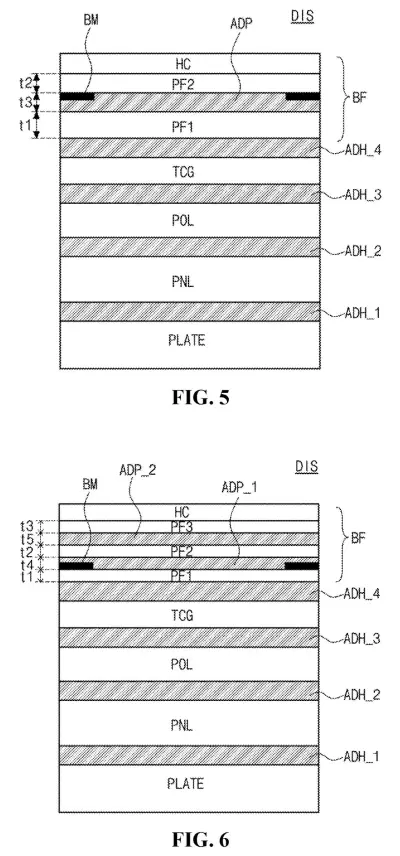
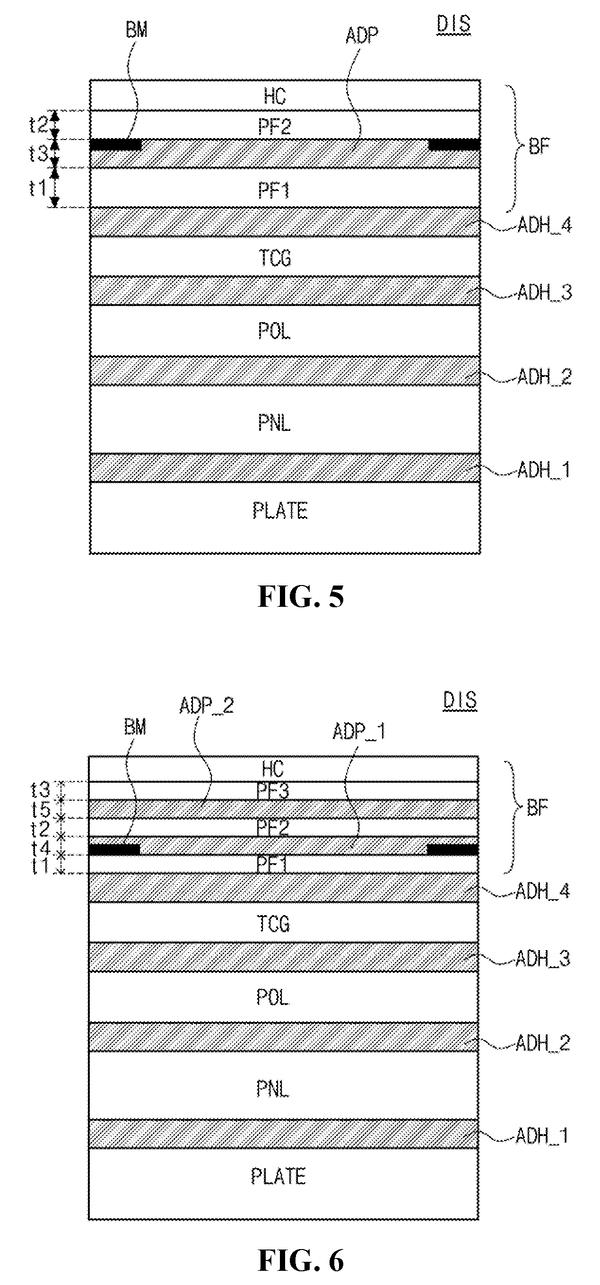
The cover on a foldable display is a thin plastic film that sits over the fragile front layer. LG's filing swaps one thick film for three stacked films held together by two thin layers of glue. The glue lets the films shift a little as the screen bends, so the strain on the surface drops. In a test described for a two-film version, stress fell to about a quarter of what a single film felt.
Thickness matters too. On a screen that folds outward, so the picture faces outside when it's closed, the film you touch is the thickest of the three. That keeps the cover sturdy against knocks without making it one stiff slab.
a foldable display panel configured to display an image, the foldable display panel having at least one out-folding portion; a front member over the foldable display panel; a protection member on the front member …
Translation: The screen can bend outward and features a special layered shield on top.
How three films and two glue layers share the strain
Claim 1 covers a foldable display with at least one out-folding portion (a section that bends so the screen faces outward). Above the display panel sits a front member, and on top of that a protection member made of three stacked plastic films. A first adhesive layer sits between films one and two, and a second between films two and three. A black matrix (a dark border strip that hides the wiring around the edge) runs along one film. The defining rule: the third, outermost film must be thicker than the first.
The dependent claims add options, including:
- The middle film can fall in between the other two in thickness.
- The glue layers can be thinner than the films around them.
- The films can be common clear plastics such as PET, TAC or COP.
- The outer film can have a plane direction retardation (a measure of how the film bends light) of about 6500 nm or more, which the description says prevents rainbow-colored blotches on screen.
- The outer film can carry a UV absorber so sunlight doesn't over-harden the glue and crack it.
- A hard coating and a fingerprint, smudge or glare layer can go on top.
The description explains the motivation. A thick single film takes more squeezing and stretching when folded, which changes the plastic's molecular structure and turns it white. Making it thinner hurts impact protection. Layering keeps the total near 90 microns while the glue absorbs strain. The cover also stops glass dust from scattering if the thin glass front layer breaks. A second independent claim, claim 18, only requires three films of different thicknesses.
… a first protection film over the front member, a second protection film on the first protection film, a third protection film on the second protection film, a first adhesive layer between the first protection film and the second protection film …
Translation: Three distinct plastic films are glued together in a stack to protect the bending display.
Why foldable screens keep fighting the crease haze
If you've used or looked at a foldable phone, you know the crease is the weak spot. A cover that clouds over looks worn long before the display itself fails. LG Display's filing goes after that single wear problem by changing how the cover is built, with no new part on the outside.
The tradeoff in the filing is useful to understand. A thinner cover bends more easily but protects the delicate layers beneath it less against knocks. Stacking thin films keeps the total at about 90 microns, according to the description, while the glue between them takes up strain. It also holds shattered glass dust in place if the front layer cracks. The application is a continuation of a 2022 filing that traces back to a Korean application from 2021, so it refines an older idea.
Source: US 2026/0371842 A1 at the USPTO (PDF). Full patent text and figures are in the official publication.
Get our take in your Top Stories
Liked this breakdown? Add Patentlyze as a preferred source on Google, and our plain-English take shows up more often in your Top Stories the next time LG patent news breaks.
Add Patentlyze on Google
One click.
There are more where this came from
We read the new patents from Big Tech, carmakers and more and send you the ones worth knowing. Plain English, free, every week.
The drawings · 4 sheets
4 drawing sheets from US 2026/0371842 A1 · click any drawing to enlarge


More from LG
All 7 LG patents →
More in Display
All 746 Display patents →
Apple
Apple Patents a Folding Screen Hinge That Props Up the Display While You Type
Samsung
Samsung Files Patent for a Foldable Hinge That Resists Drop Damage
Samsung
Samsung Patents a Charging Port That Stays Put on a Phone With an Expanding Screen
Apple
No comments yet