
Meta
Meta · AR / VR · Filed May 16, 2025 · USPTO published Nov 19, 2026 · This week's release
Meta Patents a Prescription Glasses Lens With an Eye-Tracking Camera Built Inside
If your glasses track your eyes, the camera has to look through your prescription lens, and that curve warps every picture it takes. Meta's patent buries the camera inside the lens and shapes the glass around it to undo the warping.
- Publication number
- US 2026/0367393 A1(US20260367393A1)
- Applicant
- Meta Platforms Technologies, LLC
- Filed · Published
- May 16, 2025 · Nov 19, 2026
- Inventors
- Matthew Thomas Hunwardsen, Alexander Tittiger, Dane Michael Hansen, Ramin Mirjalili, Ehsan Arbabi, Kevin Kuan
- Status when we published
- Waiting for an examiner
- Document
- 20 claims
- US classification
- 351/159.01
- Examiner
- DEAN, RAY ALEXANDER (Art Unit 2872)
What Meta's lens-embedded eye camera actually does
Smart glasses that follow your eyes need a camera with a clear view of them, ideally one that hair and eyelashes don't block. The catch is that when the camera looks through your prescription lens, the curve of that lens bends the picture, stretching one side and squashing the other. Fixing that takes extra computing power, and that drains a battery you'd rather save.
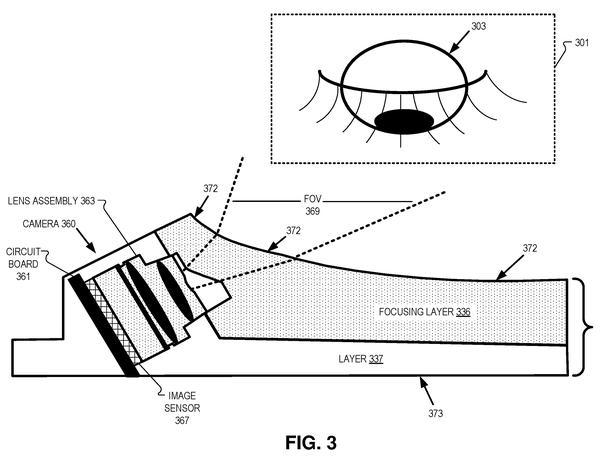
Meta's patent tucks the camera inside the lens itself, so the glasses can stay slim. The glass around the camera is shaped to cancel much of the bending, so the camera gets a cleaner, more even picture of your eye from the start.
Because the fix happens in the optics, the software has less cleanup to do afterward.
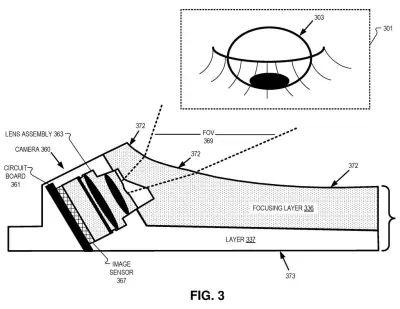
… a camera at least partially encapsulated in the refractive layer, wherein the camera is configured to image an eyebox region, and wherein an air-gap surface of the refractive layer is configured to at least partially offset a distortion of the prescription curvature to increase uniformity of a sampling resolution of eyebox images to be captured by the camera.
Translation: A tiny camera is built directly inside the prescription lens to take clear pictures of the wearer's eye without distortion.
How the air gap cancels out lens distortion
The patent covers an eyepiece (the lens part of a head-mounted device such as smart glasses) with a refractive layer, a layer of clear material that bends light. Its eye-facing side carries a prescription curvature, the curve matched to a wearer's vision. A small camera sits partly encapsulated, or sealed inside, that layer and images the eyebox, the zone where your eye sits when you wear the device.
Looking through a curved lens stretches the picture on one side and squashes it on the other. The filing says this uneven sampling resolution (how many pixels cover each part of the eye) forces extra image processing. To prevent it, the layer has an air-gap surface, the boundary of a small pocket of air near the camera, shaped to partly cancel the prescription curve's distortion.
The claims and description list several options:
- A negative-power prescription paired with a positive-power air-gap surface, or a surface with the same slope and curvature as the prescription.
- A nearly flat air-gap surface that works as a wedge to steer light toward the camera.
- Spherical or cylindrical prescription curves, each negated by a matching surface.
- A transparent air-gap piece attached to the camera lens, with the lens layer molded over it.
A third independent claim has the camera look through a cutout in the frame and the lens layer, with the curve widening the camera's field of view. The description says ten air-gap pieces could match ten prescription molds.
Why slimmer prescription smart glasses need this
The practical stake is bulk. Eye tracking lets a device respond to where you look, but a camera that sticks out or sits awkwardly in the frame makes glasses heavier and less like regular eyewear. Burying it in the lens, even for people who need a prescription, is one route to a thinner pair.
The filing also ties image quality to power. Distorted eye pictures need more processing to correct, and processing costs battery on a device small enough to sit on your face. If the lens does part of the correcting, the chips have less to do, and that could matter for all-day wearable glasses.
That makes this Meta's 87th filing we've tracked in our smart glasses watch since May, a list that already includes applications like glasses showing home workouts and AI picking your clothes.
Source: US 2026/0367393 A1 at the USPTO (PDF). Full patent text and figures are in the official publication.
Get our take in your Top Stories
Liked this breakdown? Add Patentlyze as a preferred source on Google, and our plain-English take shows up more often in your Top Stories the next time Meta patent news breaks.
Add Patentlyze on Google
One click.
There are more where this came from
We read every patent application Big Tech publishes and send you the ones worth knowing. Plain English, free, every week.
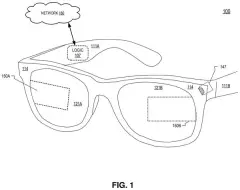
The drawings · 14 sheets
14 drawing sheets from US 2026/0367393 A1 · click any drawing to enlarge


Show the other 6 sheets


More from Meta
All 192 Meta patents →
More in AR / VR
All 713 AR / VR patents →
Meta
Meta Patents a Dual-Hinge System for AR Glasses That Bends Without Breaking
Meta
Meta Files Patent for a Tiny Vibrating Mirror That Takes Less Strain in AR Glasses
Meta
Meta Patents an Adjustable Hinged Nose Bridge for Smart Glasses
Meta
No comments yet