
Microsoft
Microsoft · AI / ML · Filed Jun 21, 2025 · USPTO published Nov 19, 2026 · This week's release
Microsoft Patents a Chatbot That Hands You to a Specialist AI Mid-Chat
A chatbot usually answers the same way whether you want a coach or a brainstorming partner. This Microsoft patent application would size up your first exchange, then move you to an AI trained for that kind of conversation.
- Publication number
- US 2026/0368185 A1(US20260368185A1)
- Applicant
- MICROSOFT TECHNOLOGY LICENSING, LLC
- Filed · Published
- Jun 21, 2025 · Nov 19, 2026
- Inventors
- Bahareh SARRAFZADEH, Sheshera Shashidhar MYSORE, Debarati DAS
- Status when we published
- Approved; patent expected soon
- Document
- 20 claims
- US classification
- 707/722
- Examiner
- MENG, JAU SHYA (Art Unit 2168)
- Parent application
- Claims priority from a provisional application 63807738 (filed May 18, 2025)
What Microsoft's chatbot hand-off actually does
Every time you ask a chatbot for a draft and then reply 'make it funnier' or 'give me five more,' you are telling it what kind of help you want. Today, one all-purpose AI answers whether you are brainstorming, polishing a cover letter, or just saying thanks.
This Microsoft patent application describes a chatbot that watches for that pattern. After your first request and the reply, it works out what you are probably trying to do. Then it hands the rest of the chat to a different AI that was trained for people who behave that way. You do not have to pick anything.
Microsoft's approach starts with real chat logs. It sorts how people follow up after an answer into a handful of recurring habits, then links each habit to the kinds of first requests that tend to lead to it. Each habit gets its own specialist version of the AI, trained on its own slice of the logs.
… selecting, based on the selected co-occurring pattern, a second AI model from a plurality of tailored AI models, each tailored AI model being fine-tuned to a respective co-occurring pattern using a segmented dataset corresponding to the respective co-occurring pattern …
Translation: The system picks a specialized chatbot that has been trained on past conversations matching what the user wants.
How follow-up habits pick the right AI model
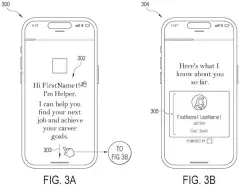
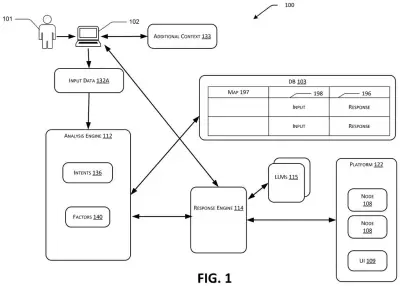
The claims describe a system with a chat window that gives you access to a first AI model. It watches your opening prompt and the model's reply, and from those it detects your intent, meaning what you are really trying to get done.
That intent maps to a co-occurring pattern of follow-up types: a recurring mix of things people say next, like asking for more options, requesting a new style, or replying with thanks. The patterns come from logs of many users' chats, where AI classifiers labeled each message (the example uses eleven follow-up types and 18 intent labels). Principal Component Analysis (a statistics method that finds the main ways data varies) groups sessions with similar habits. A regression analysis (a test of which first requests predict which habits) then links them to intents.
Each pattern gets its own tailored AI model, fine-tuned (given extra training) on the slice of logs that matches it. When the system detects your intent, it picks the matching model and sends your further messages there without user intervention. The new replies show up in the same chat window.
Per the filing, the detection and routing can be done by a separate analysis engine or by the first model itself. The examples focus on writing tasks, though the filing says the idea can apply to other AI settings.
Further user interaction is directed to a second AI model that is fine-tuned to the user intent based on a conversational history of interactions with a plurality of users.
Translation: The chat is handed off to a specialized expert bot automatically.
Why routing your chats could change AI answers
If it works, you would get help shaped to what you are doing, such as a coach that anticipates your questions or a brainstorming partner that offers ideas, without picking a mode or writing a long prompt. The filing also mentions replies tuned to the reader you are writing for, and to your own knowledge and style. Microsoft frames it as a better fit between person and AI, with fewer erroneous inputs and outputs and less wasted computing.
The patent office has approved this application, and once Microsoft pays the final fee it should be issued as a granted patent. It describes a design, not a product, and the filing names no specific Microsoft app.
That makes this Microsoft's 51st filing we've tracked since May in our AI teams working together watchlist, following applications like trimming specialist AI parts and rewriting chatbot instructions for safety.
Source: US 2026/0368185 A1 at the USPTO (PDF). Full patent text and figures are in the official publication.
Get our take in your Top Stories
Liked this breakdown? Add Patentlyze as a preferred source on Google, and our plain-English take shows up more often in your Top Stories the next time Microsoft patent news breaks.
Add Patentlyze on Google
One click.
There are more where this came from
We read every patent application Big Tech publishes and send you the ones worth knowing. Plain English, free, every week.
The drawings · 13 sheets
13 drawing sheets from US 2026/0368185 A1 · click any drawing to enlarge


Show the other 5 sheets


More from Microsoft
All 681 Microsoft patents →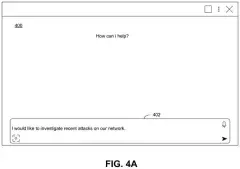

More in AI assistant & agent
All 436 AI assistant & agent patents →
Google
Google Patents a Team of Specialist AI Helpers Behind a Single Chat Box
Google
Google Patents an AI Chatbot That Creates Images Between Lines of Its Answer
IBM
IBM Files Patent for an AI Referee That Picks the Best Chatbot Answer
Nvidia
No comments yet