
Microsoft
Microsoft · AI / ML · Filed May 16, 2025 · USPTO published Nov 19, 2026 · This week's release
Microsoft Patents a Grading Checklist That Rewrites Itself When AI Misses Something
Grading an AI's answers against a fixed list of questions misses any mistake the list's authors never thought of. Microsoft's patent lets the AI grader jot down notes about what the list missed, then turns repeated notes into new questions.
- Publication number
- US 2026/0368214 A1(US20260368214A1)
- Applicant
- Microsoft Technology Licensing, LLC
- Filed · Published
- May 16, 2025 · Nov 19, 2026
- Inventors
- Sumit GULWANI, Mukul SINGH, Mansi UNIYAL, Vu Minh LE, Gust Ben Anneloes VERBRUGGEN
- Status when we published
- Waiting for an examiner
- Document
- 20 claims
- US classification
- 704/9
- Examiner
- RILEY, MARCUS T (Art Unit 2654)
What Microsoft's self-updating AI checklist does
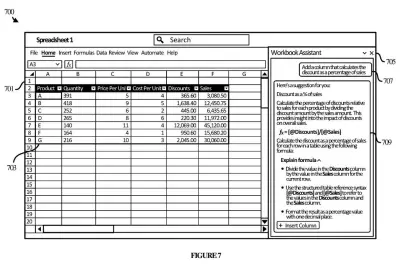
You ask the AI assistant in your spreadsheet to explain a formula, and the answer reads fine. Someone at the company still has to decide whether it is actually good. That means grading thousands of answers against a list of questions like "Is it clear?" and "Is it accurate?"
Here is the catch: a fixed list only catches the mistakes somebody thought of in advance. Microsoft's patent adds a margin note. The AI grader answers every question on the list, and it can also write a free-form comment about anything the list missed, like a typo in your original request.
When the same kind of note keeps showing up, the system turns it into a brand-new question and adds it to the list. The checklist grows along with the problems it finds.
How a free-form note becomes a new question
The system starts by building one prompt (the written instructions sent to an AI) that bundles two things: a piece of AI-written content to be judged, and a checklist of predefined questions about it. The checklist also gives the grading AI an option to write a free-form response, which is just a comment in its own words.
The grader sends back its answer to every checklist question. If it spots something the questions don't cover, it adds a comment too. If it has nothing extra to say, it adds none. The filing's own example: a spreadsheet request misspells "highlight" as "heighlight." Asked whether the request avoids ambiguous language, a grader with no outlet might wrongly say no. With the comment option, it can answer yes and note the typo separately.
Then the checklist gets updated:
- Gather free-form comments from many evaluations and find the recurring ones.
- Generate several candidate questions from them and pick the best.
- Prune questions that are redundant or low value.
The loop can repeat as new content arrives. The filing describes fully automatic updates, human approval of each change, or a mix. The claims center on spreadsheet explanations, such as explaining a formula, though the description says the same idea could grade code, translations, and more.
Why spreadsheet AI answers need better grading
If you use an AI assistant inside an app, someone behind the scenes is grading its answers before the product ships and after. A checklist that updates itself could catch new kinds of mistakes sooner, and it cuts the manual work of writing and maintaining those grading lists. You would never see this tool directly, but you might notice the result in clearer, more complete answers.
The filing's examples come from spreadsheets, where a vague or incomplete formula explanation is easy to spot. The description says the same loop could grade medical summaries, legal analyses, customer service replies, and code explanations. That breadth matters because every company shipping an AI assistant has the same grading headache.
This is the 34th Microsoft filing we've tracked since July in the AI guardrails race, following one on blocking AI from company folders and one on an AI team rewriting chatbot instructions.
Source: US 2026/0368214 A1 at the USPTO (PDF). Full patent text and figures are in the official publication.
Get our take in your Top Stories
Liked this breakdown? Add Patentlyze as a preferred source on Google, and our plain-English take shows up more often in your Top Stories the next time Microsoft patent news breaks.
Add Patentlyze on Google
One click.
There are more where this came from
We read every patent application Big Tech publishes and send you the ones worth knowing. Plain English, free, every week.
The drawings · 9 sheets
9 drawing sheets from US 2026/0368214 A1 · click any drawing to enlarge


Show the other 1 sheets

More from Microsoft
All 681 Microsoft patents →
More in AI safety
All 59 AI safety patents →
IBM
IBM Patents a Risk-Scoring Guardrail That Stops AI Agents Before They Do Something Costly
DeepMind (Google)
Google DeepMind Files Patent for an AI That Shows Its Work Step by Step
OpenAI
OpenAI Files Patent to Let Chatbot Replies Start Before Safety Checks Finish
IBM
No comments yet