
Microsoft
Microsoft · AI / ML · Filed Dec 19, 2025 · USPTO published Nov 19, 2026 · This week's release
Microsoft Patents AI That Fixes Washed-Out Colors in Text on Streamed Screens
Streaming a computer desktop means throwing away some color detail to save bandwidth, and text is where you notice it most. Microsoft's patent application has your own device use AI to put that color back.
- Publication number
- US 2026/0368862 A1(US20260368862A1)
- Applicant
- MICROSOFT TECHNOLOGY LICENSING, LLC
- Filed · Published
- Dec 19, 2025 · Nov 19, 2026
- Inventors
- Liran Lipa LYABOCK, Sandeep PATNAIK, Vadim MISHALOV, Stefan Atanasov GEORGIEV, Dag Birger FROMMHOLD, Julian Sebastian MEDER, Amir ZYSKIND
- Status when we published
- Waiting for an examiner
- Document
- 20 claims
- US classification
- 345/594
- Parent application
- Claims priority from a provisional application 63807468 (filed May 16, 2025)
What Microsoft's color-repair patent actually does
A spreadsheet streams from a data center to a basic laptop, and every letter has a faint colored fringe around it. That is the price of squeezing the picture down so it travels faster over the internet.
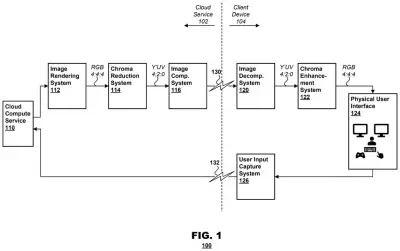
Microsoft's patent application describes a fix that happens on your end. The cloud server shrinks each image by throwing away some of the color detail, then compresses it and sends it along. Your device runs a trained AI model that guesses what the color should have been and repairs the damage before the picture reaches your screen.
The goal is to keep bandwidth low while text and thin lines still look crisp. The filing says this also spares you from needing an expensive, power-hungry graphics chip in every device, since the heavy drawing work stays in the cloud.
receiving, via a network at a client device, a compressed image; decompressing the compressed image to produce a decompressed image having subsampled chroma data; enhancing chroma data of the decompressed image to produce an enhanced image having an RGB color space …
Translation: Your computer gets a compressed picture and uses AI to fix the washed out colors.
How the AI rebuilds color lost in streaming
The core claim covers a device that receives a compressed image over a network, unpacks it, and ends up with an image whose chroma (the color part of each pixel, as opposed to its brightness) has been stored at lower resolution. The device then runs an AI model on that image to produce a full-color RGB image (the red, green, blue format screens use) and shows it on the display. The model's weights, the numbers it learned during training, are tuned to fix the specific flaws this color shortcut causes in computer desktop imagery.
The filing describes several optional steps. The device can first upsample the color data (stretch it back to the same grid as the brightness data, for example with a standard method called Lanczos interpolation) and convert it to RGB before or after the AI step. To save effort, the model can work on small tiles, such as 240 by 128 pixel pieces of a 2560 by 1440 image. The model itself is a convolutional neural network (an image-processing AI) built from two or more residual dense blocks chained in series. It predicts the missing correction and adds it to the original.
Training works in a loop: take an original desktop screenshot, strip out color detail, compress and decompress it, let the model repair it, compare the result with the original, and adjust the weights. The filing also describes an optional classifier that can tell text-heavy regions from photos, using hints from the cloud app (a spreadsheet versus a photo collection, for example). Your keyboard, mouse or controller input goes back to the cloud, which sends a fresh image in response.
A chroma enhancement system may apply an AI model system to the reconstructed image to create a chroma enhanced image which may then be presented on a display at the client.
Translation: An artificial intelligence tool fixes the color quality before showing the picture on your screen.
Why sharper streamed text matters for cloud PCs
If you use a cloud PC or stream games, this is about getting a sharper picture for the same amount of internet. The filing describes dropping color detail at the server to save bandwidth, then repairing it on your device, so text and thin lines in a spreadsheet or app window stay clean.
It also speaks to cost. The filing argues that a small image-repair model can take less computing power than rendering everything locally with a big graphics chip, which would let cheap, low-power devices serve as the screen for a powerful cloud machine. It is a patent application, so nothing here says it will ship.
That makes this Microsoft's 83rd filing we've tracked in Language AI since May, a group that includes one on filtering missed search images and one on summarizing ignored email topics.
Source: US 2026/0368862 A1 at the USPTO (PDF). Full patent text and figures are in the official publication.
Get our take in your Top Stories
Liked this breakdown? Add Patentlyze as a preferred source on Google, and our plain-English take shows up more often in your Top Stories the next time Microsoft patent news breaks.
Add Patentlyze on Google
One click.
There are more where this came from
We read every patent application Big Tech publishes and send you the ones worth knowing. Plain English, free, every week.
The drawings · 7 sheets
7 drawing sheets from US 2026/0368862 A1 · click any drawing to enlarge


More from Microsoft
All 681 Microsoft patents →
More in AI / ML
All 2,738 AI / ML patents →
Google
Google Patents an AI That Reads Text by Looking at It as a Picture
Google
Google Patents an AI That Reads App Screens the Way a Designer Would
Google
A New Google Patent Translates the Text on Your Screen While You Scroll
Qualcomm
No comments yet