
Microsoft
Microsoft · AI / ML · Filed May 19, 2025 · USPTO published Nov 19, 2026 · This week's release
Microsoft Files Patent for Using AI to Hunt Down Images Its Search Filters Miss
Most image filters learn from pictures people have already searched for, so the worst material barely shows up in their training. Microsoft's patent application has an AI go looking for it on purpose.
- Publication number
- US 2026/0369038 A1(US20260369038A1)
- Applicant
- Microsoft Technology Licensing, LLC
- Filed · Published
- May 19, 2025 · Nov 19, 2026
- Inventors
- Madhu RAMANATHAN, Ahmed Bahaaeldin MOHAMED, Sara Ahmed Mohamed ABDELGHAFFAR, Mohamed Farouk ABDELHADY
- Status when we published
- Examiner raised objections; the company can respond
- Document
- 20 claims
- US classification
- 382/224
- Examiner
- PERUNGAVOOR, SATHYANARAYA V (Art Unit 2488)
What Microsoft's image-moderation patent does
Imagine you search for a news photo and the results include something graphic, or a harmless picture gets blocked for no reason. Filters get these calls wrong partly because they learn from past searches, and truly bad images are rare in that pile, so the filter barely sees them.
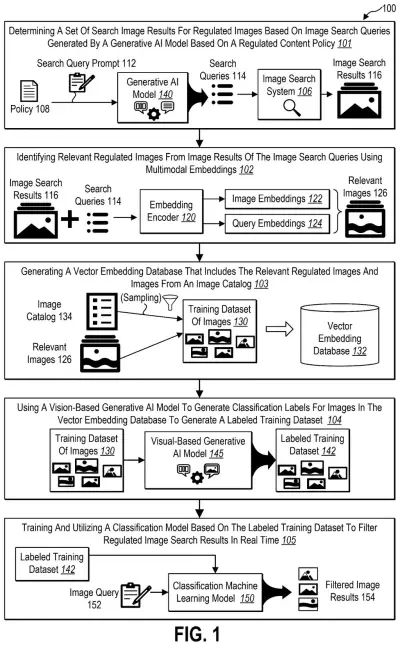
Microsoft's patent application describes a fix. An AI reads the company's rules about which images are banned or restricted, then comes up with search terms that would turn up exactly those images. The results run through an image search, and anything that doesn't match the original idea gets thrown out.
The leftovers are mixed with a random sample of ordinary pictures and labeled by a second AI that can look at images. Those labels then teach a small, fast filter that screens results the moment you search.
providing a search query generation prompt to a generative AI model to generate a set of image search queries from a regulated image policy, wherein the set of image search queries is used to identify images having a regulated image classification that is underrepresented in an image datastore; …
Translation: The system asks an AI to write search queries based on rules to find missing examples of banned images.
How the AI finds the pictures filters miss
The application covers a pipeline for building training data for an image filter. It starts with a written regulated image policy (the rules for what is banned for everyone or restricted for certain audiences). An AI model is prompted to brainstorm situations that would break the policy, then turn them into specific search terms.
Those terms go to an image search system, which returns a batch of pictures per term (the filing gives 100 as an example), with duplicates removed. Search results are messy, so each picture and each search term is converted into a vector embedding (a list of numbers that captures what something is about). A nearest-neighbor search (finding the closest matches) keeps pictures whose numbers sit near a term's numbers and drops the noise.
The kept pictures are combined with a random sample of everyday images from the existing catalog. Then a visual generative AI model (an AI that can look at an image and describe it) sorts each one using written guidelines, for example prohibited, restricted or permitted.
Finally, a small, fast classifier is trained on those labels and screens image results in real time. The filing says the big AI models do the slow prep work, sometimes during off-peak hours, because they are too slow and costly to check every search live.
This disclosure describes a content moderation system that provides a multi-stage framework utilizing generative artificial intelligence (AI) models and vector-searching of multimodal embeddings to improve the accuracy and reliability of content moderation.
Translation: Microsoft patented an AI moderation system that uses advanced vector searches to catch filtered images.
Why faster image filters matter for search
If you search for images on any service, a filter behind the scenes decides what you see. Filters trained on past searches tend to see few examples of the worst content, so they let some through and block harmless pictures. The filing's own example is a mental health article whose neutral photos get tagged as restricted. Better training data could mean fewer of both mistakes.
The filing also says the approach can add examples of harmless pictures that are often wrongly flagged, such as open-backed dresses, and that it applies to content beyond images. The examiner's first review rejected the claims as filed, which is routine at this stage and usually followed by amendments.
This is the 30th Microsoft filing we've tracked since July in our AI guardrails race, following one on a filter for AI messages and one on self-checking AI coding help.
Source: US 2026/0369038 A1 at the USPTO (PDF). Full patent text and figures are in the official publication.
Get our take in your Top Stories
Liked this breakdown? Add Patentlyze as a preferred source on Google, and our plain-English take shows up more often in your Top Stories the next time Microsoft patent news breaks.
Add Patentlyze on Google
One click.
There are more where this came from
We read every patent application Big Tech publishes and send you the ones worth knowing. Plain English, free, every week.
The drawings · 10 sheets
10 drawing sheets from US 2026/0369038 A1 · click any drawing to enlarge


Show the other 2 sheets


More from Microsoft
All 681 Microsoft patents →
More in AI / ML
All 2,738 AI / ML patents →
Google
Google Patents a Training Fix That Helps AI Search Tell Similar Questions Apart
Salesforce
Salesforce Patents a Way to Automatically Grade and Kill Bad AI Search Results
Nvidia
Nvidia Patents a System That Tests Whether Its Own AI Search Is Giving Good Answers
Adobe
No comments yet