
Microsoft
Microsoft · AI / ML · Filed May 16, 2025 · USPTO published Nov 19, 2026 · This week's release
Microsoft Patents an AI Assistant That Rewrites Its Own Cheat Sheet for Using Apps
Microsoft's patent describes an AI that keeps a short cheat sheet for each app it can control, then edits that sheet based on how slow or incomplete the app's replies turn out to be.
- Publication number
- US 2026/0368003 A1(US20260368003A1)
- Applicant
- Microsoft Technology Licensing, LLC
- Filed · Published
- May 16, 2025 · Nov 19, 2026
- Inventors
- Marc A GOODNER, Brian Scott KRABACH
- Status when we published
- Waiting for an examiner
- Document
- 20 claims
- US classification
- 719/328
What Microsoft's self-editing AI cheat sheet does
Every time you ask an AI assistant to do something inside another app, it has to work out which of that app's many available actions to use. Reading the app's full rulebook each time is slow, and it can overwhelm the AI's limited working memory.
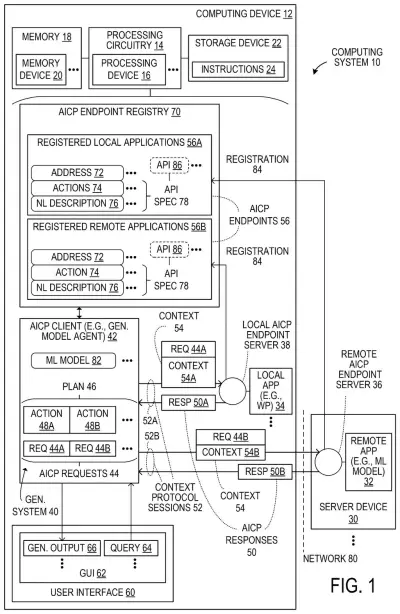
Microsoft's patent has the AI write itself a shorter cheat sheet for each app: a trimmed list of actions, a plain-language description, and a fill-in-the-blanks template for requests. After each request, the system times the reply and checks whether it came back complete. Then the AI edits the cheat sheet to fix whatever went wrong.
If you ask for something the sheet doesn't list, the AI can add it. Over time, the sheet can come to reflect how you actually use the assistant.
generate an application-programming interface (API) specification of an API respectively associated with an artificial intelligence context protocol (AICP) endpoint; and generate an API call based at least in part on the API specification; …
Translation: The system creates a technical instruction manual and a matching command for talking to software.
How the AI trims and rewrites its tool menu
The filing builds on an AI context protocol (a standard way for AI systems to talk to outside tools; Model Context Protocol is the example it names). Each outside tool sits at an endpoint (a server program at a network address) and publishes an API (a menu of actions other programs can request).
The core claim is a loop. A generative AI model writes an API specification (a condensed guide to that menu), then uses it to write an API call (the actual request). The system sends the request, receives the reply, and records monitoring data: the latency (time between request and reply) and a completeness indicator (whether every requested result came back). The model then rewrites the specification using that data and writes a modified call.
The specification can include several parts:
- A registry of actions, which can be a smaller subset of the tool's full menu so it fits in the model's context window (how much text it can read at once)
- A natural-language description of the API, written to guide the model
- An API call schema, a template with fillable fields
Another independent claim covers building the specification from the tool's initial API and using the reply to produce an answer for the user. The filing also describes repeating the update loop many times, drawing on the history of earlier calls, adding an action when a user asks for one that is missing, and tying the specification to a user profile.
… generate a modified API specification based at least in part on the API specification and the API monitoring data.
Translation: The AI updates its own instructions based on how well the previous software commands performed.
Why faster AI assistants depend on tidy tool lists
If you use an AI assistant that works across your apps, the practical payoff is fewer slow or half-finished responses. A model that only reads the actions it is likely to need has less to wade through, so it could answer faster and pick the wrong action less often. Because the cheat sheet can follow your habits, the assistant could get better at the apps you actually use.
The filing also points at a chore for developers. Today, a short list of actions has to be edited by hand whenever an app changes. Here the AI does that upkeep, including dropping actions an app has retired and adding new ones. That matters for any company building assistants that act inside other software.
That makes this Microsoft's 37th filing we've tracked since July in our AI agents that act for you watch, which already includes a report-style web search patent and a file and chat screening step.
Source: US 2026/0368003 A1 at the USPTO (PDF). Full patent text and figures are in the official publication.
Get our take in your Top Stories
Liked this breakdown? Add Patentlyze as a preferred source on Google, and our plain-English take shows up more often in your Top Stories the next time Microsoft patent news breaks.
Add Patentlyze on Google
One click.
There are more where this came from
We read every patent application Big Tech publishes and send you the ones worth knowing. Plain English, free, every week.
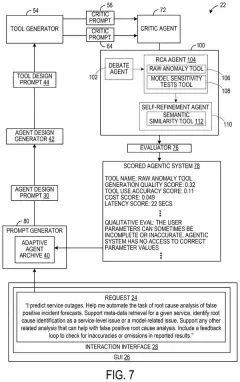
The drawings · 8 sheets
8 drawing sheets from US 2026/0368003 A1 · click any drawing to enlarge


More from Microsoft
All 681 Microsoft patents →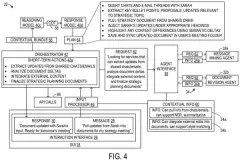
More in AI assistant & agent
All 436 AI assistant & agent patents →
Samsung
Samsung Files Patent for a Phone That Builds Its Own Shortcuts From Your Chats
IBM
IBM's New Patent Covers a Chatbot That Spins Up New AI Assistants Mid-Conversation
Google
Google Files Patent for a TV Assistant That Learns What Your Apps Can Do
Sony
No comments yet