
Microsoft
Microsoft · AI / ML · Filed Jul 23, 2026 · USPTO published Nov 19, 2026 · This week's release
Microsoft Files Patent for Web Searches That Come Back as a Written Report
Search 'best time to visit Hawaii' and this Microsoft system would run several extra searches you never typed, pick the best results, and write you a cited report.
- Publication number
- US 2026/0368190 A1(US20260368190A1)
- Applicant
- Microsoft Technology Licensing, LLC
- Filed · Published
- Jul 23, 2026 · Nov 19, 2026
- Inventors
- Mohamed Salman Ismail GADIT, Elbio Renato Torres ABIB, Andrew Peter OAKLEY, Nathan James CHALMERS, Ming GONG, Wenbiao DING, Aparna RAJARAMAN, Baoquan FAN, Lile PALMA HATTORI
- Status when we published
- Waiting for an examiner
- Document
- 20 claims
- US classification
- 707/726
- Parent application
- Continuation of 19/067,307 (filed Feb 28, 2025)(19067307)
What Microsoft's report-style search does
When you search the web today, you mostly get a list of links, plus a quick answer for popular topics. The rest is on you: opening tabs, skimming pages, and piecing together what's true. Microsoft's patent application describes a way for the search engine to do that reading for you.
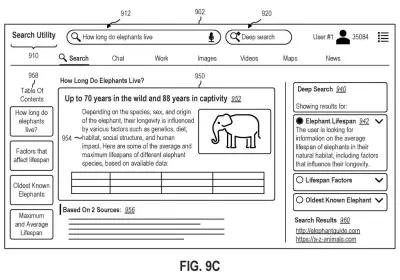
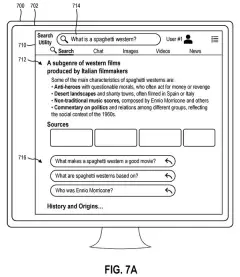
Say you search for best time to visit Hawaii. The system first works out what you're really after, then runs extra searches of its own, like the cheapest time to travel, when the weather is best, and when events happen. It gathers hundreds of results, keeps the top handful, and has AI write a short answer plus several topic sections, each with links back to its sources.
Only harder questions get this treatment. A search like 'youtube' or '2+2' just gets normal results. The filing's goal is to deliver the whole report in under 10 seconds.
… determining a search intent associated with the search query; determining multiple related queries for the search query based on the set of initial search link results and the search intent; …
Translation: The system figures out what you actually mean and thinks up follow up questions based on the initial links.
How the extra searches get ranked and written
The system starts with a normal search. It pulls a first list of links from the search index, then hands the query and those links to a small AI model (a compact model, about 1.5 billion settings in the filing's example, trained for one narrow job). That model works out the search intent, meaning what you're really trying to find out.
Next, a second small model creates related queries, which the filing calls fan-out. Each one runs against the index in parallel. In the filing's example, 5 related queries bring back 250 extra results. A third small model scores them against your intent and keeps the top 5 or 10 as the 'enhanced' results.
Then several jobs overlap:
- A complexity score decides whether the question deserves a full document at all.
- Another model writes a one or two sentence directed answer at the same time.
- Several copies of a section-writing model draft topic sections in parallel, with cited links.
- Lightweight checkers remove repeated content, inaccurate claims and broken image links, and enforce safety rules.
- A layout model adds matching answer cards (short, targeted answers) and arranges the page.
The filing says doing these steps one at a time could take over a minute. Overlapping them aims for under 10 seconds.
… utilizes search results to determine intent, generate a directed answer, curate topic sections, and create a generative search results document for the search query.
Translation: It reads through web links to write a custom answer organized into neat sections just for you.
Why Microsoft's cited-report search could matter
For you, this points to a search page that reads like a short briefing on research-style questions, with sources attached so you can check the claims. The regular links stay on the page, so you can still go read the originals.
For Microsoft, the pitch is cost and speed. Search runs at huge volume, and the filing leans on small, specialized models that use less computing power than large ones. It also describes skipping simple queries and reusing a finished document when the same search comes back with similar results. That keeps the expense of AI-written answers in check.
This is the 36th Microsoft filing we've tracked since July on our AI agents that act for you watchlist, adding to earlier work like one screening what the AI reads and one fixing networks from manuals.
Source: US 2026/0368190 A1 at the USPTO (PDF). Full patent text and figures are in the official publication.
Get our take in your Top Stories
Liked this breakdown? Add Patentlyze as a preferred source on Google, and our plain-English take shows up more often in your Top Stories the next time Microsoft patent news breaks.
Add Patentlyze on Google
One click.
There are more where this came from
We read every patent application Big Tech publishes and send you the ones worth knowing. Plain English, free, every week.
The drawings · 13 sheets
13 drawing sheets from US 2026/0368190 A1 · click any drawing to enlarge


Show the other 5 sheets


More from Microsoft
All 681 Microsoft patents →
More in AI / ML
All 2,738 AI / ML patents →
Google
Google Files Patent for an AI That Turns Plain-English Orders Into Robot Programs
Salesforce
Salesforce Files Patent for an AI That Writes Hidden Text to Lift Search Rankings
Google
Google Files Patent for a Search Tool That Researches Big Questions for You
Google
No comments yet