
Microsoft
Microsoft · AR / VR · Filed May 16, 2025 · USPTO published Nov 19, 2026 · This week's release
Microsoft Files Patent for Turning One Selfie Into a 3-D Face Model
Microsoft has a patent application that turns one flat selfie into a 3-D model of your face, with no extra angles and no camera details. The trick is teaching the AI which way every patch of your skin is facing before it guesses your face shape.
- Publication number
- US 2026/0369011 A1(US20260369011A1)
- Applicant
- Microsoft Technology Licensing, LLC
- Filed · Published
- May 16, 2025 · Nov 19, 2026
- Inventors
- Lohit Dev PETIKAM, Charles Thomas HEWITT, Mohammad Sadegh ALI AKBARIAN, Fatemehsadat SALEH, Tadas BALTRUSAITIS
- Status when we published
- Approved; patent expected soon
- Document
- 20 claims
- US classification
- 345/419
- Examiner
- LETT, THOMAS J (Art Unit 2611)
What Microsoft's one-selfie 3-D face patent does
Ever made a digital avatar from a selfie and ended up with someone who looks vaguely like your cousin? Turning a flat photo into a believable 3-D face is harder than it sounds, because a photo hides how far your nose sticks out or how sharply your jaw curves.
Microsoft's patent describes a program that studies a single photo and builds a 3-D model of your face from it. It does not need pictures from other angles, and it does not need to know anything about the camera. Along the way it works out which way each patch of skin is facing, and it pinpoints spots like the corners of your eyes and the edges of your lips.
Then it starts from a blank, generic face and reshapes it to match yours. The filing says the result keeps your proportions and fine details like wrinkles, and it runs fast enough to work in real time.
… processing the image patches through an embedding layer to transform each image patch into a corresponding embedding vector; processing the two-dimensional image through the embedding layer to generate a classification embedding token for the two-dimensional image; …
Translation: The system breaks down the photo into pieces and creates digital tokens to represent every part.
How the model turns skin direction into a face
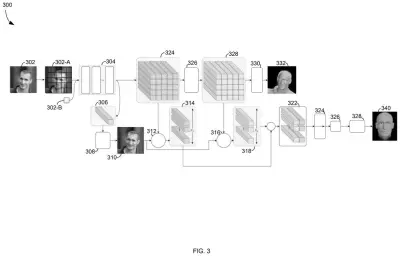
The system takes one face photo and cuts it into a grid of small squares called patches (typically 16 by 16 pixels). A Vision Transformer (an AI model that looks at every piece of an image and how the pieces relate) turns each patch into a visual token, a bundle of numbers describing the textures, wrinkles and contours in that part of the face. It also produces one overall summary token that captures things like lighting and color across the whole image.
From there, the work splits into two tracks:
- Surface direction map: a decoder builds a surface normal map, which records the direction each point of skin faces. This acts as a stand-in for 3-D shape.
- Landmarks: the summary token is used to predict the 2-D positions of eye corners, lip boundaries, eyebrows and jaw. During training the model also estimates how confident it is in each position.
At each landmark, the system grabs both the appearance information and the surface direction information and merges them (a step called grid sampling). A second stage turns these merged details into a set of identity numbers, 260 in the filing's example. Those numbers reshape a generic template face, a 3-D mesh of points, to match the person. Expression and head pose are set to zero, so the result is a neutral version of your face.
The whole model is trained on computer-generated faces, where the correct answers, including surface direction maps, are known exactly.
The techniques enable real-time face reconstruction without requiring camera information or multiple views, while maintaining high accuracy through training on synthetic data.
Translation: It builds the 3D model instantly using just one normal photo instead of special multi-angle camera setups.
Why selfie-built avatars could get easier
If you want an avatar that looks like you without sitting for a multi-angle scan, this is the idea: one selfie, a quick result. The filing points to augmented reality, virtual reality, games and avatar-based communication, and says the approach runs in real time, where older fitting methods can take seconds or minutes per face. Training on computer-generated faces also avoids collecting real people's face data, which the filing frames as a privacy benefit.
The patent office has approved this application, and once Microsoft pays the final fee it should be issued as a granted patent. It is not issued yet, and a patent describes an idea, not a shipping product.
This is the 652nd Microsoft patent application we've tracked since May in our Microsoft coverage, a corpus that includes filings like one on finding missed search images and one on diagnosing voice mishearing.
Source: US 2026/0369011 A1 at the USPTO (PDF). Full patent text and figures are in the official publication.
Get our take in your Top Stories
Liked this breakdown? Add Patentlyze as a preferred source on Google, and our plain-English take shows up more often in your Top Stories the next time Microsoft patent news breaks.
Add Patentlyze on Google
One click.
There are more where this came from
We read every patent application Big Tech publishes and send you the ones worth knowing. Plain English, free, every week.
The drawings · 6 sheets
6 drawing sheets from US 2026/0369011 A1 · click any drawing to enlarge


More from Microsoft
All 681 Microsoft patents →
More in AR / VR
All 713 AR / VR patents →
Meta
Meta Patents a Virtual Hoop at Your Feet for Getting Around in VR
IBM
IBM Patents a Safety Zone That Slows Forklifts Around Workers Operating Distant Machines
Qualcomm
Qualcomm Files Patent for AR Meetings Where Remote Coworkers Appear Beside Your 3D Model
Apple
No comments yet