
Microsoft
Microsoft · Security · Filed Feb 26, 2025 · USPTO published Aug 27, 2026 · Aug 27 release
Microsoft Patents Secure Transfer of Private Cloud Computers to Local Hardware
Moving a running, encrypted computer from a cloud server to a local device sounds risky. Microsoft has patented a process that does it without ever exposing the machine's secrets.
- Publication number
- US 2026/0252373 A1(US20260252373A1)
- Applicant
- Microsoft Technology Licensing, LLC
- Filed · Published
- Feb 26, 2025 · Aug 27, 2026
- Inventors
- Jin LIN, Giridhar VISWANATHAN, Michael Bishop EBERSOL
- Status when we published
- Waiting for an examiner
- Document
- 20 claims
- US classification
- 718/1
How Microsoft's confidential VM migration actually works
A hospital server runs a sensitive patient-data workload in the cloud all year. Then the hospital needs that same workload to run locally, closer to its equipment, without the data ever being readable in transit. That gap between cloud and local hardware is exactly what this patent addresses.
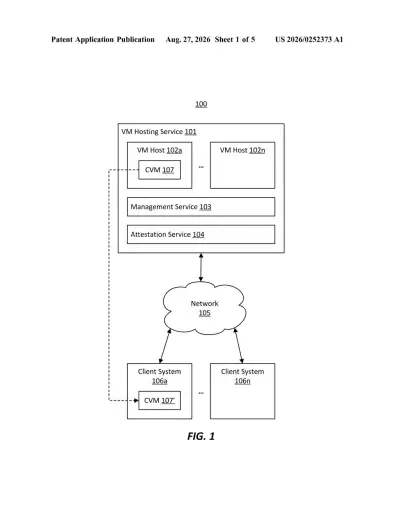
Microsoft's idea is a kind of secure handoff protocol for encrypted virtual machines. A virtual machine is basically a computer running inside another computer as software. A confidential virtual machine adds a lock: even the cloud provider can't peek at what's inside. The patent describes a way to move one of these locked machines to a different location, whether that's a factory floor, a hospital network, or a retail store, while keeping the lock intact the whole time.
The trick is a two-step key swap. Before the machine travels, it drops its old encryption key and picks up a new one from the destination. Only the destination device can unpack the machine when it arrives. Your data never travels unprotected.
removing a first secret from the virtualized firmware layer; encrypting a guest state file associated with the CVM using a second secret received from the remote computer system, the guest state file including a state of the virtualized firmware layer; and initiating a migration of the CVM to the remote computer system …
Translation: The system wipes its internal keys, locks up its state data with a new key from the target machine, and starts the transfer.
Inside the key-swap that keeps the VM's secrets safe
The patent covers a method built into the virtualized firmware layer of a confidential virtual machine (CVM). Firmware is the low-level software that sits between hardware and the operating system; making it "virtualized" means it runs inside a software container rather than on physical chips directly.
Here is the sequence the patent describes:
- Receive a migration signal: an orchestration component (think of it as a traffic controller for cloud workloads) tells the CVM it needs to move.
- Validate the destination: the firmware checks that the remote system, the edge device, meets a defined security standard before anything moves. This is called attesting the remote system.
- Drop the old secret: the firmware deletes the first encryption key, the one tied to the original cloud environment, so it can't be extracted during transit.
- Encrypt with the destination's key: the full state of the machine, memory, firmware state, and all, is wrapped using a second secret provided by the remote device. Only that device can unwrap it.
- Transmit: the encrypted package is sent to the edge device, which decrypts and resumes the machine as if nothing happened.
The whole process happens inside the firmware layer, meaning the host operating system and even Microsoft's own cloud infrastructure never hold the decrypted state. That is the core security claim.
… ensuring a secure and confidential transfer of the CVM to the designated destination.
Translation: This process guarantees that the cloud machine moves to its new home without exposing any private data.
What this means for cloud security at the edge
For industries that process regulated data, healthcare, finance, defense, the ability to shift an encrypted workload from a central cloud to a local device without breaking confidentiality removes a real barrier. Right now, moving sensitive workloads often means decrypting them at some point in the journey, which creates a window of exposure. This approach keeps the lock on throughout.
The practical path to a product here is mostly software, which is a shorter road than most security patents require. The main prerequisite is hardware that already supports confidential computing, like AMD's SEV or Intel's TDX chips, which are already in the market. Microsoft runs confidential computing services on Azure today, so the infrastructure foundation exists. Cloud-security filings like this one are part of this week's Big Tech patents tracking where enterprise computing is being rebuilt from the ground up.
This is the 335th Microsoft filing in our Microsoft coverage since May, adding to work like the screen-peeker identity check and the focus-based code editor.
Source: US 2026/0252373 A1 at the USPTO (PDF). Full patent text and figures are in the official publication.
Get our take in your Top Stories
Liked this breakdown? Add Patentlyze as a preferred source on Google, and our plain-English take shows up more often in your Top Stories the next time Microsoft patent news breaks.
Add Patentlyze on Google
One click.
There are more where this came from
We read the new patents from Big Tech, carmakers and more and send you the ones worth knowing. Plain English, free, every week.
The drawings · 5 sheets
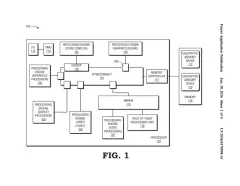
5 drawing sheets from US 2026/0252373 A1 · click any drawing to enlarge


More from Microsoft
All 681 Microsoft patents →
More in Security
All 354 Security patents →
Google
Google Patents a Cloud System That Keeps Private Data Locked Inside a Sealed Processing Chamber
IBM
Red Hat Patents a Cloud-to-Local Secrets Manager Topology Migrator
Qualcomm
Qualcomm Patents a Way for Car Computers to Verify Each Other's Software Updates
AMD