
Microsoft
Microsoft · Software · Filed Aug 6, 2025 · USPTO published Nov 19, 2026 · This week's release
Microsoft Patents a Search Tool That Switches Tactics When You Add Filters
Search a huge database for photos taken in Japan before 2004, and the system has to choose between two very different ways of looking. Microsoft's patent adds a quick check that picks the cheaper one for each query.
- Publication number
- US 2026/0368172 A1(US20260368172A1)
- Applicant
- Microsoft Technology Licensing, LLC
- Filed · Published
- Aug 6, 2025 · Nov 19, 2026
- Inventors
- Haiyang XU
- Status when we published
- Approved; patent expected soon
- Document
- 20 claims
- US classification
- 707/715
- Examiner
- MACKES, KRIS E (Art Unit 2153)
- Parent application
- Claims priority from a provisional application 63808448 (filed May 19, 2025)
What Microsoft's filter-aware search does
Ever searched a big photo library for pictures from Japan taken before 2004? Every filter you add makes the database's job harder, because it has to sift through a lot of items that were never going to match.
Microsoft's patent tackles this for large databases. Before searching, the system checks how many items pass your filters. If plenty pass, it uses a shortcut that hops between similar items, steered toward the ones that fit your filters. If only a handful pass, that shortcut wastes effort, so the system skips it and checks the short list directly.
A separate training step sets the cutoff between the two approaches. It measures how each one performs and finds the point where one becomes cheaper than the other. The goal is faster answers for less computing cost.
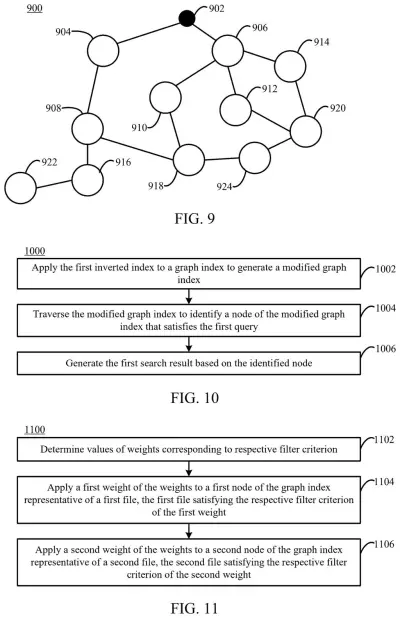
utilize a first search strategy by applying the first inverted index to a graph index to generate a modified graph index and traversing the modified graph index to identify a first node of the modified graph index that satisfies the first query …
Translation: It updates the search map using your filters to find the right data.
How the system decides when to skip the graph
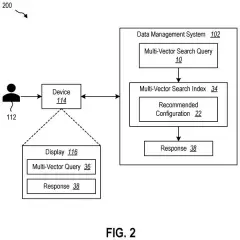
The patent describes a search system for databases that find items by meaning. In a vector similarity search, each item is turned into a long list of numbers, so items with similar meaning end up close together. When a query arrives with filters, such as "country is Japan" and "year before 2004," the system reads those filters from the query or its metadata (the labels attached to it).
It then builds an inverted index, a lookup table that maps each filter term to the files that match it, like the index at the back of a book. That table is used to measure selectivity, meaning how many files pass the filters. The system then compares that number to a threshold and picks one of two routes:
- Many files pass: the lookup table is applied to a graph index (a web of linked items, where each connects to similar ones). Matching items get higher weights so the search is more likely to visit them, and non-matching items can be down-weighted or removed. The system then walks the modified graph to find a match.
- Few files pass: the graph is skipped. Depending on a second threshold on the number of candidate items, the system either runs a tree-based range scan over compressed vectors or loads the documents directly and searches them.
Filters can be ranked by priority, so a country filter can weigh more than a year filter. A training system measures both search methods and sets the thresholds.
An inverted index is generated based on the filter criterion and a graph index of the database. The inverted index is utilized to determine a level of selectivity of the query. A search strategy is selected based on the determined level of selectivity having a relationship with a threshold.
Translation: The system checks how restrictive your filters are to pick the best search method.
Why Microsoft's approved search patent matters
If you have ever waited on a search that got slower as you piled on filters, this is the problem the patent targets. Microsoft's design checks how many items pass your filters and picks the cheaper route, which should cut wait times and the computing bill for anyone running a large searchable collection. The filing even offers a security example: faster queries mean less time a weakness stays exposed to hackers.
The patent office has approved this application and Microsoft has paid the fee to have it issued, so it should become a granted patent soon. The filing does not name a product. It describes the technique for any system that searches large collections by meaning with filters attached.
That makes this Microsoft's 670th filing in our Microsoft coverage since May, adding to work like the specialist AI handoff and the file-read filter.
Source: US 2026/0368172 A1 at the USPTO (PDF). Full patent text and figures are in the official publication.
Get our take in your Top Stories
Liked this breakdown? Add Patentlyze as a preferred source on Google, and our plain-English take shows up more often in your Top Stories the next time Microsoft patent news breaks.
Add Patentlyze on Google
One click.
There are more where this came from
We read every patent application Big Tech publishes and send you the ones worth knowing. Plain English, free, every week.
The drawings · 10 sheets
10 drawing sheets from US 2026/0368172 A1 · click any drawing to enlarge


Show the other 2 sheets


More from Microsoft
All 681 Microsoft patents →
More in Software
All 814 Software patents →
Google
A New Google Patent Lets a Database Switch Tactics While It Searches

Apple
Apple Patents a Search Interface That Remembers Where You Left Off
Microsoft
Microsoft Files Patent to Stop AI Search Databases From Storing Data Twice
Google
No comments yet