
Microsoft
Microsoft · AI / ML · Filed Jun 20, 2025 · USPTO published Nov 19, 2026 · This week's release
Microsoft Patents a Filter That Decides Which Files and Chats Its AI Reads
Microsoft's patent describes a research-assistant step for work AI. It sorts your meetings, chats and files, tosses duplicates and contradictions, and remembers its work for next time.
- Publication number
- US 2026/0368186 A1(US20260368186A1)
- Applicant
- MICROSOFT TECHNOLOGY LICENSING, LLC
- Filed · Published
- Jun 20, 2025 · Nov 19, 2026
- Inventors
- Sakshi MUNJAL, . CHAITANYA, Priyank RASTOGI, Sachin SWAMI, Rohan GYANI, Sheetal S SETHI, Sandeep Kumar SRIVASTAVA
- Status when we published
- Approved; patent expected soon
- Document
- 20 claims
- US classification
- 707/723
- Examiner
- LEWIS, CHERYL RENEA (Art Unit 2166)
What Microsoft's AI information sorter actually does
Imagine you ask a work AI assistant to draft a project update. Behind the scenes it could pull from last month's meeting recordings, hundreds of chat messages, shared files and web pages. Most of that is noise, and some of it contradicts itself.
Microsoft's patent describes a sorting system that sits between those sources and the AI doing the work. It breaks long material into smaller pieces, labels each piece with a topic and where it came from, and scores how useful it is for the task. It throws out duplicates and anything that doesn't connect to other relevant material. What's left gets stitched into one clean briefing.
The system can also ask its own questions to fill gaps in what it knows. It remembers its work for a while, so the next task doesn't start from scratch.
… ranking and filtering out irrelevant contexts; adding a re-ranking and filtering phase; and synthesizing remaining contexts into a usable format.
Translation: The system sorts through data multiple times to drop useless information before combining what is left.
How chunks get scored, re-ranked and cached
The patent covers a pipeline for the grounding step in Microsoft's Multi-Agent Runtime Service, which is used to build and run teams of AI agents. Grounding means handing an AI model the background information it needs, such as meeting recordings, chats, files and planner data. The filing says pulling from so many places adds delay and raises the risk of using wrong or irrelevant data.
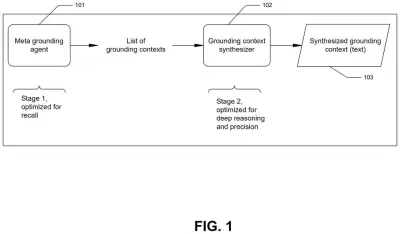
The pipeline works in stages:
- Gather: a meta grounding agent pulls possibly relevant material from every source, tuned for speed. Each item carries notes on what it is, where it came from and the context it was shared in.
- Split: a preprocessor agent (an AI model assigned to this job) cuts long text into chunks of whatever size it judges best. It tags each chunk with topics and a source link for citations.
- Rank and filter: a reasoning agent groups chunks by topic, scores them on task relevance and source credibility, and drops duplicates and conflicts.
- Re-rank: a second pass updates the scores using the relationships between chunks. It drops low scorers and anything that clashes with high scorers.
- Synthesize: what remains is joined into one grounding context for the agents doing the task.
The filing also describes an index, so each execution agent reads only the parts it needs on its turn and can follow a link back to the source. Selected results can be saved for a chosen time window, so repeat tasks run faster. A questioning agent can generate questions to fill in missing information, and a knowledge graph can map how chunks relate.
Depending on the signals from initial phases, the processing pipeline is expanded to perform preprocessing over extracted grounding context and splitting data into chunks with context as needed.
Translation: The software breaks files into smaller pieces and processes them dynamically based on early results.
Why workplace AI answers depend on this step
If you use an AI assistant at work, the quality of its answers depends on what it reads first. Feed it too much and it slows down or loses detail. Feed it the wrong paragraph and it answers wrongly with total confidence. Sorting, double-checking and saving earlier work aims to make answers faster and less likely to rest on stale or irrelevant material.
The patent application has been approved by the patent office. Once Microsoft pays the final fee, it should be issued as a granted patent. The filing ties the idea to Microsoft's Multi-Agent Runtime Service, so it reads as groundwork for AI agents that handle tasks across your meetings, chats and files.
One more thing to know: the patent office has already approved this application. Once Microsoft pays the final fee, it should be issued as a granted patent, and the final claims may read a little differently from the version described here.
This is the 22nd Microsoft filing we've tracked since June on our assistants that remember you watchlist, following one on ignored email topics and one on coding context.
Source: US 2026/0368186 A1 at the USPTO (PDF). Full patent text and figures are in the official publication.
Get our take in your Top Stories
Liked this breakdown? Add Patentlyze as a preferred source on Google, and our plain-English take shows up more often in your Top Stories the next time Microsoft patent news breaks.
Add Patentlyze on Google
One click.
There are more where this came from
We read every patent application Big Tech publishes and send you the ones worth knowing. Plain English, free, every week.
The drawings · 20 sheets
20 drawing sheets from US 2026/0368186 A1 · click any drawing to enlarge


Show the other 12 sheets


More from Microsoft
All 681 Microsoft patents →
More in AI assistant & agent
All 436 AI assistant & agent patents →
Salesforce
Salesforce Patents Chatbot Memory That Shrinks Old Topics and Keeps the Relevant Ones
OpenAI
OpenAI Files Patent for Shared AI Project Folders With Built-In Instructions
Google
Google Files Patent for Reusing a Chatbot's Past Work on Similar Questions
IBM
No comments yet