
Microsoft
Microsoft · Security · Filed May 19, 2025 · USPTO published Nov 19, 2026 · This week's release
Microsoft Patents a Filter That Screens What AI Assistants Send and Receive
AI assistants are learning to call outside tools on their own, and Microsoft's patent filing puts a security guard between the two. Every request going out and every answer coming back gets checked before it goes through.
- Publication number
- US 2026/0370629 A1(US20260370629A1)
- Applicant
- Microsoft Technology Licensing, LLC
- Filed · Published
- May 19, 2025 · Nov 19, 2026
- Inventors
- Samuel Edward SCHILLACE
- Status when we published
- Examiner raised objections; the company can respond
- Document
- 20 claims
- US classification
- 726/1
- Examiner
- FAROOQUI, QUAZI (Art Unit 2491)
What Microsoft's AI tool checkpoint actually does
Today, an AI assistant can reach out to other programs to get things done: look up a database, edit a document, call a web service. Those connections run on a shared standard, and the filing points to two dangers. A shady tool can pose as a trusted one and feed your assistant bad instructions, or the assistant can hand confidential data to a program that should never see it.
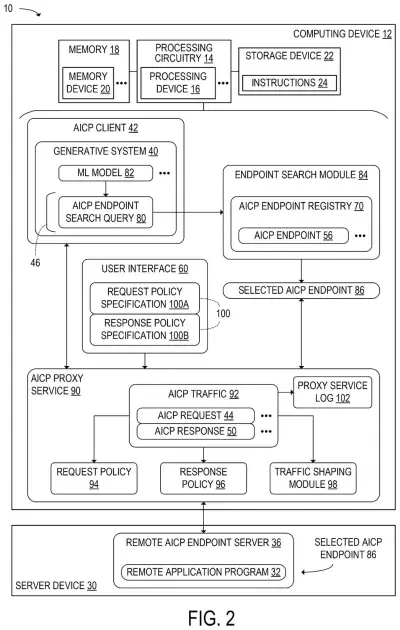
Microsoft's patent describes a go-between that sits in the middle. When your assistant needs a tool, it searches a list of approved ones, and every message in either direction passes through a checkpoint first. Anything that breaks the rules gets blocked or trimmed.
You, or your company's IT staff, could write those rules yourselves. The checkpoint also keeps a log, so someone can review later what the assistant sent and received.
… enforce a request policy on the one or more AICP requests, and/or enforce a response policy on the one or more AICP responses …
Translation: It acts as a security guard, screening what goes into and comes out of the AI.
How the proxy vets tools, requests and replies
The claims cover a proxy service (a middleman program) for the artificial intelligence context protocol, the shared standard AI systems use to talk to outside tools. The filing names Model Context Protocol as an example. First, the AI system, meaning the software wrapped around a language model, sends a search query describing the job it wants to hand off. The system picks a matching tool from a registry, using a vector similarity search (a way of comparing descriptions by meaning, like a search engine does).
Then all traffic between the AI and that tool flows through the proxy, which applies two sets of rules:
- Request policy: checks outgoing messages. One example is blocking a message whose contents are marked confidential, or limiting which tools may receive it. Others are a check that the user is allowed to ask for that action, and a check that the tool is on the approved list.
- Response policy: checks incoming answers for user permission, for spoofing (a fake tool posing as a real one), and for malicious code, using a classifier model.
The proxy can also edit rather than block, for example by stripping an untrusted part of a reply. New tools earn a place on the approved list by passing a round of test traffic. The proxy can also reorder, delay, limit or drop traffic to prevent slowdowns, and it can store everything in a log. Finally, the AI model builds its answer from the checked responses.
… select an AICP endpoint that matches the AICP endpoint search query from among a plurality of AICP endpoints …
Translation: It finds the right external data source by searching through many available options.
Why AI assistants with outside tools need a guard
If you use an AI assistant at work that can read company files and call outside services, the big question is what it sends, and to whom. A checkpoint like this would let a company set rules once, such as keeping anything marked confidential away from outside tools, and have them applied to every request. The audit log gives security teams a record to review when something goes wrong.
For Microsoft, the pitch is trust: businesses are more willing to give AI access to their data if they can control the connections. The examiner's first review rejected the claims as filed, which is routine at this stage, so the final scope could change.
This is the 29th Microsoft patent we've tracked in our AI guardrails race watchlist since July, following one on self-checking coding help and one on database speed checks.
Source: US 2026/0370629 A1 at the USPTO (PDF). Full patent text and figures are in the official publication.
Get our take in your Top Stories
Liked this breakdown? Add Patentlyze as a preferred source on Google, and our plain-English take shows up more often in your Top Stories the next time Microsoft patent news breaks.
Add Patentlyze on Google
One click.
There are more where this came from
We read every patent application Big Tech publishes and send you the ones worth knowing. Plain English, free, every week.
The drawings · 10 sheets
10 drawing sheets from US 2026/0370629 A1 · click any drawing to enlarge


Show the other 2 sheets


More from Microsoft
All 681 Microsoft patents →
More in Security
All 353 Security patents →
IBM
IBM Files Patent for Turning Plain-English Requests Into Security Alert Rules
Samsung
Samsung Patents a System That Keeps AI Programs From Misusing Your Phone's Data
Samsung
A New Samsung Patent Tracks Which Phone Sent a Bad AI Update
OpenAI
No comments yet