
Milwaukee
Milwaukee · Gear · Filed May 19, 2026 · USPTO published Nov 19, 2026 · This week's release
Milwaukee Tool Patents Heated Clothing With Flexible Round Wires for Better Comfort
Heated clothing has a quiet annoyance: the wires that carry the warmth can be the part you feel. Milwaukee Tool's patent application goes after that problem with a round, braided cable and some belt-loop-style wire holders.
- Publication number
- US 2026/0363364 A1(US20260363364A1)
- Applicant
- MILWAUKEE ELECTRIC TOOL CORPORATION
- Filed · Published
- May 19, 2026 · Nov 19, 2026
- Inventors
- Bradley J. VAN WAGONER, Matthew D. STROMMEN, Luke I. BRADLEY, Action FAN, Carina ZENG
- Status when we published
- Waiting for an examiner
- Document
- 20 claims
- US classification
- 219/211
- Parent application
- Claims priority from a provisional application 63807987 (filed May 19, 2025)
What Milwaukee's heated base layer actually does
A worker pulls on a heated base layer before heading out into the cold. The warmth is the whole point, but the wires that feed the heaters can bunch, snag or press into you as you move.
Milwaukee Tool's patent application describes a fix. Instead of the flat cable the filing says conventional heated clothing uses, it calls for a round cable made of fine wires braided together, with a flexible outer layer. The idea is that a round cable can roll along the fabric as you move instead of digging in. On the pants version, small loops near the waistband, a bit like belt loops, hold the cable in place so it doesn't bunch up but still has slack when you bend and walk.
A battery pack in a pocket powers the heaters, and a small button panel lets you pick the heat level.
An article of clothing comprising: a body configured to be worn by a user; a heating array supported by the body; a power source; and a wire connecting the power source to the heating array, the wire having a round cross-section.
Translation: The garment features a built in heater powered by a wire with a round shape.
How Milwaukee's round braided cable is built
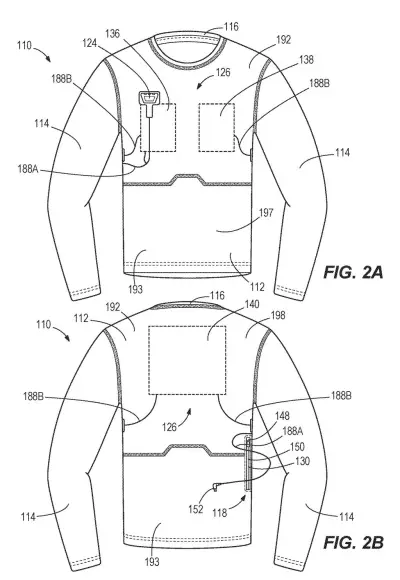
The filing describes heated base layers, one shirt style and one pants style. Each has a heating array (a set of heater panels sewn in), a battery pocket, and a control button panel. The shirt version has heaters on the left chest, right chest and back. The pants version has them on the left leg, right leg and rear.
The core of the filing is the cable that links these parts. It is a braided wire with a round cross-section (circular, oval or similar). Inside, several conducting wires are each coated in a stretchy plastic called TPEE, grouped in clusters, and mixed with nylon support wires for strength and heat resistance. An outer shielding layer wraps them: thin wires woven into a mesh around a plastic core. The filing also describes yarn strands woven in a circular over-under pattern.
On the pants, the cable passes through wire holding members near the waistband. These can be loops, clips or hooks, and the cable either slides through them or is fixed to them. The filing says this improves comfort and keeps the cable from bunching while leaving slack for movement.
Power comes from a 12-volt lithium battery pack, which the filing says can also run power tools. A control module cuts power if the battery voltage runs low. The buttons switch between high, medium and low heat, with an optional pre-heat mode at the start.
Why a rounder wire matters for heated gear
If you have ever worn anything with a wire running through it, you know the cable is the part you notice. Heated clothing adds more of them: a battery connection, heater panels and a control button, all linked by cable. A rounder, flexible cable that moves with the fabric, plus loops that stop it bunching at your hips, targets that daily annoyance directly.
The filing also shows how much of this runs on tool-style hardware. The battery pack is described as a 12-volt lithium pack that can also power drills and saws, with an 18-volt option mentioned. That points to heated gear built around the same batteries a job site already uses. It is a small comfort-focused filing, but comfort is what decides whether people keep wearing this kind of clothing.
Milwaukee's second filing in the Power tools & outdoor topic we've tracked since November follows pipe cameras reading rust and clogs.
Source: US 2026/0363364 A1 at the USPTO (PDF). Full patent text and figures are in the official publication.
Get our take in your Top Stories
Liked this breakdown? Add Patentlyze as a preferred source on Google, and our plain-English take shows up more often in your Top Stories the next time Milwaukee patent news breaks.
Add Patentlyze on Google
One click.
There are more where this came from
We read the new patents from Big Tech, carmakers and more and send you the ones worth knowing. Plain English, free, every week.
The drawings · 11 sheets
11 drawing sheets from US 2026/0363364 A1 · click any drawing to enlarge


Show the other 3 sheets


More from Milwaukee
All 2 Milwaukee patents →More in Gear
All 26 Gear patents →
Chervon
Chervon Patents a Nail Gun Depth Dial You Can Set With One Quick Turn
Hilti
Hilti Files Patent for a Surveying Laser That Rechecks Where It's Standing
Hilti
Hilti Files Patent for a Lighter Piston Inside Its Hammer Drills
Greenworks
No comments yet