
Xilinx Patents a Multi-Die Circuit That Gives Each Chip a Unique Hardware Fingerprint
Every chip coming off a factory line has tiny, random imperfections — and Xilinx wants to turn those imperfections into an uncloneable identity badge baked right into the silicon.
How Xilinx turns random chip imperfections into a security key
Imagine if your fingerprint wasn't something you chose, but something that formed naturally from the random way your skin grew. Chip makers have a similar idea for hardware: every silicon chip has microscopic manufacturing variations that make it subtly unique. A Physical Unclonable Function, or PUF, is a circuit that reads those natural variations and turns them into a kind of hardware password — one that can't be copied even if someone has an identical chip design.
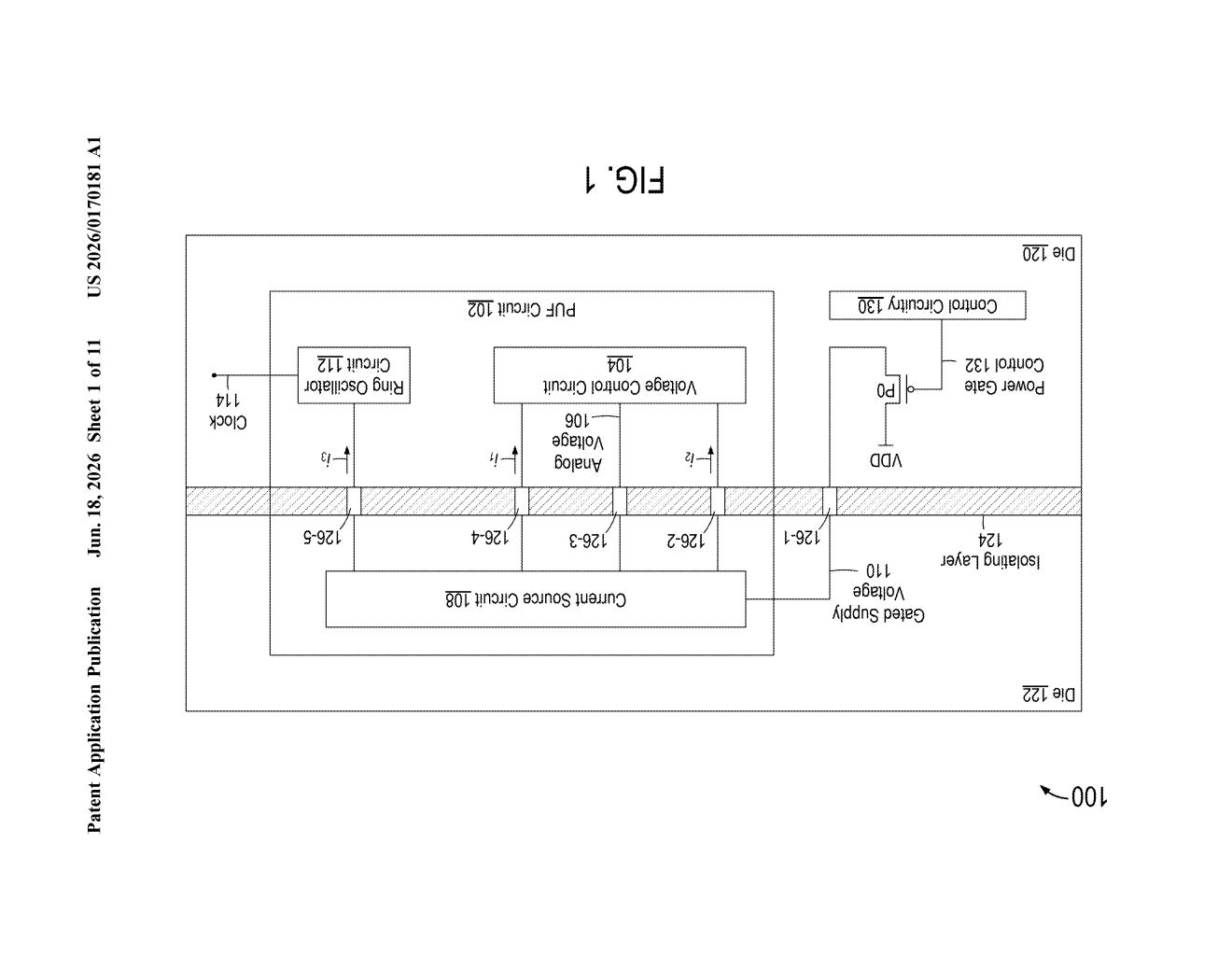
Xilinx's patent describes a PUF circuit that's split across two separate silicon dies (the individual chips inside a multi-chip package). One die holds a current-controlling circuit, while another holds the oscillator that actually generates the unique signal. Because the random variations exist in both dies, an attacker would need to replicate both perfectly — a much harder task.
The result is a chip that can prove its own identity to a server or device, making it useful for preventing counterfeit hardware, securing encrypted data, and verifying that a chip hasn't been tampered with.
How the split-die ring oscillator generates its unique signal
At the core of this patent is a ring oscillator — a circuit that generates a repeating clock signal whose exact frequency depends on tiny physical properties of the chip. Because manufacturing is never perfectly consistent, two identical ring oscillator designs will vibrate at slightly different frequencies on different chips. That difference becomes the chip's unique identifier.
Xilinx's design adds a twist: the circuit is deliberately split across two dies in a multi-die package. A current source circuit on one die produces three precisely controlled electrical currents, drawing from a gated (switched) power supply. Those currents are fed to a voltage control circuit (specifically a differential-input OTA — a type of amplifier that compares two signals and adjusts its output to keep them balanced) on the other die. The voltage controller, in turn, fine-tunes the current feeding the ring oscillator.
The ring oscillator's output frequency reflects both the deliberately set current and the random physical variations of components spread across both dies. Key configurable features include:
- Adjustable clock frequency to produce different identity "challenges"
- Time-multiplexed frequencies — the circuit can rapidly switch between frequencies to generate richer fingerprint data
- Split entropy (randomness drawn from two separate dies), making cloning significantly harder
This architecture makes the PUF more resistant to modeling attacks, where an adversary tries to mathematically predict a chip's responses without physically cloning it.
What this means for hardware security and anti-counterfeiting
PUF technology is one of the more practical answers to the chip counterfeiting problem, which costs the electronics industry billions of dollars a year. A chip that can cryptographically prove it's genuine — without storing a secret key that could be extracted — is genuinely useful for everything from military hardware to cloud servers to consumer devices.
Xilinx (now part of AMD) makes FPGAs and adaptive computing chips that often end up in high-security environments like data centers, defense systems, and telecommunications equipment. Spreading the PUF circuit across multiple dies means the security property is harder to bypass even with sophisticated physical attacks. For you as an end user, this kind of technology is what sits behind guarantees that the hardware inside a server or a secure device is exactly what the manufacturer says it is — not a knock-off.
This is solid, specific security engineering rather than a flashy concept patent. Splitting a PUF circuit across multiple dies to increase attack resistance is a meaningful architectural choice, not just a paperwork exercise. AMD/Xilinx operates in markets where hardware authentication is a real procurement requirement, so this has a credible path to production silicon.
There are more where this came from
We read every patent application Big Tech publishes and send you the ones worth knowing. Plain English, free, every week.
Want this weekly breakdown for a company we don't cover? Patentlyze Pro →