
Nvidia
Nvidia · Biotech · Filed May 14, 2025 · USPTO published Nov 19, 2026 · This week's release
Nvidia Patents an AI Shortcut for Picking Which Drug Candidates Get Tested
Nvidia's patent application turns molecules into points on a map, then uses the distance between them to guess which drug candidates would stick best to a target. When two molecules are too different to compare directly, the AI builds a trail of in-between molecules to bridge them.
- Publication number
- US 2026/0369352 A1(US20260369352A1)
- Applicant
- NVIDIA Corporation
- Filed · Published
- May 14, 2025 · Nov 19, 2026
- Inventors
- Yuxing PENG, Emine KUCUKBENLI, Guoqing ZHOU, Michelle Lynn GILL, Micha LIVNE, Maria KORSHUNOVA, Timur RVACHOV, Yonatan ISRAELI
- Status when we published
- Waiting for an examiner
- Document
- 20 claims
- US classification
- 702/19
What Nvidia's molecule-map patent actually does
Every time a drug team lines up a fresh batch of candidate molecules, someone has to guess which ones are worth the time and money to make and test in a lab. Computers can help by estimating how tightly each candidate would grab onto a target protein, but the math gets slow and shaky when two molecules look very different.
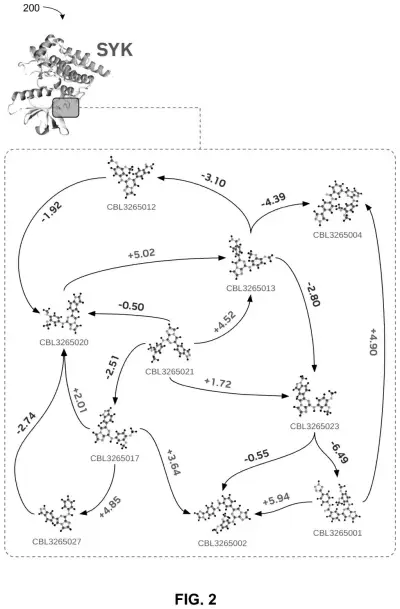
Nvidia's patent application has an AI model turn each molecule into a point on a giant map, where similar molecules land close together. When two points sit far apart, the system lays out a trail of in-between molecules, each a small tweak of the last, and adds up the small steps to get an answer. Answers get saved, so the same step is never worked out twice.
If you are waiting on a new treatment, the hoped-for payoff is simple: fewer wasted lab experiments on the way to one.
… calculating a distance in the embedding space between the first embedding representation and the second embedding representation; and predicting, based on the calculated distance in the embedding space, a relative binding affinity between the first molecule and the second molecule relative to a target molecule.
Translation: It measures how far apart the digital profiles are to estimate how well the molecules will interact with a target.
How the AI builds a trail between two molecules
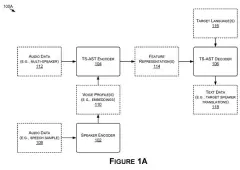
The claims cover a method run on a computer. A generative AI model (software trained on large amounts of chemistry data) reads a molecule written as a text formula or a graph and converts it into an embedding, a list of numbers that works as a coordinate on a map with many dimensions. Two molecules become two points.
The system measures the distance between the points, for example a straight-line (Euclidean) distance, and uses it to predict a relative binding affinity: how much better one molecule would stick to a target protein than another.
When the distance passes a threshold, the molecules are too different to compare directly. The system then:
- Picks evenly spaced points along the straight line between them on the map;
- Decodes each point back into a real molecule, each a slight modification of the one before;
- Predicts the binding difference for each neighboring pair and adds those up;
- Stores results in a lookup table (a hash table or tree) so repeat pairs are looked up instead of recalculated.
The filing also describes a variation using a minimum spanning tree (a web linking every molecule with the shortest total gaps), which needs far fewer full calculations than comparing every pair. The best-ranked molecules, by top count or a cutoff score, are then picked for synthesis.
… generating, using a generative artificial intelligence model, a first embedding representation of a first molecule and a second embedding representation of a second molecule; calculating a distance in an embedding space between the first embedding representation and the second embedding representation; …
Translation: The system uses AI to convert two molecules into computer vectors and then measures the gap between them.
Why this could shrink the drug-testing shortlist
For people outside a lab, the practical stake is how fast and cheaply new medicines reach the testing stage. Making and testing a molecule is expensive, so any method that narrows thousands of candidates to a short list matters. Nvidia says the map approach cuts computing cost and gives more accurate rankings than methods that compare molecules by shared structure alone.
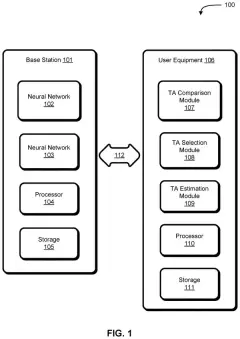
The filing also fits Nvidia's business: the description names its parallel processors as hardware that can run the prediction software, and it lists data centers and cloud computing as settings. It names no drug, partner or product, so it describes a computing technique only.
This is the 648th Nvidia filing in our Nvidia coverage since May, adding to work like saving power on idle connections and fixing colors in harsh light.
Source: US 2026/0369352 A1 at the USPTO (PDF). Full patent text and figures are in the official publication.
Get our take in your Top Stories
Liked this breakdown? Add Patentlyze as a preferred source on Google, and our plain-English take shows up more often in your Top Stories the next time Nvidia patent news breaks.
Add Patentlyze on Google
One click.
There are more where this came from
We read every patent application Big Tech publishes and send you the ones worth knowing. Plain English, free, every week.
The drawings · 5 sheets
5 drawing sheets from US 2026/0369352 A1 · click any drawing to enlarge


More from Nvidia
All 665 Nvidia patents →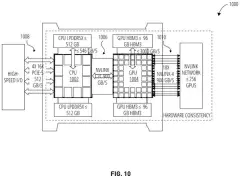
More in Biotech
All 27 Biotech patents →
Sony
Sony Files Patent for a System That Predicts Sleepwalking Before You Fall Asleep
Microsoft
Microsoft Files Patent for AI That Points Technicians to Seizure Spikes in Brain Scans
IBM
IBM Files Patent for Pain Treatment Matched to Sleep, Mood and Activity Patterns
IBM
No comments yet