
Nvidia
Nvidia · Networking · Filed Oct 16, 2025 · USPTO published Nov 19, 2026 · This week's release
Nvidia Files Patent for AI That Powers Down Idle Datacenter Connections, Then Wakes Them Early
Inside an AI datacenter, the network connections between chips sit idle roughly half to four-fifths of the time, yet they draw almost as much power as when they're busy. Nvidia's filing teaches a small AI to put each connection to sleep and wake it just before data shows up.
- Publication number
- US 2026/0370516 A1(US20260370516A1)
- Applicant
- NVIDIA Corporation
- Filed · Published
- Oct 16, 2025 · Nov 19, 2026
- Inventors
- Jonathan Paul, Amit Kazimirsky, Gal Chechik, Gal Dalal
- Status when we published
- Waiting for an examiner
- Document
- 20 claims
- US classification
- 709/238
- Parent application
- Claims priority from a provisional application 63806199 (filed May 15, 2025)
What Nvidia's link-sleeping AI actually does
A graphics chip in an AI datacenter finishes sending its results and goes back to crunching numbers. The network connection it just used goes silent, yet it keeps drawing almost as much power as when it was busy.
Now multiply that by thousands of connections. The filing says networking eats roughly 20% of a datacenter's power, and these connections sit idle 50 to 80% of the time. Turning them off sounds easy, but waking one takes over 100 microseconds (millionths of a second), about ten times longer than a normal trip across the network. Those delays slow down big AI jobs.
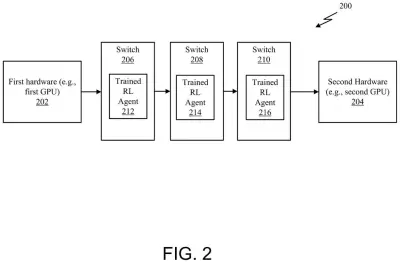
So the patent gives every connection its own small AI. It learns the rhythm of the traffic, lets the connection sleep during quiet stretches, and wakes it just before data arrives.
… prior to the first switch obtaining a first data packet that is to be forwarded to the hardware element, transitioning the network link to the active state; and based on transitioning the network link to the active state, obtaining and forwarding the first data packet to the hardware element.
Translation: The system wakes up the asleep network connection just before new data arrives so things stay fast.
How each switch port decides when to wake
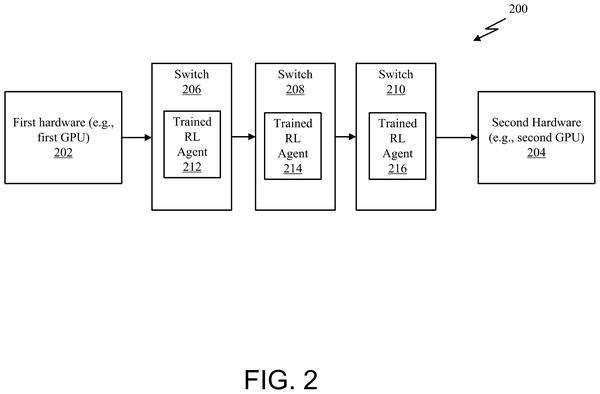
The core claim describes a loop run by a reinforcement learning agent (software that learns by trial and error, gaining points for good choices and losing them for bad ones). It watches traffic on one link between a switch and another device and decides whether that link should sleep. A sleeping link cannot pass data along. When the traffic picture changes, the agent wakes the link before the next packet reaches the switch.
Each agent sees a short summary of its own link:
- Consecutive idle time: how long since the last packet.
- Time in the current power state: how long it has been asleep or awake.
- Recent forced wake-up: a yes/no flag for whether traffic recently caught it sleeping.
- Traffic history: a short record of past idle stretches.
Training happens in a simulator that replays real traffic from large language model (the AI behind chatbots) training jobs. Two rewards shape the agent: an energy savings bonus for time spent asleep, and a forced wake-up penalty whenever a packet hits a sleeping link.
After training, the same settings are copied to every switch, and each link decides alone using local counters and timers. The filing describes shrinking the model to 8-bit numbers so it fits inside switch hardware. One version adds a convolutional neural network (a pattern-spotting layer) to read the idle history, since AI traffic repeats in cycles.
… the RL agents may learn to anticipate future network activity, which may allow the RL agents to preemptively wake links before traffic arrives, which may minimize latency penalties, and identify extended idle periods where links may safely sleep, which may maximize energy savings.
Translation: The artificial intelligence predicts network traffic to save power during downtime without slowing things down.
Why shaving datacenter power could free up GPUs
For you, the effect is indirect but real: AI services run in datacenters where electricity is the limit. The filing reports 8% total datacenter power savings in simulation, against a ceiling of 11 to 12% for a perfect policy. It also says moving that saved power over to the chips raised GPU performance by roughly 5 to 8%.
The company also says the approach kept network delays in check and has been built into next-generation networking hardware. Treat that as Nvidia's own account, since most of the numbers come from simulation. Still, if power is the bottleneck for building bigger AI clusters, saving it in the network means more of it reaches the chips doing the work.
This is the 67th Nvidia filing we've tracked in AI chip wars since July, following one on buyer software control and one on chip traffic jams.
Source: US 2026/0370516 A1 at the USPTO (PDF). Full patent text and figures are in the official publication.
Get our take in your Top Stories
Liked this breakdown? Add Patentlyze as a preferred source on Google, and our plain-English take shows up more often in your Top Stories the next time Nvidia patent news breaks.
Add Patentlyze on Google
One click.
There are more where this came from
We read every patent application Big Tech publishes and send you the ones worth knowing. Plain English, free, every week.
The drawings · 11 sheets
11 drawing sheets from US 2026/0370516 A1 · click any drawing to enlarge


Show the other 3 sheets


More from Nvidia
All 665 Nvidia patents →
More in Networking
All 516 Networking patents →
AMD
AMD Patents an AI Math Circuit That Feeds Its Own Answers Back In
Intel
Intel Files Patent for Graphics Chips That Split Into Custom-Sized Slices for Different Users
Intel
Intel Files Patent for Reusing AI Software on Newer Chips Without Starting Over
Samsung
No comments yet