
Sony
Sony · Display · Filed Aug 4, 2025 · USPTO published Nov 12, 2026 · This week's release
Sony Patents a Folded Graphite Strip to Cool a Camera Sensor That Moves
Your camera's image sensor slides around to cancel out shaky hands, which makes it awkward to cool. Sony's filing carries the heat away with a strip of graphite folded twice so it never tugs on the moving part.
- Publication number
- US 2026/0361981 A1(US20260361981A1)
- Applicant
- SONY GROUP CORPORATION
- Filed · Published
- Aug 4, 2025 · Nov 12, 2026
- Inventors
- ATSUSHI TANI, HIROSHI ABE
- Status when we published
- Examiner raised objections; the company can respond
- Document
- 8 claims
- US classification
- 348/208.7
- Examiner
- SPINKS, ANTOINETTE T (Art Unit 2639)
- Parent application
- National Stage Entry of PCT/JP2024/002748 (filed Jan 30, 2024)(PCTJP2024002748)
What Sony's heat-carrying camera strip does
In many cameras today, the chip that captures your photo sits on a small platform that slides around to cancel out your hand shake. That chip also gets hot while it works, and a stiff heat-conducting part would tug on the platform and spoil the stabilization.
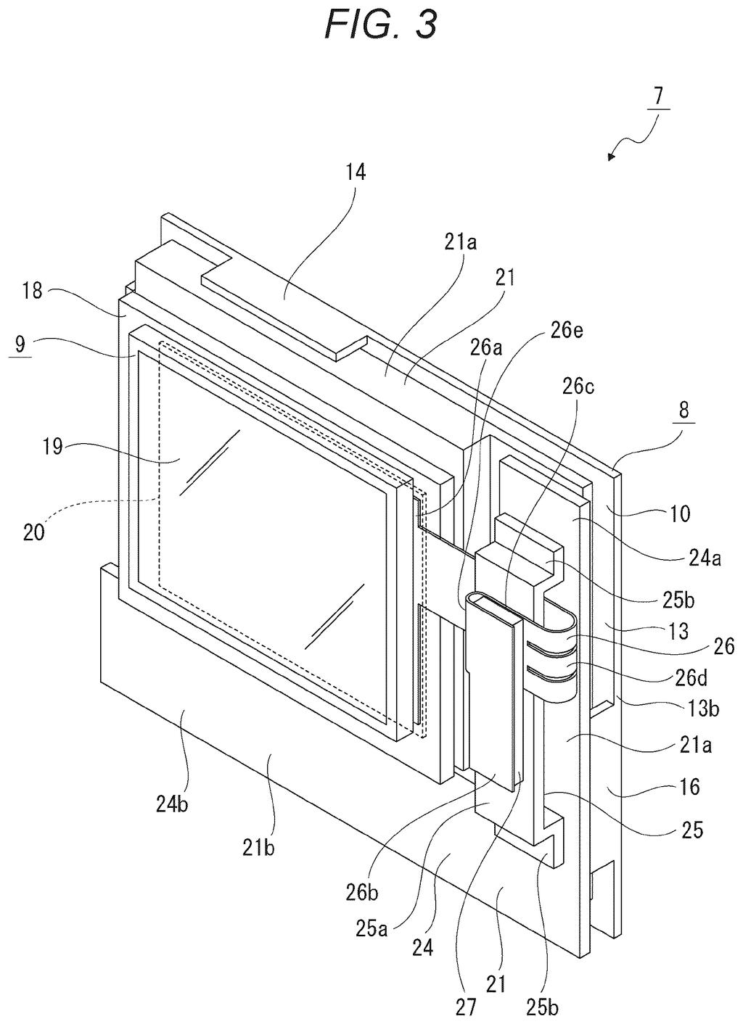
Sony's filing describes a thin graphite sheet (a lightweight, bendy material that moves heat well) that carries warmth from the moving sensor platform to the outer body of the camera. One end touches the moving part, the middle touches the fixed frame, and the far end touches the inside of the camera body. The sheet is folded back on itself twice, so the folds flex when the sensor slides instead of pulling on it.
A small piece of sponge presses the sheet against the camera body's inner wall, with no glue or tape between them, which helps heat pass through.
… a movable body having an imaging element and moved in a direction orthogonal to an optical axis direction with respect to the fixed body; and an elastically deformable heat transfer sheet provided as a first close contact portion partially in close contact with the movable body …
Translation: The moving camera sensor uses a flexible cooling sheet to transfer heat while shifting.
How the double fold lets the sensor float
A camera with sensor-shift stabilization (the image sensor sits on a platform that slides sideways, up and down, and even twists to cancel out hand shake) has two jobs that pull against each other. The sensor and its circuit board get hot, so heat has to leave. Yet the platform must glide freely.
Sony's answer is an elastic heat transfer sheet, with graphite as the main example. Its first end slips into the small gap behind the sensor on the moving platform. A middle section presses against a bracket on the fixed frame. The far end presses against the inside of the housing (the camera body). Between those three contact spots sit two folds, each bent back 180 degrees in opposite directions.
- The fold next to the sensor flexes whenever the platform moves, soaking up the pull so the stabilizer is not slowed.
- The fold near the housing flexes when the fixed frame is shifted forward or back while focus is set during assembly, so no strain builds up.
The sponge sits between the middle and far sections and pushes both against their surfaces, avoiding an adhesive layer that would resist heat. The filing also describes a looped version, a version touching two spots on the housing, and copper foil or a flexible circuit strip in place of graphite.
Why cooler sensors matter for your camera
A hot sensor is a constant nuisance in a camera, and the filing says heat can disturb how the sensor and its circuit board run. Getting that heat out without making the stabilizer sluggish could mean steadier operation from a camera with a floating sensor. The filing's main example is a still camera, but it also names video cameras, mobile phones and portable information terminals as places the idea could apply.
There is a cost angle too: if a flexible circuit strip does double duty as wiring and heat path, the camera needs fewer parts. The examiner's first review rejected the claims as filed, a routine step that usually leads to amendments, so the final wording may change.
Sony's 103rd filing in the Display patents we've tracked since May adds to work like one on cheaper holographic parts and one on backlight ghosting fixes.
Source: US 2026/0361981 A1 at the USPTO (PDF). Full patent text and figures are in the official publication.
Get our take in your Top Stories
Liked this breakdown? Add Patentlyze as a preferred source on Google, and our plain-English take shows up more often in your Top Stories the next time Sony patent news breaks.
Add Patentlyze on Google
One click.
There are more where this came from
We read every patent application Big Tech publishes and send you the ones worth knowing. Plain English, free, every week.
The drawings · 8 sheets
8 drawing sheets from US 2026/0361981 A1 · click any drawing to enlarge


More from Sony
All 707 Sony patents →
More in Display
All 730 Display patents →
Samsung
Samsung Files Patent for a Camera Sensor Fix That Captures Shadows and Highlights Faster
Qualcomm
Qualcomm Files Patent to Shrink the Black Bar Around Your Phone Camera in Sunlight
Qualcomm
Qualcomm Files Patent for a Touch Shortcut That Cuts Screen Stutter on Your Phone
Samsung
No comments yet