
Nvidia
Nvidia · Software · Filed Jul 27, 2026 · USPTO published Nov 19, 2026 · This week's release
Nvidia Files Patent for Checking If a Point Is Inside a 3D Object
Is a spot in a 3D scene inside an object or outside it? Nvidia's patent application answers that during a single search, even when the model has holes.
- Publication number
- US 2026/0368926 A1(US20260368926A1)
- Applicant
- NVIDIA Corporation
- Filed · Published
- Jul 27, 2026 · Nov 19, 2026
- Inventors
- Miles Macklin, Nuttapong Chentanez
- Status when we published
- Waiting for an examiner
- Document
- 20 claims
- US classification
- 382/100
- Parent application
- Continuation of 18/520,087 (filed Nov 27, 2023)(18520087)
What Nvidia's inside-or-outside test does
Today, when software needs to know whether a spot in a 3D scene is buried inside a solid object, it often fires imaginary rays from that spot in three directions and counts how many times each one pierces the surface. That means searching the object's data over and over, and the method can fail if the model has holes or gaps.
This Nvidia patent application describes a shortcut. While the computer is already hunting for the nearest spot on the object's surface, it also gathers a little extra information about the surfaces around that spot. One quick calculation then says whether your point is inside, outside, or right on the surface.
Why care? Games, simulations and 3D design tools all need to know when one object overlaps or bumps into another. A single search with no prep work beforehand saves time and memory.
… determining, based at least on the classification normal, whether the query point is located outside of a volume enclosed by the surface mesh; and performing one or more operations based at least on whether the query point is located outside of the volume enclosed by the surface mesh.
Translation: The system figures out if a specific point sits outside a 3D shape and then triggers actions based on that result.
How the closest-point search picks the answer
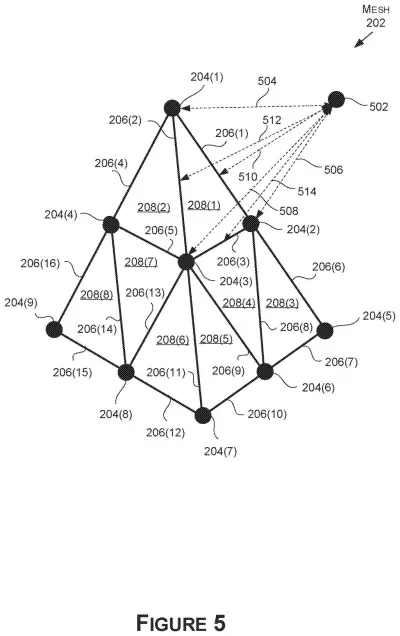
A 3D object in a game or simulation is usually built from many small triangles, called a mesh. To search it quickly, the software sorts those triangles into a tree-shaped index (a bounding volume hierarchy): one box holds everything, smaller boxes hold pieces, and the smallest boxes hold a few neighboring triangles.
The patent starts with a query point, the spot you are asking about. As the software walks down the tree to find the closest point on the object, it also records, for each candidate triangle, a weight and the direction that triangle faces (its surface normal, an arrow pointing straight out from the surface). The weight depends on where the closest point lands:
- On the flat face of a triangle: 2π
- Along an edge shared by triangles: π
- At a corner: the angle of that corner
Each triangle's arrow is multiplied by its weight and the results are added, giving an angle-weighted normal. A dot product (a standard way to measure whether two arrows point the same way) between that result and the line from the closest point to the query point gives a number. Positive means outside, negative means inside, and zero means on the surface.
Triangles that tie for closest, within a small tolerance distance, all get counted, which is how the method copes with disconnected pieces. The filing says this takes only one trip through the tree, with no preprocessing and no extra stored data, even when the mesh changes.
Systems and methods are disclosed that determine an angle-weighted normal, such as during a traversal of a bounding volume hierarchy (BVH) of a three-dimensional (3D) object, and then use the angle-weighted normal to determine whether a query point is located inside or outside of the 3D object.
Translation: The technology calculates special surface vectors while searching through a 3D object's structure to test point locations.
Why faster collision checks matter for 3D work
Most readers will never see this directly. It sits underneath software that has to know whether two 3D objects overlap, whether a moving object hits another, and which points of an object show up in an image. Making that check cheaper and tougher on messy models helps all of that run with less work.
The filing lists many possible homes: simulation, digital twins, light transport (how light bounces around a rendered scene), 3D content creation, robots, and perception or control systems for autonomous machines. Nvidia makes graphics chips, so a cheaper, single-pass test fits naturally with the hardware it sells.
This is the 47th Nvidia filing we've tracked since July in our GPU rendering race, joining earlier applications on brightest-spot lighting and one on shadows and reflections.
Source: US 2026/0368926 A1 at the USPTO (PDF). Full patent text and figures are in the official publication.
Get our take in your Top Stories
Liked this breakdown? Add Patentlyze as a preferred source on Google, and our plain-English take shows up more often in your Top Stories the next time Nvidia patent news breaks.
Add Patentlyze on Google
One click.
There are more where this came from
We read every patent application Big Tech publishes and send you the ones worth knowing. Plain English, free, every week.
The drawings · 11 sheets
11 drawing sheets from US 2026/0368926 A1 · click any drawing to enlarge


Show the other 3 sheets


More from Nvidia
All 665 Nvidia patents →
More in Software
All 814 Software patents →
Qualcomm
Qualcomm Files Patent to Reshuffle Data While a Graphics Chip Loads It
Qualcomm
A New Qualcomm Patent Has Graphics Chips Load Their Next Batch of Data While Still Working
Adobe
Adobe Patents a Coin-Flip Shortcut for Drawing See-Through 3D Objects Faster
Sony
No comments yet