
Nvidia
Nvidia · Chip · Filed Jul 27, 2026 · USPTO published Nov 19, 2026 · This week's release
Nvidia Files Patent for Graphics Chip Hardware That Speeds Up Game Shadows and Reflections
Buildings that sit at an angle in a video game get wrapped in boxes full of empty air, and every light ray that pokes at that air wastes time. Nvidia's patent application has the chip's ray-tracing hardware re-aim the rays so the boxes can hug the shapes more closely.
- Publication number
- US 2026/0368994 A1(US20260368994A1)
- Applicant
- NVIDIA Corporation
- Filed · Published
- Jul 27, 2026 · Nov 19, 2026
- Inventors
- Gregory MUTHLER, John BURGESS, James ROBERTSON, Magnus ANDERSSON
- Status when we published
- Waiting for an examiner
- Document
- 20 claims
- US classification
- 345/418
- Parent application
- Continuation of 18/668,599 (filed May 20, 2024)(18668599)
What Nvidia's slanted-box fix does for graphics
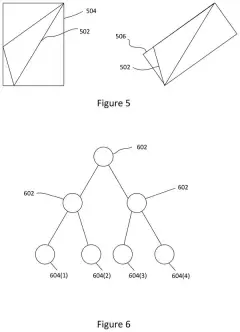
Imagine a video game village where a stone cottage sits at a slant. To keep track of it, your graphics chip wraps the cottage in an invisible box that lines up with the map grid. Because the cottage is tilted, that box is mostly empty air, and every light ray that clips the air still gets checked for nothing.
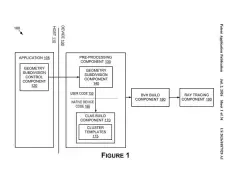
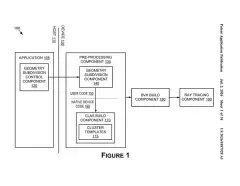
Nvidia's patent application describes a fix. For selected frames, the scene is re-aimed into a different viewpoint where the boxes hug the buildings more closely, so far fewer rays waste time. The twist is that the chip's built-in ray-tracing hardware does the viewpoint switching itself, instead of making the main processor do it first.
The picture on your screen stays the same. If it works, the only thing you would notice is smoother performance.
… in response to reaching a second instance node specifying a transform from the second world space to a third world space, output the ray, as transformed to the second world space, and traversal state identifying the second instance node, to the processor; …
Translation: When hitting a complex boundary, the chip pauses and asks the main processor for help before continuing.
How the chip switches views, then hands off the ray
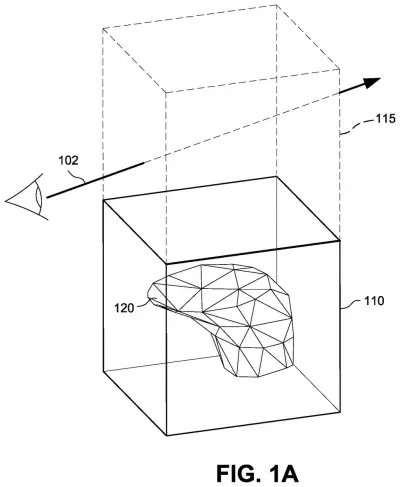
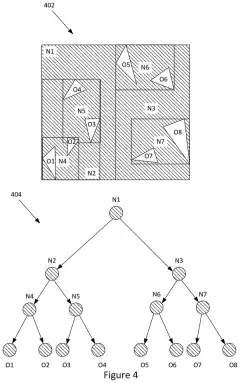
Ray tracing fires virtual light rays into a 3D scene to see what they hit, which is how games get realistic shadows and reflections. To avoid testing everything, the scene is stored in an acceleration structure (a tree of nested boxes, where a ray that misses a big box skips everything inside). The boxes line up with the scene's axes, so slanted objects get boxes full of empty space and cause false hits (rays that touch a box but miss the object).
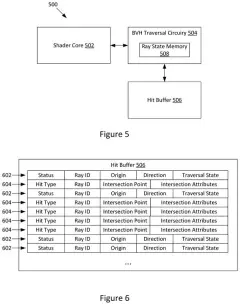
The claims cover a hardware helper (Nvidia's description calls it a traversal coprocessor) that walks the tree for the main processor. The tree can hold instance nodes (markers saying switch to a different coordinate system here, meaning a different way of measuring positions). The chip:
- Receives a ray in the original "world space" plus a pointer to where the tree starts
- Switches the ray into a second world space at the first marker and keeps going
- Stops at the second marker without applying it, and hands the ray and its place in the tree back to the main processor
- Takes the relaunched query, switches to a third world space, continues to a third marker, converts the ray to the object's own space, tests for hits, and returns the result
A separate claim adds the software half: for each frame, the processor picks the second and third spaces and rebuilds the tree with the markers. The description says it can test rotations every few frames and keep the one with the fewest false hits.
… transform a ray, received from a processor, from the world space to at least one alternate world space and then to an object space in hardware before a corresponding ray-primitive intersection results are returned to the processor.
Translation: The chip handles complex coordinate math internally before sending final shadow and reflection data back to the main processor.
Why this matters for game shadows and robot training
If you play games with realistic shadows and reflections, anything that cuts wasted work in ray tracing can show up as smoother performance or room for better visuals. The filing says the switch can happen under the hood, so a developer who can't or won't rework a game could still get tighter boxes. It also names game streaming from data centers and images used to train and test AI for robots and self-driving cars.
The catch is that this is a patent application, and the filing gives no speed numbers. It describes a way to split the work between the chip's ray-tracing helper and the main processor, but how much faster it makes real games is not stated. The description also says the chip handles two levels of switching natively, with extra levels passed back to the processor.
This is the 45th Nvidia filing we've tracked since July in our GPU rendering race watchlist, following one on a memory shortcut for small models and one on shadows without extra computing.
Source: US 2026/0368994 A1 at the USPTO (PDF). Full patent text and figures are in the official publication.
Get our take in your Top Stories
Liked this breakdown? Add Patentlyze as a preferred source on Google, and our plain-English take shows up more often in your Top Stories the next time Nvidia patent news breaks.
Add Patentlyze on Google
One click.
There are more where this came from
We read every patent application Big Tech publishes and send you the ones worth knowing. Plain English, free, every week.
The drawings · 21 sheets
21 drawing sheets from US 2026/0368994 A1 · click any drawing to enlarge


Show the other 13 sheets


More from Nvidia
All 665 Nvidia patents →
More in Chip
All 649 Chip patents →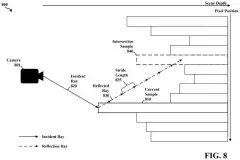
Qualcomm
Qualcomm Files Patent for Faster Reflections in Games and VR
AMD
AMD Patents a Way to Trim GPU Memory Waste in Ray-Traced Games
AMD
AMD Patents a Fix That Stops Its Graphics Hardware from Stalling Mid-Scene
AMD
No comments yet