
Qualcomm Patents an AI Vision System That Corrects Itself Without Human Oversight
Training an AI model usually requires mountains of hand-labeled data. Qualcomm's latest patent describes a system where the model labels its own images and retrains itself in real time, while it's already doing its job.
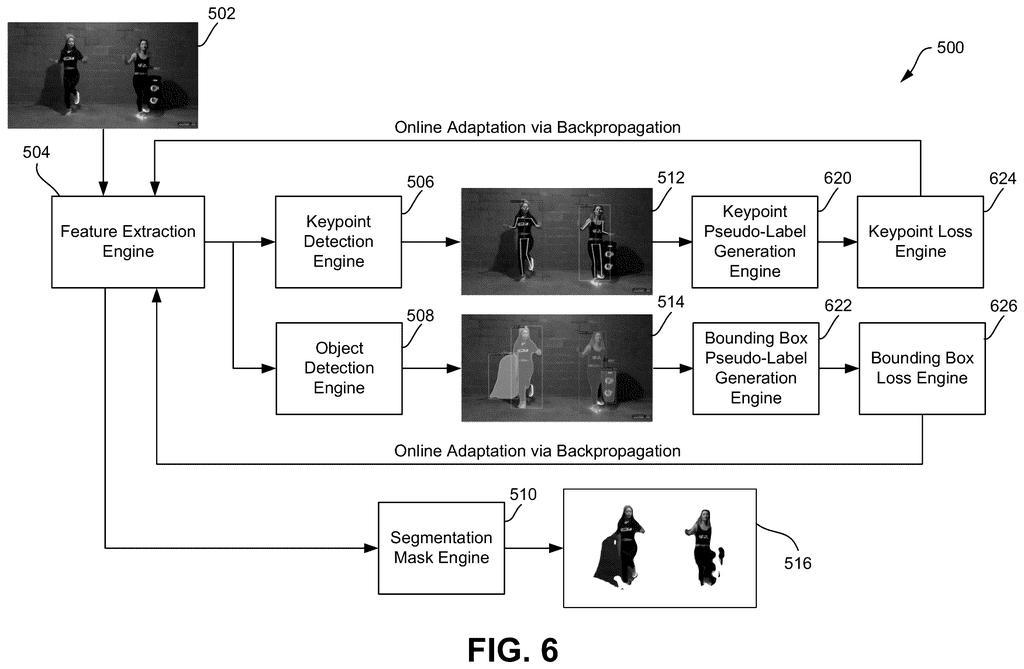
How Qualcomm's self-updating vision AI actually works
AI models that identify objects in images are trained once, then shipped. The problem is that the world keeps changing: different lighting, new environments, unfamiliar objects. When conditions drift from what the model was trained on, accuracy drops.
Qualcomm's patent describes a way for the model to keep itself up to date while it's running. Instead of waiting for engineers to collect new labeled images, the model looks at what it already found in a picture, like the rough outline of an object or the positions of key points on a body or face, and uses those as its own training targets. It then nudges its own internal settings in a direction that makes it better at those same images.
The end result is a segmentation mask: a pixel-by-pixel map that separates an object from its background. Think of it as the AI drawing a precise outline around a person, a car, or a product, and improving its ability to draw that outline without anyone telling it where the lines go.
The process may further include adapting, based on the at least one self-supervised loss, parameter(s) of the machine learning model. The process may include generating, using the machine learning model with the adapted parameter(s), a segmentation mask for the image (or another image).
Translation: The system automatically adjusts its own internal settings to improve how it identifies objects in photos.
How the model generates its own training signal on the fly
The patent describes a two-step process that runs during normal operation, not during a separate training phase.
Step one: extract signals from the current image. The model processes an image the usual way, producing two kinds of intermediate outputs:
- Keypoint estimates, predicted locations of specific points on an object, like the joints on a person's body or the corners of a face.
- Bounding region estimates, a rough box or region around the object of interest.
Step two: turn those outputs into a training signal. The system treats its own estimates as pseudo-labels (stand-ins for the hand-labeled data a human would normally provide). It calculates a self-supervised loss, a mathematical score measuring how far the model's predictions are from self-consistency, then uses that score to slightly adjust the model's internal parameters.
After those adjustments, the model produces a segmentation mask for the same or a follow-on image. A segmentation mask is essentially a stencil that classifies every pixel: this pixel is part of the object, that one is background.
The key design choice is that no external labels, no cloud round-trip, and no separate offline training pass are required. The model adapts on whatever hardware is running it, using only what it already computed.
What self-retraining AI means for on-device vision tasks
For any device that processes camera images on-chip, such as a phone, a drone, a security camera, or an XR headset, model accuracy that degrades in new environments is a real operating cost. Sending images to the cloud for retraining burns bandwidth and raises privacy questions. Shipping updated models takes weeks. A model that adjusts itself in the field sidesteps all three problems at once.
Qualcomm makes the processors that run AI inference on a large share of the world's Android phones and edge devices, so a patent in this space is a direct signal about where its chip software stack is heading. For anyone tracking how on-device AI is evolving, Patentlyze covers plain-English patent summaries across Qualcomm and the rest of Big Tech's edge-AI filings, where self-supervised adaptation is becoming a recurring theme.
This is the 21st Qualcomm filing we've tracked under AI training and infrastructure since May, joining work on merging AI models on a chip and compressing AI model data faster.
The core tradeoff here is trust: the model is being asked to learn from its own guesses. If those guesses are systematically wrong, say, because lighting conditions have pushed every prediction in a biased direction, the self-supervised signal will reinforce the error rather than correct it. That is not a small risk.
Qualcomm appears to lean on the consistency of keypoint and bounding-box geometry as a stabilizing anchor, betting that structural relationships in an image hold even when appearance shifts. That bet is defensible for well-structured objects like human bodies, but more fragile for amorphous or unfamiliar shapes where keypoints are inherently noisy.
The filing reads as a practical engineering commitment to on-device adaptation rather than a speculative research idea. Whether it survives real-world deployment without a feedback loop from ground-truth labels will be the actual test.
Get our take in your Top Stories
Liked this breakdown? Add Patentlyze as a preferred source on Google, and our plain-English take shows up more often in your Top Stories the next time Qualcomm patent news breaks.
There are more where this came from
We read every patent application Big Tech publishes and send you the ones worth knowing. Plain English, free, every week.
The drawings
12 drawing sheets from US 2026/0253396 A1 · click any drawing to enlarge


Want this weekly breakdown for a company we don't cover? Patentlyze Pro →
Be the first to weigh in