
Qualcomm
Qualcomm · AI / ML · Filed Aug 5, 2025 · USPTO published Nov 19, 2026 · This week's release
Qualcomm Patents a Phone Zoom That Uses AI on Photos and Cheaper Math on Text
Qualcomm's patent application describes a way for your phone to use AI on only the part of a zoomed screen that needs it, such as a photo, and cheap stretching for the rest.
- Publication number
- US 2026/0368850 A1(US20260368850A1)
- Applicant
- QUALCOMM Incorporated
- Filed · Published
- Aug 5, 2025 · Nov 19, 2026
- Inventors
- Nan ZHANG, Jianying DUAN, Wenkai YAO
- Status when we published
- Waiting for an examiner
- Document
- 20 claims
- US classification
- 382/100
- Parent application
- National Stage Entry of PCT/CN2023/086124 (filed Apr 4, 2023)(PCTCN2023086124)
What Qualcomm's split-screen AI zoom actually does
Every time you pinch to zoom into a web page, your phone has to make up detail that was never on the screen. Stretch it cheaply and photos turn blurry. Run AI on every pixel and your battery pays for it.
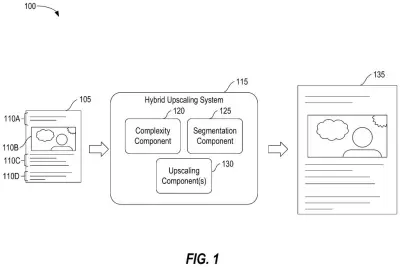
Qualcomm's patent application describes a split approach. When you zoom, the phone first checks whether the page mixes busy areas, like a photo, with plain areas, like black text on a white background. If it does, it carves the screen into regions, picks the ones you most likely care about, and gives only those the AI treatment. Everything else gets a fast, basic stretch.
If the whole screen is one big photo, or all text, there's no split at all. The phone just picks one method for the entire frame and moves on.
… classifying a first region, from the plurality of regions, as a region of interest; in response to classifying the first region as the region of interest, generating a first upscaled region, wherein generating the first upscaled region includes upscaling the first region using an upscaling machine learning model; …
Translation: The phone uses artificial intelligence to enhance only the most important parts of the picture.
How the phone decides which parts get AI
The method starts when you ask to enlarge something, such as a double tap or a pinch. The system then measures frame complexity, meaning how varied the picture on screen is. It does this with histogram analysis (a count of how many pixels fall at each brightness level) across a grid of tiles. A tile of dark text on white has a narrow, spiky histogram, while a photo has a wide, flat one.
If some tiles are complex and others are plain, the frame qualifies for hybrid treatment. The system then segments the frame into regions, using layer data, edge detection or a trained segmentation model, and scores each region as a possible region of interest. A region's score goes up when:
- It sits close to the center of the frame
- It is near where your finger zoomed
- It is itself visually complex
Regions of interest go through an upscaling machine learning model (a neural network trained to add resolution, often called a super resolution model). The remaining regions use interpolation (filling in new pixels by blending nearby ones). The results are stitched together and shown on screen.
If the frame is uniform, the system skips the segmenting step. An all-photo frame goes to the AI model, and an all-text frame goes to interpolation.
At least a second upscaled region is generated, where generating the at least the second upscaled region includes upscaling at least a second region of the plurality of regions using interpolation.
Translation: It uses faster, cheaper math for the rest of the image.
Why a zoom feature has to watch your battery
The practical point is battery life. The filing says AI upscaling gives good results but demands too much power to run across a whole phone display, while plain stretching looks poor on photos. Splitting the work aims to give you a zoom that looks sharp where you're looking without draining the phone.
The filing also notes that many apps only magnify limited content, such as the map in a navigation app. This method works on whatever frame is on the display, which could mean zoom that behaves the same across apps. The filing describes a smartphone with a neural processing unit (a chip block built for AI tasks) but names no product, and it is an application, not a granted patent.
This is the 21st Qualcomm filing we've tracked in AI photo editing since July, following one on giving AI time to think and one on mapping group photo positions.
Source: US 2026/0368850 A1 at the USPTO (PDF). Full patent text and figures are in the official publication.
Get our take in your Top Stories
Liked this breakdown? Add Patentlyze as a preferred source on Google, and our plain-English take shows up more often in your Top Stories the next time Qualcomm patent news breaks.
Add Patentlyze on Google
One click.
There are more where this came from
We read every patent application Big Tech publishes and send you the ones worth knowing. Plain English, free, every week.
The drawings · 7 sheets
7 drawing sheets from US 2026/0368850 A1 · click any drawing to enlarge


More from Qualcomm
All 637 Qualcomm patents →
More in AI / ML
All 2,738 AI / ML patents →
Google
Google Files Patent for an AI That Erases Text From Photos for Translation
Google
Google Patents an AI System That Recolors Photos Using Text Descriptions
Google
Google Patents a System That Teaches AI to Copy Text Styles in Images
Google
No comments yet