
Qualcomm
Qualcomm · AI / ML · Filed Oct 15, 2025 · USPTO published Nov 12, 2026 · This week's release
Qualcomm Files Patent for Giving AI Photo Editors a Moment to Think
Ask an AI photo editor to add a bumblebee to your flower photo, and Qualcomm says the model should plan the job first. This patent application splits your request into steps and adds built-in pauses so the AI works through them.
- Publication number
- US 2026/0360025 A1(US20260360025A1)
- Applicant
- QUALCOMM Incorporated
- Filed · Published
- Oct 15, 2025 · Nov 12, 2026
- Inventors
- Shreya Kadambi, Risheek Garrepalli, Shubhankar Mangesh Borse, Munawar Hayat, Fatih Murat Porikli
- Status when we published
- Waiting for an examiner
- Document
- 20 claims
- US classification
- 345/418
- Parent application
- Claims priority from a provisional application 63803255 (filed May 9, 2025)
What Qualcomm's step-by-step photo edit does
A photo of yellow roses in a vase sits in a phone's gallery. Its owner types one short request: put a bumblebee near one of the flowers. It sounds simple, but a good edit means placing the bee, sizing it, matching the colors, and softening the background. If you've ever asked an AI editor for several changes at once and got only some of them, you know the problem.
Qualcomm's patent application tackles it by doing the planning before the AI touches the picture. Your request gets split into a short list of separate jobs, and each job is rewritten with more detail than you gave. Then the system drops special blank markers in between the jobs. Those markers tell the image model to hold off drawing and spend extra effort working through what it has been told so far.
The hoped-for result is an edit that follows your instructions more closely.
… each of the sub-series of prompts being separated by a number of pause tokens in the series of prompt tokens, the pause tokens comprising tokens configured to cause the AI/ML model to increase a computational capacity when performing the complex revision task …
Translation: Inserting special pause tokens gives the AI model extra processing time to handle complicated photo edits.
How pause markers give the AI extra thinking time
The claims cover a method with four moves. It starts with an image and a prompt that bundles two or more sub-tasks, aimed at an AI model that does in-context image generation (a model that edits using the picture and instructions you hand it in the moment, rather than being retrained for each job).
- Split the prompt into sub-prompts, one per sub-task. The claims also allow adding steps you never spelled out.
- Turn those sub-prompts into a series of tokens (small chunks of text the model reads; the filing says a token might be about four characters).
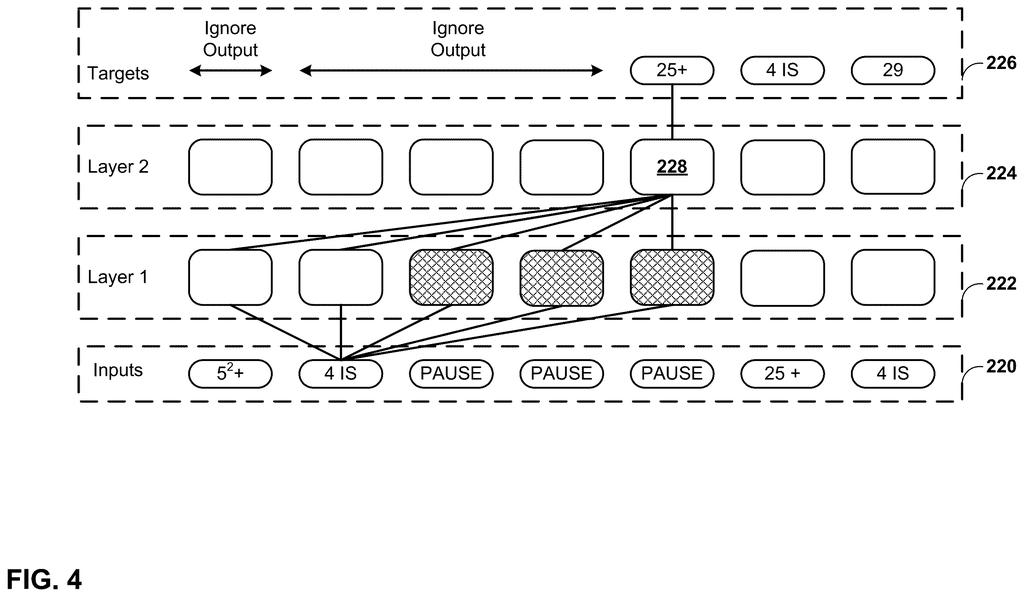
- Insert a number of pause tokens between each group of tokens.
- Send the image and the full token series to the model, which returns the revised image.
A pause token tells the model to stop producing output but keep updating its KV cache (its running memory of what it has read) and to keep refining its predictions. The filing says each pause adds attention units (the parts of the model that weigh which words matter). In its diagram, three pauses add three extra units.
A language model can do the splitting and rewriting, guided by a written instruction. The number of pauses comes from configuration data, and the description says a user can request any whole number.
… receive an image and a prompt to modify the image, the prompt representing a complex revision task including sub-tasks to be issued to an artificial intelligence/machine learning (AI/ML) model configured to perform in-context image generation …
Translation: The system takes an image and a multi-step editing instruction to send to the image generation model.
What this means for AI photo editing on phones
The practical payoff is for anyone who stacks several requests into one edit. A model that handles each step in order, with room to think between them, could land closer to what you pictured. The filing points to professional photo editing, brand imagery, filters in chat apps, camera features, gaming and extended reality.
There is a trade-off the filing admits only in passing: more internal work per edit. It gives no measurements of how much better the images get or how much slower the process becomes. For now, the interesting part is that the lever is software, a rewritten and padded request, with no new chip or camera involved.
Qualcomm's 20th application we've tracked since July in the AI photo editing race watch follows one on group photo positioning and one on faster image generation.
Source: US 2026/0360025 A1 at the USPTO (PDF). Full patent text and figures are in the official publication.
Get our take in your Top Stories
Liked this breakdown? Add Patentlyze as a preferred source on Google, and our plain-English take shows up more often in your Top Stories the next time Qualcomm patent news breaks.
Add Patentlyze on Google
One click.
There are more where this came from
We read every patent application Big Tech publishes and send you the ones worth knowing. Plain English, free, every week.
The drawings · 9 sheets
9 drawing sheets from US 2026/0360025 A1 · click any drawing to enlarge


Show the other 1 sheets

More from Qualcomm
All 624 Qualcomm patents →


More in AI image & video
All 223 AI image & video patents →
Samsung
Samsung Patents an AI That Grades Its Own Photo Edits to Get Better Over Time
Adobe
Adobe Files Patent for a Photo Editor That Suggests Fixes Based on What's in Your Picture
Samsung
Samsung Files Patent for Photo Editing That Finishes Cut-Off People You Drag Around
Adobe
No comments yet