
Qualcomm Files Patent to Shrink the Black Bar Around Your Phone Camera in Sunlight
On a sunny day, the black patch your phone draws around its camera hole stops matching the hole, and you can see the seam. Qualcomm's filing has the screen shrink that patch whenever a light sensor says it's bright out.
What Qualcomm's sunlight camera-hole fix does
Imagine you're standing outside on a bright afternoon, checking directions on your phone. Near the top of the screen is a small hole for the front camera, and around it sits a dark patch meant to blend in. In direct sun, though, the two blacks don't match. The hole reflects light one way, the patch reflects it another, and the seam jumps out at you.
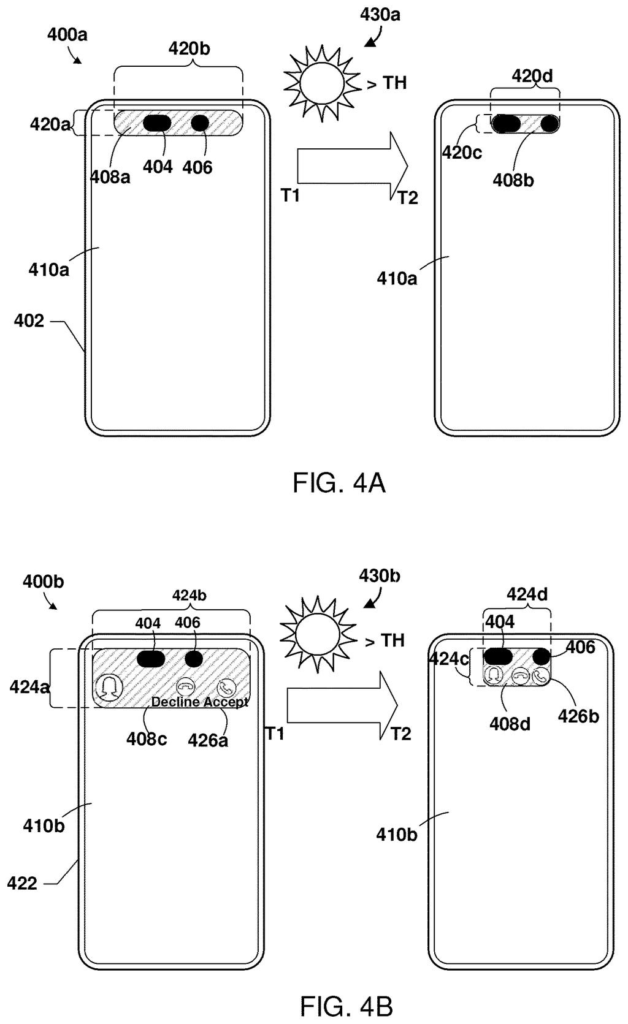
Qualcomm's patent application describes a simple fix. The phone's light sensor keeps track of how bright it is outside. Once the light passes a set level, the phone shrinks the patch until it fits the hole almost exactly, leaving less mismatched area to notice.
Anything that lives inside that patch, like a call alert or flight info, gets squeezed down and packed closer together to fit. If the light gets even brighter, the patch can shrink again.
… control the display to present a display mask region that substantially matches the display cut out in response to the intensity of ambient light meeting the ambient light threshold.
Translation: It adjusts the black border around the camera when bright light hits the phone.
How the phone resizes the mask as light changes
The core claim covers a device with a display that has a cut out (a physical gap in the screen so a camera or sensor underneath can see through), an ambient light sensor (the part that measures how bright the surroundings are), and a processor. The processor checks whether the light level meets a set threshold. When it does, the processor draws a mask region (the dark patch around the hole) that substantially matches the size and shape of the cut out.
The filing also covers the same idea as a method and in a version written with generic 'means for' wording. Several narrower claims add detail:
- The mask can depend on what the screen is showing, using a mask layer that is adjusted to fit both the cut out and the on-screen elements.
- An app can tell the system about its own on-screen elements, and the mask is generated on the fly from that information.
- With more than one threshold, the phone can show one mask size at one moment and a different one later as the light changes.
The description adds that the threshold can be fixed or can shift based on what is on screen. Items inside the patch, such as call buttons, can shrink and sit closer together, and the phone can pick the mask's color based on the light or on nearby graphics.
Why the camera hole could stop standing out
If you have ever tilted your phone to dodge glare outdoors, you know the problem: a camera hole that looks nothing like the dark patch drawn around it. Devices often hide cameras and sensors behind the screen, and this fix needs only a light sensor and software. The filing describes it running on the phone's own processor and names no specific product.
A patent application is not a product, and this one is still under review. The examiner's first look rejected the claims as filed, which is routine at this stage and usually followed by amendments. Even if the claims narrow, the basic move of shrinking the patch when the sun comes out is easy to picture on a real phone.
Qualcomm's 71st filing we've tracked in our cell phone coverage since May adds to a run that includes one on screen-synced vibration and one on detecting clogged speakers.
Every fix here costs something. Shrinking the dark patch hands the hiding job back to the camera hole itself, so anything that used to live in the patch, such as a call alert or flight tracker, has to squeeze down and sit closer together. Smaller content arrives at the very moment you are squinting at a sunlit screen.
The second cost is motion. Walk from shade to sun and back, and a patch that resizes with the light could draw more attention than the mismatch it was built to hide. The filing describes several brightness levels, each with its own smaller patch, which leaves room for gentle steps, but it says little about calming the changes when the light hovers near a cutoff.
Still, the trade looks worth it. A slightly smaller notification area is a small price for a camera hole that stops glaring at you outdoors, and the idea needs no new hardware, only a sensor phones already carry.
Get our take in your Top Stories
Liked this breakdown? Add Patentlyze as a preferred source on Google, and our plain-English take shows up more often in your Top Stories the next time Qualcomm patent news breaks.
There are more where this came from
We read every patent application Big Tech publishes and send you the ones worth knowing. Plain English, free, every week.
The drawings
11 drawing sheets from US 2026/0349636 A1 · click any drawing to enlarge


Show the other 3 sheets


Want this weekly breakdown for a company we don't cover? Patentlyze Pro →
Be the first to weigh in