
Qualcomm
Qualcomm · AI / ML · Filed May 16, 2025 · USPTO published Nov 19, 2026 · This week's release
Qualcomm Files Patent for Splitting One AI Model Across Several Phones and Laptops
Qualcomm's filing describes a way for several devices to share one AI model, switching how they divide the work between reading your question and writing the answer.
- Publication number
- US 2026/0368486 A1(US20260368486A1)
- Applicant
- QUALCOMM Incorporated
- Filed · Published
- May 16, 2025 · Nov 19, 2026
- Inventors
- Qi XUE, Abhijit NAVALEKAR
- Status when we published
- Waiting for an examiner
- Document
- 20 claims
- US classification
- 706/15
What Qualcomm's device-sharing AI patent does
You're pasting a long document into an AI assistant on your phone and asking for a summary. Then you wait, because a model that big strains one phone's memory, battery and processing power.
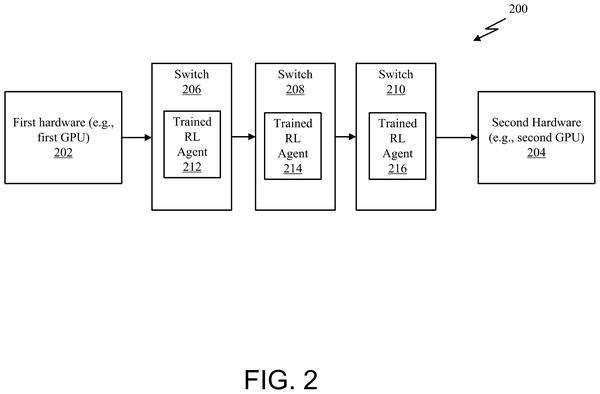
Qualcomm's patent describes spreading that work across several devices, such as phones, tablets or laptops, and changing how the work is divided partway through. Reading your question goes fastest when each device takes a stretch of the model, like stations on an assembly line. Writing the answer goes fastest when every device takes a slice of every step and they all work at once.
A built-in speed chart tells the system which method to use at each stage, and how many devices to bring in.
determine to process an input embedding to generate key-value pairs using a pipeline parallelization mode of the apparatus; process the input embedding to generate the key-value pairs based on the pipeline parallelization mode of the apparatus …
Translation: The device figures out how to break down the AI task and starts processing the first part of the workload.
How the work switches between two splitting modes
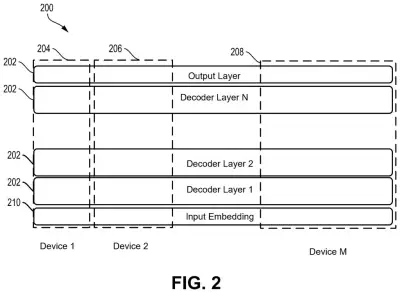
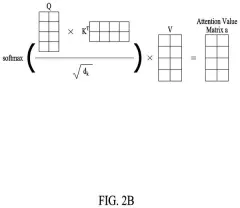
The patent covers a device that runs an AI language model in two stages and shares the work differently in each. First, the model reads your prompt and saves key-value pairs, notes about your question that it can reuse so it doesn't reread everything for each new word. The filing calls this the prefill stage.
For that stage it uses pipeline parallelism: the model's layers are divided into groups and each device runs one group, like stations on an assembly line. The filing's example has three devices with ten layers each. To write the answer, it switches to tensor parallelism: every device holds a slice of each layer, and they combine partial results after every layer. The example uses two devices here, and the saved notes move between their caches while other work continues.
The choice rests on numbers. For the first stage, the device compares token latency (the wait until the first piece of the answer appears) and picks the lower. For the writing stage, it compares decode rate (how fast new pieces come out) and picks the higher. Both come from a lookup table that factors in link speed between devices, prompt size, device count and the expected size of the saved notes.
What this means for AI on phones and laptops
The practical idea is that a few devices working together could run an AI model too big for any one of them. The filing's background describes exactly that limit on portable electronics: power, memory and processing. It also offers a way to share the load that does not depend only on cloud servers, though the filing lists servers among the devices that could take part.
For you, the payoff would be a shorter wait before an answer starts and faster writing once it does. The filing describes the speed chart and the switching logic but gives no real timing figures, so how much faster this would be is unknown.
That makes this Qualcomm's 69th filing we've tracked since July in the AI chip wars, adding to work like the chatbot memory shortcut and skipping conversation reruns.
Source: US 2026/0368486 A1 at the USPTO (PDF). Full patent text and figures are in the official publication.
Get our take in your Top Stories
Liked this breakdown? Add Patentlyze as a preferred source on Google, and our plain-English take shows up more often in your Top Stories the next time Qualcomm patent news breaks.
Add Patentlyze on Google
One click.
There are more where this came from
We read every patent application Big Tech publishes and send you the ones worth knowing. Plain English, free, every week.
The drawings · 15 sheets
15 drawing sheets from US 2026/0368486 A1 · click any drawing to enlarge


Show the other 7 sheets


More from Qualcomm
All 637 Qualcomm patents →
More in AI / ML
All 2,738 AI / ML patents →
Nvidia
Nvidia Files Patent to Shrink Large AI Language Models Without Breaking Them
Google
Google's New Patent Covers a Shortcut That Helps AI Text Tools Run Faster
Microsoft
Microsoft Patents a System That Sends AI Requests to Models Based on Answer Length
Samsung
No comments yet