
Qualcomm
Qualcomm · AI / ML · Filed Dec 16, 2025 · USPTO published Nov 19, 2026 · This week's release
Qualcomm Files Patent for AI That Links Far-Apart Pieces of a Photo
Qualcomm describes a way to organize the pieces of a photo into a layered tree, so far-apart parts can still influence each other without checking every pair.
- Publication number
- US 2026/0368548 A1(US20260368548A1)
- Applicant
- QUALCOMM Incorporated
- Filed · Published
- Dec 16, 2025 · Nov 19, 2026
- Inventors
- Evgenii EGOROV, Hanno ACKERMANN, Markus NAGEL, Hong CAI
- Status when we published
- Waiting for an examiner
- Document
- 27 claims
- US classification
- 706/61
- Parent application
- Claims priority from a provisional application 63806157 (filed May 15, 2025)
What Qualcomm's tree-shaped AI patent actually does
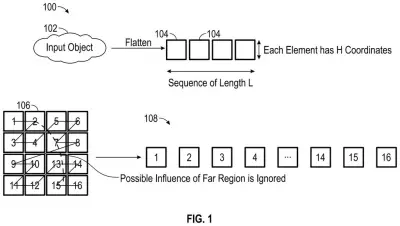
Some AI models handle a photo by flattening it into one long line of pieces and reading them in order, like words in a sentence. The catch: two pieces that influence each other can land far apart in that line, and the connection gets lost.
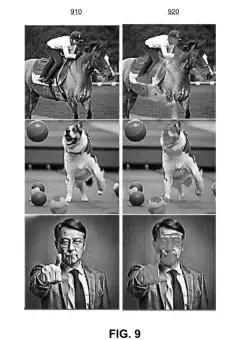
Qualcomm's filing adds a tree on top of that line. Small groups of pieces feed into a group node, groups of groups feed into a bigger node, all the way up to one top node. Information travels up the tree and then back down, so the first piece in the line can still affect the last one.
The other way to catch those links is to compare every piece with every other piece, which gets expensive fast. The tree aims to get long-range context without that cost.
… effectively matrix multiply an inverse of the tree matrix with the sequence of tensors to generate state variables according to a state space model …
Translation: It combines hierarchical data structures with math models to track relationships across the image.
How the tree carries context up and back down
The system starts by scanning an input, such as an image or a 3D point cloud (a cloud of measured points in space), into a sequence of tensors (bundles of numbers describing each piece). Flattening like this loses relationships between pieces that end up far apart in the sequence.
To restore them, the filing builds a tree with at least two levels. The bottom level holds the pieces. Higher levels hold either virtual nodes (stand-in nodes that summarize a group) or existing pieces promoted to parent roles. Each node carries four things:
- A self-term (how it relates to itself)
- A child-to-parent term
- A parent-to-child term
- Its own input features
These terms form a tree matrix, a grid of numbers that is mostly empty (sparse). The system multiplies the inverse of that grid with the sequence to get the state variables (the model's running summary of what it has seen). The inverse is dense, so every piece can influence every other, but it is applied in two passes: leaves to root, then root back to leaves.
The result can feed another machine learning model, and the system then acts, for example by detecting objects, classifying them, or recognizing faces.
Why cheaper long-range context matters for phones
If your phone tags objects in your photos or recognizes faces, models like this sit behind it. The filing names those tasks, plus generating text replies, and describes running on devices such as a smartphone with a dedicated AI chip (an NPU).
The appeal is cost. The filing says comparing every piece with every other piece grows expensive quickly, and it describes a coarse version of the tree that works on groups of pieces to cut computing and memory demands. The patent gives no speed or accuracy numbers, so how much it saves is an open question. Qualcomm makes phone chips, so efficiency gains like this are a natural interest.
This is the 12th Qualcomm filing we've tracked in our AI image and video coverage since May, adding to earlier work like one on shrinking AI generators for phones and one on giving photo editors time to think.
Source: US 2026/0368548 A1 at the USPTO (PDF). Full patent text and figures are in the official publication.
Get our take in your Top Stories
Liked this breakdown? Add Patentlyze as a preferred source on Google, and our plain-English take shows up more often in your Top Stories the next time Qualcomm patent news breaks.
Add Patentlyze on Google
One click.
There are more where this came from
We read every patent application Big Tech publishes and send you the ones worth knowing. Plain English, free, every week.
The drawings · 16 sheets
16 drawing sheets from US 2026/0368548 A1 · click any drawing to enlarge


Show the other 8 sheets


More from Qualcomm
All 637 Qualcomm patents →
More in AI image & video
All 226 AI image & video patents →
Nvidia
Nvidia Patents a Fix for Digital Faces That Can't Keep Up With Fast Talkers
Adobe
Adobe Files Patent for an AI Judge That Grades Photos and Graphic Designs Differently
Salesforce
Salesforce Patents an AI Video Maker That Follows Your Company's Brand Rules
Samsung
No comments yet