
Adobe
Adobe · AI / ML · Filed May 8, 2025 · USPTO published Nov 12, 2026 · This week's release
Adobe Files Patent for an AI Judge That Grades Photos and Graphic Designs Differently
Adobe's patent application gives an AI image judge a panel of experts and a way to decide whose opinion counts most for each picture.
- Publication number
- US 2026/0359961 A1(US20260359961A1)
- Applicant
- ADOBE INC.
- Filed · Published
- May 8, 2025 · Nov 12, 2026
- Inventors
- Eric Slyman, Gahye Park, Kushal Kafle, Xiaoyang Li
- Status when we published
- Examiner raised objections; the company can respond
- Document
- 20 claims
- US classification
- 382/159
- Examiner
- ALAVI, AMIR (Art Unit 2668)
What Adobe's AI image judge actually does
Ever asked two friends which of two pictures looks better and gotten different answers? A photographer and a graphic designer judge by different standards, so the 'right' opinion depends on who you ask and what you're looking at.
Adobe's patent applies that idea to AI that rates images. Instead of grading a picture with one fixed set of instructions, the system keeps several, such as 'you are a graphic designer' and 'you are a landscape artist.' It then checks what kind of picture it is looking at, a sunset photo or a poster-style illustration, and leans harder on the expert who fits.
If a picture looks mostly like a landscape photo, the landscape artist's opinion counts for more. If it falls in between, the system blends the opinions. The AI model itself doesn't change. Only how much each opinion counts does.
… generating, using a multi-modal language model, evaluation data for the input image by performing a group-specific weighted sum and a cross-group weighted sum based on the group-assignment value.
Translation: An AI grades the picture by calculating scores within and across different categories.
How the judge blends expert opinions per image
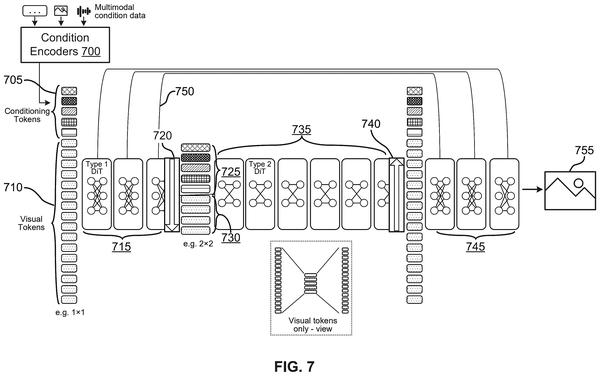
The system starts with an image and a set of evaluation prompts, which are written instructions for an AI model that understands both pictures and text (a multi-modal language model). One prompt might say 'You are a graphic designer' and another 'You are a landscape artist,' each ending with a question such as which of two images the judge prefers.
Before it sees your image, the system sorts a pile of sample images into clusters, such as landscape photos and graphic design, using a standard grouping method called k-means. Each cluster gets its own set of weights (numbers between 0 and 1 that add up to 1) saying how much to trust each prompt. In the filing's example, graphic design images give one prompt 0.8 and the other 0.2, while landscape photos flip it to 0.3 and 0.7.
Then, for a new image:
- Match the image to groups. The picture is compared to each cluster using image embeddings (numeric fingerprints of what a picture looks like), which gives a probability for each group. A Niagara Falls photo might get 0.05 for graphic design and 0.95 for landscape.
- Score within each group. The AI judge answers every prompt, and those answers are blended using that group's weights.
- Blend across groups. Each group's blended score is multiplied by the image's group probability and added up, giving a final chance of an outcome like 'preferred.'
The weights are trained on images that human annotators have labeled, while the language model itself stays frozen.
An image processing model generates a first group-assignment value and a second group-assignment value for the input image corresponding to the first group and the second group, respectively.
Translation: The system figures out how well the picture fits into different distinct styles.
Why picking the right AI critic matters for Adobe
Training an image generator takes enormous piles of pictures, and somebody has to decide which ones are good. The filing describes using this judge to pick preferred images for the training sets of other image generation models. A judge that adjusts to whether it is looking at a photo or a poster could make those picks less lopsided, and the filing says the weights are tuned without retraining the language model.
You would not see this directly. If it works as described, the effect would show up indirectly, in the quality of the images AI tools produce. The filing says experiments showed better performance than conventional systems but gives no numbers in the text. The examiner's first review rejected the claims as filed, which is routine at this stage.
Adobe's eighth filing we've tracked since July in our AI models working in teams adds to a pattern that includes two AIs editing video and a pre-search proofreader.
Source: US 2026/0359961 A1 at the USPTO (PDF). Full patent text and figures are in the official publication.
Get our take in your Top Stories
Liked this breakdown? Add Patentlyze as a preferred source on Google, and our plain-English take shows up more often in your Top Stories the next time Adobe patent news breaks.
Add Patentlyze on Google
One click.
There are more where this came from
We read every patent application Big Tech publishes and send you the ones worth knowing. Plain English, free, every week.
The drawings · 19 sheets
19 drawing sheets from US 2026/0359961 A1 · click any drawing to enlarge


Show the other 11 sheets


More from Adobe
All 264 Adobe patents →
More in AI image & video
All 223 AI image & video patents →
Google
Google Patents a Two-Model AI System That Grades Its Own Image Drafts
Google
Google Files Patent for an Image AI That Sends Each Photo Piece to a Specialist
Samsung
Samsung Patents a Three-AI System That Builds, Titles, and Illustrates Content Lists Automatically
Samsung
No comments yet