
Salesforce
Salesforce · AI / ML · Filed Sep 5, 2025 · USPTO published Nov 19, 2026 · This week's release
Salesforce Files Patent for AI Assistants That Think Within a Set Budget
Ask an AI reasoning model what five times four is, and most of its answer can be spent thinking out loud. Salesforce's patent application describes a way to train these models to think inside a fixed limit and still land on the right answer.
- Publication number
- US 2026/0368539 A1(US20260368539A1)
- Applicant
- Salesforce, Inc.
- Filed · Published
- Sep 5, 2025 · Nov 19, 2026
- Inventors
- Yuhui Xu, Hanze Dong, Lei Wang, Doyen Sahoo, Junnan Li, Caiming Xiong
- Status when we published
- Waiting for an examiner
- Document
- 20 claims
- US classification
- 706/15
- Parent application
- Claims priority from a provisional application 63804902 (filed May 13, 2025)
What Salesforce's thinking-budget AI actually does
Today's AI reasoning models like to think out loud, and they don't know when to stop. For a question as simple as 'how much is five times four?', the filing says the thinking part can take up roughly 90% of everything the AI writes. If you are billed by the amount of text the AI produces, that rambling gets expensive fast.
Salesforce's fix is to train the AI with a thinking budget. During practice, the AI gets a fixed amount of room to think and a separate fixed amount to give its final answer. If it runs out of thinking room, it is cut off mid-thought and still has to answer. It earns a reward only when the answer is right.
The result is an AI that learns to put its best ideas first, so you can later tell it how much thinking you are willing to pay for.
… generating, by a first neural network based language model, a training output including a reasoning portion subject to a first generative budget and a solution portion that results from the reasoning portion subject to a second generative budget …
Translation: The AI separates its thinking process from its final answer, giving each part a strict limit on how much it can write.
How the AI learns to answer from unfinished thoughts
The patent describes a training recipe for a reasoning language model (an AI that writes out step-by-step thinking before giving a final answer). The model gets a practice question with a known correct answer. It produces a thinking section limited by a first budget and a solution section limited by a second budget. Budgets can be counted in tokens (small chunks of text), processor cycles, memory or time.
- A second language model grades the solution against the known answer and hands out a reward.
- The first model's settings are adjusted to make rewarded behavior more likely, using reinforcement learning (learning by trial and reward). One described version uses a method called GRPO, which compares several attempts at the same question against each other.
- If the thinking runs out of room, the system forcibly inserts a special end-of-thinking marker so the model has to answer anyway.
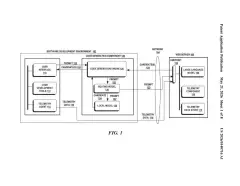
In the example setup, both budgets were 1,000 tokens, and the practice questions were math or code problems. Once trained, the model can work to a budget set by the user, and the claims cover building the AI agent on a server using that model.
In the company's own tests, the trained models used about 32.1% less text on one math benchmark and 37.4% less on a coding benchmark with no limit set, with accuracy mostly holding up.
iteratively refining the training output while maintaining the training output under a total generative budget …
Translation: The system repeatedly practices and improves its work while strictly staying under a total resource limit.
Why a thinking cap matters for AI customer service
If you have waited for a chatbot to finish 'thinking' before it answers, or your company pays for every word an AI generates, this is aimed at you. A model that can be told how much to think could answer easy questions fast and spend more effort only on hard ones. The filing points to customer service, IT troubleshooting, healthcare questions and coding help as places where cost and speed matter.
The detail that stands out is where the limit lives: inside the training itself. The filing says simply chopping off an AI's output often leaves no usable answer. Training the model to answer from an unfinished thought means a tight limit costs less accuracy. The company also reports that a model trained with a 1,000-token limit handled other limits without any extra training.
This is the 38th Salesforce filing in our AI assistant & agent coverage since May, following one on chatbot memory shrinking old topics and one on learning from flawed web examples.
Source: US 2026/0368539 A1 at the USPTO (PDF). Full patent text and figures are in the official publication.
Get our take in your Top Stories
Liked this breakdown? Add Patentlyze as a preferred source on Google, and our plain-English take shows up more often in your Top Stories the next time Salesforce patent news breaks.
Add Patentlyze on Google
One click.
There are more where this came from
We read every patent application Big Tech publishes and send you the ones worth knowing. Plain English, free, every week.
The drawings · 15 sheets
15 drawing sheets from US 2026/0368539 A1 · click any drawing to enlarge


Show the other 7 sheets


More from Salesforce
All 110 Salesforce patents →
More in AI assistant & agent
All 436 AI assistant & agent patents →
Google
Google Files Patent for a Slider That Dials Your AI Chatbot Between Budget and Luxury
IBM
IBM's New Patent Covers a Chatbot That Spins Up New AI Assistants Mid-Conversation
Microsoft
Microsoft Files Patent for Labels That Tell AI Assistants What Each Website Button Does
Microsoft
No comments yet