
Samsung Patents a Way to Turn Nearby Devices Into Automatic Wi-Fi Extenders
Your laptop has a great Wi-Fi signal. Your smart TV in the next room barely connects. Samsung has filed a patent that would let the laptop become a Wi-Fi relay for the TV, automatically, without you touching a setting.
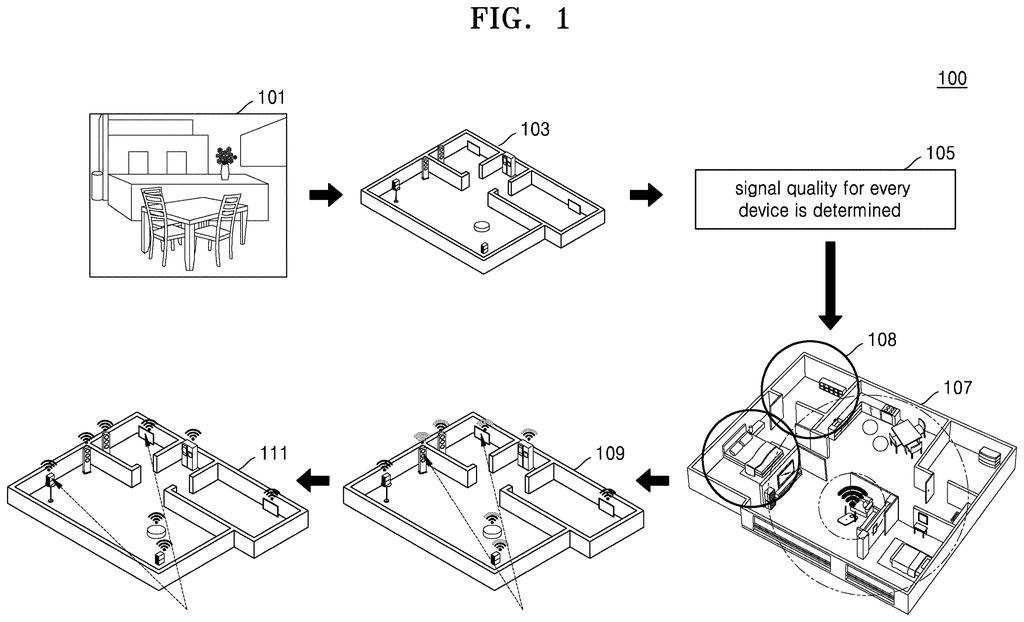
How Samsung's dead-zone fix actually works for you
Most homes have Wi-Fi dead zones: a corner bedroom, a basement room, or a spot behind a thick wall where the signal just dies. Today, fixing that usually means buying a dedicated Wi-Fi extender, plugging it in, and configuring it yourself.
Samsung's patent describes a system that skips all of that. It maps your home by measuring signal strength at each connected device. When it finds a device with a weak connection, it draws a virtual boundary around that trouble spot, then looks for nearby devices that do have a strong signal. The system then picks the best candidate from those strong-signal devices and switches it into extender mode, relaying the router's signal toward the weak device.
The key idea is that you probably already own devices that could be doing this job. Your phone, smart speaker, or another connected gadget sitting near the dead zone could become a temporary bridge, and the system would handle that decision for you.
… identifying, based on the determined signal quality, the one or more device parameters, and one or more area parameters, boundary coordinates of one or more sub-areas around one or more weak strength devices, among the one or more devices, having a first Wi-Fi signal strength that is less than a predefined threshold signal strength; …
Translation: The system maps out dead zones where devices are struggling to get a decent signal.
How the system maps weak spots and recruits signal helpers
The patent describes a three-stage process that runs on a central controller, likely a router or a hub, scanning the user's environment.
- Signal mapping: The system polls each connected device for its Wi-Fi signal strength and logs device parameters like location and hardware capability. It builds a picture of which areas have good coverage and which don't.
- Boundary identification: For any device falling below a set signal threshold (what the patent calls a "weak strength device"), the system draws boundary coordinates around that weak-signal zone, essentially marking the edges of the problem area.
- Candidate selection and activation: The system scans for devices sitting just outside those boundaries that have strong signals. It then filters those candidates based on "extender parameters" (things like available processing power, battery level, and network capability) and enables the best pick to operate as a Wi-Fi extender, relaying the signal into the weak zone.
The selection step is important because not every device nearby is a good relay candidate. A phone on low battery, for example, might be deprioritized in favor of a plugged-in smart display. The system is designed to make that call without user input.
… detecting one or more strong strength devices located in the proximity of the identified boundary coordinates of the one or more sub-areas, identifying one or more candidate strong strength devices from the detected one or more strong strength devices and enabling the identified one or more candidate strong-strength devices to operate as the one or more Wi-Fi extenders
Translation: It finds nearby devices with good connections and recruits them to act as boosters.
What this means for households with patchy Wi-Fi
If this works as described, the payoff is that dead zones get fixed before you notice them, using hardware you already own. You would not need to buy a mesh Wi-Fi kit or a dedicated range extender. The system just reassigns devices to cover the gap.
The practical limit is that most devices are not designed to simultaneously serve their own apps and relay Wi-Fi for others. Performance trade-offs are real, and the patent's filtering step acknowledges that not every device is a good fit. Whether Samsung can make this work without noticeably slowing down the devices pressed into relay duty is the engineering challenge this filing doesn't fully answer.
That makes this Samsung's 1244th filing in our Samsung coverage since May, a run that includes a look at a slimmer camera module and a self-connecting housing.
Dead zones in a home have one reliable fix today: buy a new device, plug it in, hope you positioned it correctly. This patent describes a different approach, where your existing gadgets step in automatically to carry the wireless signal further without you doing anything at all.
The moment you would feel this working is exactly when you normally feel the frustration: a video call dropping as you walk to the kitchen, music cutting out in the bedroom, a thermostat that stops responding. The system is specifically designed to find devices near those weak spots that are strong enough to help without slowing down themselves, which separates this from simply overwhelming your network with extra traffic.
For anyone already running a mix of Samsung phones, televisions, and speakers at home, the concrete promise is fewer dead zones without a hardware purchase or a settings menu.
There are more where this came from
We read every patent application Big Tech publishes and send you the ones worth knowing. Plain English, free, every week.
The drawings
10 drawing sheets from US 2026/0281749 A1 · click any drawing to enlarge


Want this weekly breakdown for a company we don't cover? Patentlyze Pro →