
Samsung
Samsung · AI / ML · Filed Jul 1, 2026 · USPTO published Nov 19, 2026 · This week's release
Samsung Files Patent for a Camera That Fixes Colors by Recognizing the Sky and Plants
Your phone camera usually fixes colors by guessing what the light looks like. Samsung's filing adds a second opinion: an AI that knows where the sky, plants and skin are in the shot.
- Publication number
- US 2026/0370770 A1(US20260370770A1)
- Applicant
- SAMSUNG ELECTRONICS CO., LTD.
- Filed · Published
- Jul 1, 2026 · Nov 19, 2026
- Inventors
- Jinkeun SEOK, Seungwan SHON, Saetek OH
- Status when we published
- Waiting for an examiner
- Document
- 20 claims
- US classification
- 382/167
- Parent application
- Continuation of PCT/KR2024/097167 (filed Dec 19, 2024)(PCTKR2024097167)
What Samsung's subject-aware white balance does
Imagine you snap a sunset over a field. Your phone has to decide what color the light is, and it can get fooled: a patch of gray-looking sky might get "corrected" until the warm glow you actually saw is washed out.
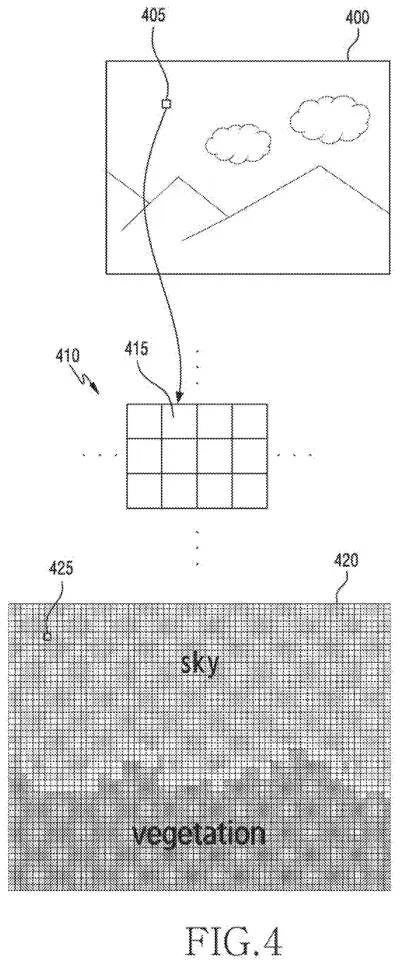
Samsung's filing describes a fix. The camera chops the photo into a grid of small blocks and labels each one by color, such as gray or green. Then an AI model produces a map of what is really in each part of the picture: sky, plant, skin, hair, clothing, pet or background. Where the two labels disagree, the AI's map wins.
With better labels, the phone adjusts colors more sensibly. Sunsets can keep their yellows and reds, and leaves can stay leafy green. If you need a quick shot, the phone can skip the AI step to save time.
… a neural network model trained through machine learning to output a category map comprising category information for classifying types of subjects corresponding to a plurality of regions of an input image …
Translation: An AI system labels different parts of a photo to figure out what subjects are in each area.
How Samsung's camera relabels blocks of a photo
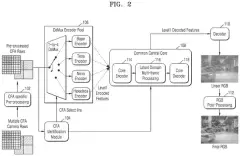
The patent covers an electronic device with a camera, a processor and a neural network model (software trained on labeled example images). The model takes a photo and outputs a category map, a layout that says which type of subject appears in each region.
Separately, the device divides the image into blocks and labels each block by color. The filing's example is a block that looks gray, so it is first treated as a gray region. If the category map says that region is sky, the label is changed to a light blue region.
Those updated labels then drive the color fix. The claims and description cover two main adjustments:
- Auto white balance (AWB): adjusting the red, green and blue levels so colors look the way your eyes saw them under that light.
- Color correction matrix: a set of numbers that converts the sensor's raw color readings into more accurate colors.
The description adds details. The AI map can be finer than the block grid (256 by 192 regions versus 64 by 48 blocks), so each block takes the most common category among the map regions that fall inside it. The device also counts how many blocks belong to a subject and how many are a certain color, then uses the ratio to pick between two sets of corrections, or blend them. For speed-priority shots, the update step can be skipped.
… determine object category information for classifying a plurality of blocks of an image captured through the camera, update the object category information, based on a category map for the image, and correct color information for the image, based on the updated object category information.
Translation: The device figures out what is in different parts of a photo and uses that map to fix the colors.
Why this matters for Samsung phone photos
If you take photos on a phone, color is where cameras often disappoint: skies look flat, skin looks off, grass turns odd shades under strange light. Teaching the camera what is in the frame, not just what the light looks like, targets those complaints directly.
The filing mentions a sunset as its example, where it would push yellows and reds in the sky region. It also builds in a speed option, which matters for burst shots and live preview where waiting on extra AI work would slow things down. The filing describes the AI running on a phone's neural processing chip or on an external device.
This is the 177th Samsung filing we've tracked in our camera sensor push watchlist since May, adding to work like per-color photo processing and group shot expression blending.
Source: US 2026/0370770 A1 at the USPTO (PDF). Full patent text and figures are in the official publication.
Get our take in your Top Stories
Liked this breakdown? Add Patentlyze as a preferred source on Google, and our plain-English take shows up more often in your Top Stories the next time Samsung patent news breaks.
Add Patentlyze on Google
One click.
There are more where this came from
We read every patent application Big Tech publishes and send you the ones worth knowing. Plain English, free, every week.
The drawings · 8 sheets
8 drawing sheets from US 2026/0370770 A1 · click any drawing to enlarge


More from Samsung
All 1,662 Samsung patents →
More in AI vision
All 351 AI vision patents →
Samsung
Samsung Patents a Real-Time Video System That Labels Every Pixel Across Frames
Microsoft
Microsoft Files Patent to Help Phones and Robots Tell Where They Are From Video
Adobe
Adobe Files Patent for AI Videos That Run Longer Without Losing the Plot
Adobe
No comments yet