
Samsung Files Patent to Stop Phone Cameras From Reading Stacked Words as Gibberish
Samsung's filing teaches a phone camera to read a sign every which way, then keep only the reading that is an actual word.
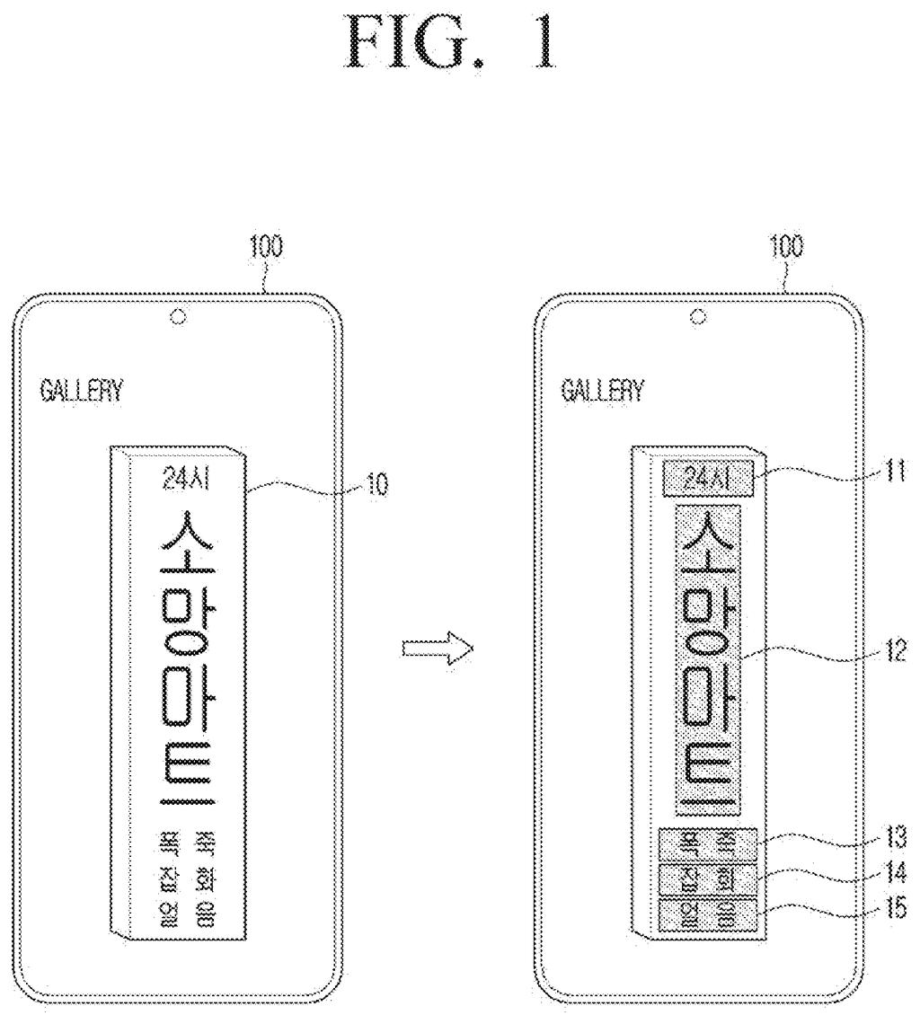
What Samsung's word-checking camera actually does
Every time you point your phone at a shop sign to translate it, the camera has to decide where one word ends and the next begins. Usually that works. When a sign stacks words in a column or tucks them side by side, the phone can read across when it should read down, and hand you gibberish.
Samsung's patent application describes a fix that checks the answer against real life. The phone sorts letters into groups by size, font and color, then tries reading each group in several directions: across, down and diagonally. Each guess gets looked up in a big list of words that many people actually use.
A guess nobody uses gets thrown out, and a common word wins. In the filing's own example, Sale stacked over Rent could be misread as SR, AE, Ln and ET, and the word list is what steers the phone back to the right pair.
group characters included in the input image into at least one box based on characteristics of each character; connect adjacent characters included in the at least one box in a plurality of directions to form a plurality of character strings; …
Translation: The phone groups text from a photo into boxes and connects the letters in multiple directions to find possible words.
How the phone tries every reading direction
The system starts with an image: a saved photo, a downloaded picture, or the live view through a phone camera. It splits the text into single characters, then groups them into boxes (virtual regions around text) when their font, size or color falls in a similar range and they sit next to each other.
Next comes the step the claims center on. Inside each box, the processor links neighboring characters in more than one direction (the filing names horizontal, vertical and diagonal) to build several candidate character strings, meaning possible words. Each candidate is looked up in a word database, a list of words used by many people, and the one whose frequency of use passes a threshold gets extracted.
When letters land in separate boxes, the filing describes judging whether the boxes belong together using three signals:
- How similar the boxes are in size
- How close together they are
- How much they overlap when slid on top of each other (called Projection IOU, a measure of shared area)
One string can also hold several words run together with no spaces, and the system picks out each one that clears the threshold. The database can live on the phone or on a server, such as one built from social network posts. Extracted words can feed a web search, or a translation shown in the same direction as the original text.
… identify a frequency of use for each of the plurality of character strings based on a word database including words used by a plurality of users, and extract one of the plurality of character strings according to the frequency of use.
Translation: It compares the potential words against a database of common human language to pick the most likely correct one.
Why sign translation could stop reading gibberish
If you use your camera to translate a menu or search a product label, you have probably met the failure this targets: a sign comes back as nonsense. The filing's examples are shop signs where words stack in columns or run in different directions, and a reader that only looks at which letters sit nearby pairs the wrong neighbors. A check against real vocabulary gives the phone a way to catch its own mistake.
The idea also reaches past phones. The filing lists TVs, kiosks, tablets and servers as possible devices, and says the word list could be updated from a web portal. The text offers no accuracy numbers, so how much it improves reading is unknown. The logic is easy to follow, though: a guess that no one ever writes gets rejected.
That makes this Samsung's 163rd filing we've tracked since May in our camera sensor push watchlist, building on earlier applications like one cutting video file size and one stripping patch color averages.
Nothing here needs new hardware. The filing describes a phone with a camera, a screen and a connection to a word list, and every current smartphone has all three. The work is software: sort letters into groups, try several reading directions, and look up each guess.
The piece that has to exist first is the word list. The filing says it can sit on the phone or on a server, built from words people post on social networks and web pages, and a list that goes stale would reject new brand names and slang. Keeping it fresh is the real engineering chore.
The shortest route to a product is a small update to a camera search or translation feature, since the filing itself names those two uses. You would only notice it when it prevents a mistake. That makes this a short road with a modest payoff, and with no test results in the text, the size of the improvement stays unproven.
Get our take in your Top Stories
Liked this breakdown? Add Patentlyze as a preferred source on Google, and our plain-English take shows up more often in your Top Stories the next time Samsung patent news breaks.
There are more where this came from
We read every patent application Big Tech publishes and send you the ones worth knowing. Plain English, free, every week.
The drawings
14 drawing sheets from US 2026/0341064 A1 · click any drawing to enlarge


Show the other 6 sheets


Want this weekly breakdown for a company we don't cover? Patentlyze Pro →
Be the first to weigh in