
Sony Files Patent for Fine-Tuning Cameras That Have No Lens
A camera with no lens has to rebuild its pictures with math, and that math only works if the software knows exactly where every part sits. Sony's filing describes a test setup that checks each camera against small lights placed at several distances.
What Sony's lens-free camera fix actually does
Today, a camera without a lens works by letting light pass through a patterned mask onto the sensor, which produces a blurry jumble that software then has to unscramble. That software needs an exact map of how the mask and sensor sit relative to each other, and no two cameras come out of manufacturing perfectly identical.
Sony's filing describes a way to fix that for each individual camera. A small test light, narrowed by a slit, is placed at several known distances, and the camera photographs each one. Software then compares those photos with computer-made versions, picks the closest match, and works out how far the camera's parts are off. The result is a small correction saved inside the camera.
Why more than one distance? Because the unscrambling recipe changes depending on how far away your subject is, so each distance gets its own correction.
… a mask configured to modulate an incident light ray from a subject, an imaging element configured to image the incident light ray modulated by the mask and generate an observation image …
Translation: A pattern blocks incoming light onto a sensor instead of using a traditional glass lens.
How the test lights tune each camera's math
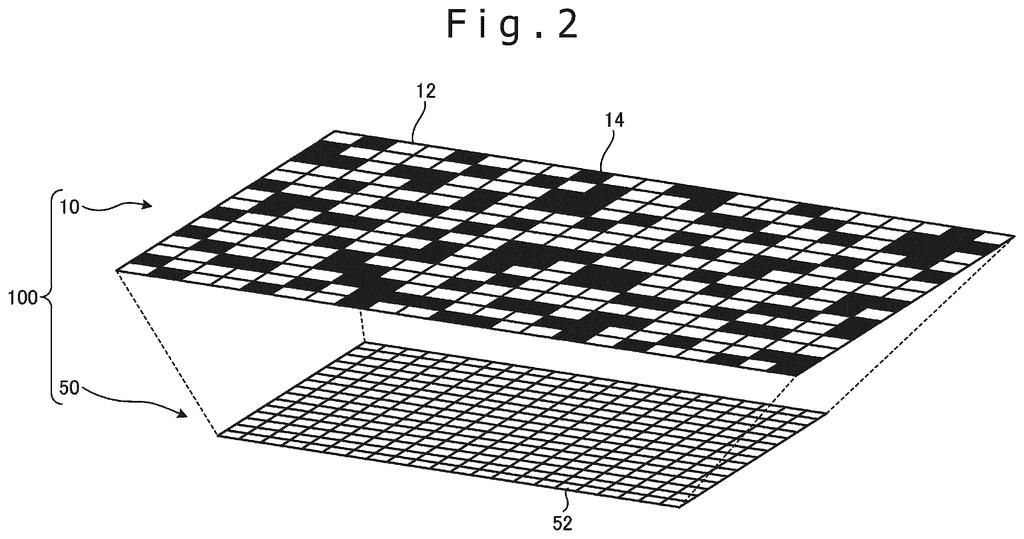
A camera with no lens still has to form a picture. Sony's version puts a patterned mask (a sheet with clear and blocked spots) over the sensor, so each pixel receives a jumble of light. Software reverses the jumble using restoration information, which the description ties to a point spread function (a recipe for how a single dot of light smears across the sensor). A separate recipe is kept for each distance to the subject.
The patent covers a correction device that tunes those recipes. Two parts do the work:
- A correction control unit makes the camera photograph test lights, one placed for each of the chosen distances.
- A calculation unit compares each test photo with computer-simulated versions made by nudging settings such as the mask position, picks the closest one, and saves a correction value, for example a shift left, right, up or down.
The test light is an LED narrowed by a slit, and the slit's opening can be resized to suit the distance. The filing also describes red, green and blue test lights, or a white light with color filters, so the correction can be checked for each color.
Other versions include a spinning disk that carries several cameras past the lights to save time, and stacked chip layouts. The filing says splitting the restoring and correcting jobs across separate devices can improve security.
Why tiny build errors matter for lens-free cameras
If you ever use a camera without a lens, the sharpness of your photos would depend on how precisely its mask and sensor line up, and the filing says those positions vary from one unit to the next. A correction made for each camera means the software works from that unit's real geometry, and the filing states the aim plainly: more accurate information for restoring the image.
The filing names no product and does not say who would run the check, so it reads as groundwork for accuracy. Still, any maker of these cameras faces the same unit-to-unit variation, and a repeatable test with a few lights and some computer matching is a practical answer to it.
Sony's 86th filing in our Camera patent coverage since May follows earlier applications like a drone mic hiding from camera and surgical dye visibility in the cases we've tracked.
Every camera under this plan needs a trip to a test rig. That costs time and equipment: lights at each distance, a way to move the camera past them, and a round of computer matching per distance. The filing admits the time cost itself, since it adds a rotating holder that carries several cameras at once to shorten the wait.
The other price is coverage. The correction is worked out only for the distances picked in advance, and its precision depends on how finely the computer varies its guesses, because it tries small steps and keeps the closest. The filing does not say what happens to distances in between.
For a camera whose parts shift a little from unit to unit, a per-camera check looks like a fair deal. It is a manufacturing step with a clear job, and the trade pays off if every unit's pictures come out sharper.
Get our take in your Top Stories
Liked this breakdown? Add Patentlyze as a preferred source on Google, and our plain-English take shows up more often in your Top Stories the next time Sony patent news breaks.
There are more where this came from
We read every patent application Big Tech publishes and send you the ones worth knowing. Plain English, free, every week.
The drawings
11 drawing sheets from US 2026/0352966 A1 · click any drawing to enlarge


Show the other 3 sheets


Want this weekly breakdown for a company we don't cover? Patentlyze Pro →
Be the first to weigh in