
Sony
Sony · AI / ML · Filed Feb 7, 2025 · USPTO published Nov 19, 2026 · This week's release
Sony Patents a Camera System That Measures Speed in Millionths of a Second
Sony's filing describes a camera system that can judge how fast an object is moving within a few millionths of a second. It gets there by training on an ordinary camera first, then copying what it learned into a much faster, brain-style chip.
- Publication number
- US 2026/0368525 A1(US20260368525A1)
- Applicant
- Sony Group Corporation
- Filed · Published
- Feb 7, 2025 · Nov 19, 2026
- Inventors
- Dario BRESCIANINI, Peter DÜRR, Yin BI, Raphaela KREISER
- Status when we published
- Waiting for an examiner
- Document
- 18 claims
- US classification
- 706/25
- Parent application
- National Stage Entry of PCT/EP2023/071968 (filed Aug 8, 2023)(PCTEP2023071968)
What Sony's speed-reading camera actually does
You're driving at highway speed when a ball bounces into the road. Your car's camera grabs a fresh picture up to a few hundred times a second, then needs a few more milliseconds to work out how fast the ball is moving and where it is headed. To a human that gap is invisible. To a drone dodging a branch or a car braking for a child, it can matter.
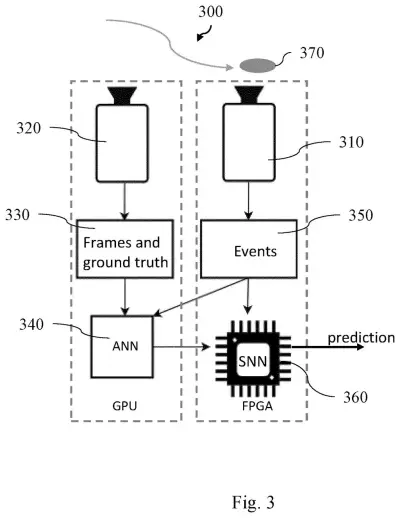
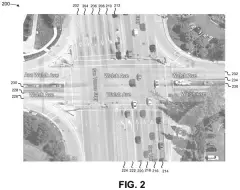
Sony's patent application describes a different kind of camera that doesn't take pictures at all. Each of its pixels reports the instant its own brightness changes, so the stream of data is thin and quick. Sony pairs that camera with a brain-style chip that reacts to every change as it arrives, giving a fresh speed estimate within microseconds.
The catch is that these chips are hard to train directly. So Sony trains an ordinary neural network first, using a regular camera as the teacher, and then copies what it learned into the faster chip.
obtaining event data of an object in the environment of the event-based imaging system using an event-based vision sensor (EVS); obtaining motion data of the object using a reference sensor; …
Translation: The camera gathers visual details and speed measurements from its surroundings using two different sensors.
How Sony turns a slow teacher into a fast student
The filing covers building a fast motion reader in two stages. An event-based vision sensor (a camera whose pixels each report only when their own brightness changes) watches an object, while a reference sensor, such as an RGB camera, LiDAR, radar, infrared or ultrasonic sensor, measures its actual motion.
In the description's example, an RGB camera runs at 100 frames a second and a Bayes filter (a statistical method that smooths noisy position guesses into a speed) estimates velocity. Readings with too much uncertainty, scored with a Mahalanobis distance (how far a reading sits from what is expected), get thrown out. The rest become the answer key.
Matched pairs of event data and answer-key speeds train an ordinary artificial neural network (software that learns from examples). That network is then converted into a spiking neural network with the same layers and weights, except the input layer's activation function (the rule for what a neuron passes on) becomes a leaky-integrate-and-fire neuron, which adds up incoming events over time and fires at a threshold.
The spiking version can run on an FPGA (a reconfigurable chip) or neuromorphic hardware (chips built to mimic neurons). If the reference camera stays attached, the network can keep training while it works. Claims also cover vehicles, drones and robots.
Why Sony's fast speed readings matter for drones
If you ride in a car with driver assistance or fly a drone, the practical hope is faster reactions. The filing says today's camera pipelines are held back by frame rates and processing time, and that its approach can update a speed estimate within microseconds, at rates above tens of thousands of times a second. That is the claimed ceiling, and the filing gives no test results.
It also takes the grunt work out of preparing training data. Real observations from a reference sensor replace hand-labeled or simulated motion, which the filing says may give higher accuracy. For drones, robots and vehicles, the same setup could keep learning on the job, because the reference camera can stay on board as conditions change.
This is the 38th Sony filing we've tracked since July in the self-driving sensing race, building on one on stacked pixel layers and one on pixel wall barriers.
Source: US 2026/0368525 A1 at the USPTO (PDF). Full patent text and figures are in the official publication.
Get our take in your Top Stories
Liked this breakdown? Add Patentlyze as a preferred source on Google, and our plain-English take shows up more often in your Top Stories the next time Sony patent news breaks.
Add Patentlyze on Google
One click.
There are more where this came from
We read every patent application Big Tech publishes and send you the ones worth knowing. Plain English, free, every week.
The drawings · 7 sheets
7 drawing sheets from US 2026/0368525 A1 · click any drawing to enlarge


More from Sony
All 722 Sony patents →
More in AI vision
All 351 AI vision patents →
Nvidia
Nvidia Patents Technology That Measures Object Distance Using Two Cameras
Qualcomm
Qualcomm Patents a System That Spots Objects and Measures Their Depth at the Same Time
Nvidia
Nvidia Files Patent to Teach Camera AI to Spot Objects in Rain and Dim Light
Nvidia
No comments yet