
Sony
Sony · Camera · Filed Oct 24, 2025 · USPTO published Oct 1, 2026 · Oct 1 release
Sony Patents a Camera Lens That Shields Its Own Light-Capturing Film
Sony has filed a patent on a smarter way to stack the layers inside optical elements, solving a manufacturing headache: how do you coat a delicate light-sensitive layer without the next coating dissolving it?
- Publication number
- US 2026/0299167 A1(US20260299167A1)
- Applicant
- SONY GROUP CORPORATION
- Filed · Published
- Oct 24, 2025 · Oct 1, 2026
- Inventors
- Masanori IWASAKI, Tsuyoshi KANEKO, Yui ISHII, Yuri Nakamura, Shoichi OZAWA
- Status when we published
- Waiting for an examiner
- Document
- 24 claims
- US classification
- 359/19
- Parent application
- National Stage Entry of PCT/JP2024/016453 (filed Apr 26, 2024)(PCTJP2024016453)
What Sony's light-sensitive optical layer actually does
Imagine building a tiny, delicate light-sensor with multiple coatings, like painting over wet ink without smudging it. That's roughly the challenge Sony is addressing here.
Optical elements (the components inside cameras, sensors, and displays that respond to light) often need a sensitive inner layer that reacts to light, plus a protective outer layer on top of it. The problem is that applying the protective layer can chemically damage the sensitive layer underneath if the wrong solvents are used.
Sony's approach is to choose a solvent for the protective layer that cannot dissolve the light-sensitive layer beneath it. That way, each coating stays intact as the next one goes on. The result is a cleanly stacked optical element where both layers do their jobs without interfering with each other.
… the photosensitive layer at least contains a derivative of a photosensitizing substance and a polymer of a photosensitizing polymerizable monomer, the protective layer contains a protective polymer soluble in a protective layer solvent and a compound related to the protective layer solvent, and the protective layer solvent does not dissolve the photosensitive layer.
Translation: The protective coating goes on safely because its liquid base is chemically unable to melt the light-sensitive film underneath.
How Sony keeps the photosensitive layer intact during manufacturing
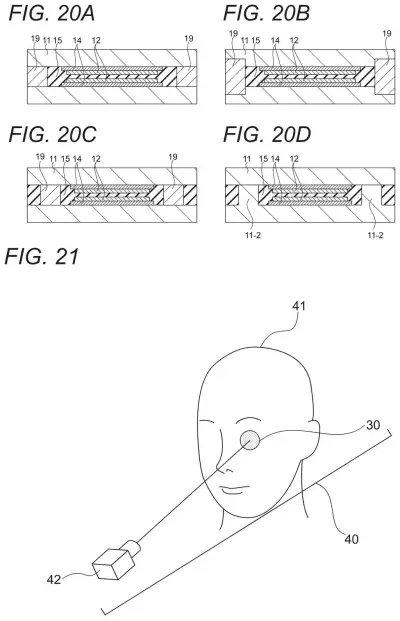
The patent describes an optical element built from at least three stacked layers on a base material:
- A photosensitive layer (a layer that reacts to light, containing a photosensitizing substance and a polymer formed from a photosensitizing monomer)
- A protective layer sitting directly on top of the photosensitive layer
- A base material layer underneath everything else
The core innovation is in how each layer is applied during manufacturing. The photosensitive layer is deposited from a polar solvent solution containing the light-reacting chemicals. Once that layer is in place, the protective layer is applied using a solvent that is chemically incompatible with the photosensitive layer, meaning it cannot dissolve or degrade it.
The protective layer polymer is chosen specifically because it dissolves in that "safe" solvent. So the protective coating goes on cleanly, and when the solvent evaporates, only the protective polymer remains, sitting neatly on top of an undamaged photosensitive layer.
This solvent-selection approach is the heart of the claim. It is a materials-chemistry solution to a precision manufacturing problem: keeping fragile functional layers intact while adding the coatings they need.
… the present inventors have found that it is possible to form a photosensitive layer by using a photosensitive layer-forming solution prepared by dissolving a photosensitizing substance and a photosensitizing polymerizable monomer in a polar solvent, and to form a protective layer adjacent to the photosensitive layer by using a protective layer-forming solution …
Translation: Sony's inventors figured out how to layer a protective shield directly over a light-capturing chemical film without ruining it.
What this means for optical sensors and display components
In practice, this kind of layering precision matters for any optical component that needs to be both light-sensitive and durable, things like camera sensors, holographic elements, or specialized display optics. If the protective layer damages the sensitive layer during fabrication, the device simply does not perform as designed.
For Sony, which makes imaging sensors, cameras, and display technology at scale, improvements to optical element manufacturing quality can affect yield (how many good units come off a production line) and, ultimately, performance. This is manufacturing-process IP, which tends to have real downstream value even when it sounds unexciting on paper.
Sony's 78th filing in our camera patent coverage since May follows gesture headset control and 3D surface light filtering among the applications we've tracked.
Source: US 2026/0299167 A1 at the USPTO (PDF). Full patent text and figures are in the official publication.
Get our take in your Top Stories
Liked this breakdown? Add Patentlyze as a preferred source on Google, and our plain-English take shows up more often in your Top Stories the next time Sony patent news breaks.
Add Patentlyze on Google
One click.
There are more where this came from
We read the new patents from Big Tech, carmakers and more and send you the ones worth knowing. Plain English, free, every week.
The drawings · 14 sheets
14 drawing sheets from US 2026/0299167 A1 · click any drawing to enlarge


Show the other 6 sheets


More from Sony
All 722 Sony patents →
More in Camera
All 278 Camera patents →
Samsung
Samsung Patents a Projector That Grows Its Image as the Lens Cover Opens
Samsung
Samsung Patents a Refrigerator Camera That Reads the Room Before You Open the Door
Apple
Apple Patents a Prism-Tilting Camera System for Thinner Optical Zoom
Apple
No comments yet