
Tesla
Tesla · Automotive · Filed Jul 23, 2026 · USPTO published Nov 19, 2026 · This week's release
Tesla Patents a Parking Display That Judges Distance With Cameras Alone
Tesla describes a parking screen that draws a color-changing outline around your car, and the car works out every distance from its cameras alone.
- Publication number
- US 2026/0367622 A1(US20260367622A1)
- Applicant
- TESLA, INC.
- Filed · Published
- Jul 23, 2026 · Nov 19, 2026
- Inventors
- Brandon LEUNG, Nicholas KOURIS, Lewey GESELOWITZ, Lauren YANG, Nishant DESAI, Pengfei Phil DUAN
- Status when we published
- Waiting for an examiner
- Document
- 20 claims
- US classification
- 701/2
- Parent application
- Continuation of 18/777,322 (filed Jul 18, 2024)(18777322)
What Tesla's color-coded parking screen shows
Imagine backing into a tight spot at night, with a concrete post somewhere behind you that you can't quite see. Many cars rely on beeping sensors that only listen in a narrow cone, so they tell you something is close but not where.
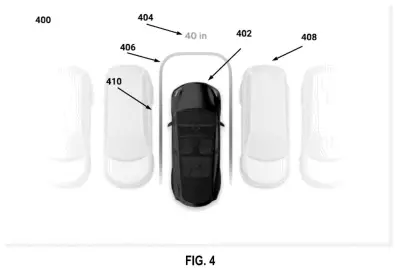
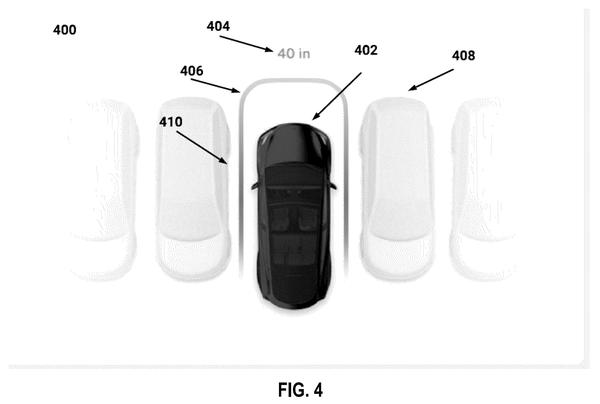
Tesla's patent describes a parking screen that draws a top-down view of your car with a glowing outline around it. The outline shifts from green (all clear) toward red (too close), so you can see which corner is in trouble. A second outline can hug the curb or the neighboring car itself, and the screen can show a distance, such as 40 inches.
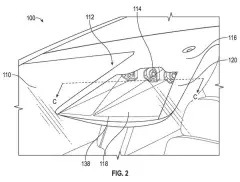
The twist is where the information comes from. The car's cameras supply all of it, and software estimates how far away everything is. If something slips out of view, like a parking block that passes under the rear camera, the car keeps tracking it based on how you have moved.
… execute a machine learning model to process the image data and determine proximity information associated with one or more objects relative to the ego, the machine learning model configured to output the proximity information associated with the one or more objects relative to the ego using only the image data …
Translation: An AI processes the camera feeds to figure out how close things are without needing radar or sonar.
How the car measures distance from camera images
The system takes pictures from cameras around the car (the filing describes eight) and feeds them to an occupancy network. That is a neural network (software trained on large numbers of examples) that works out which chunks of 3D space around the car are filled by something solid. The claims say the distance information comes from the image data only.
For parking, the model splits the surroundings into angular slices, like cutting a pie around the car. The filing's example is 72 slices of 5 degrees each. For every slice, the model says whether something is within a set distance and how far away it is. It repeats this many times a second (24 or 30 times in the examples).
The results drive what you see on the display:
- A colored outline around the car's icon, shifting from green to red as an object gets closer.
- An outline stuck to the outside of a curb, post or neighboring car, colored the same way.
- Optionally, the closest distance as a number, plus chimes that grow more frequent or louder as you approach.
A memory step keeps tabs on objects after they leave a camera's view, using the car's own motion. The filing also says objects outside a height range, such as a garage ceiling the car's body can't touch, can be left off the screen.
… computing a forward pass through an occupancy network to output, at least, information reflecting, for individual angular ranges about the vehicle, whether an object is within a threshold distance of the vehicle for an individual range along with an estimated distance to the object …
Translation: The system calculates how close nearby objects are in every direction around the car.
What this means for tight parking spots and curbs
Parking is where small misjudgments cost money. Low posts, curbs and parking blocks are hard to see from the driver's seat, and the filing points out that common ultrasonic sensors (the ones that beep) only watch a narrow beam, about 10 to 15 degrees. A screen that covers all the way around your car, and shows which corner is closest, could take much of the guessing out of tight spaces.
It also points to a direction: cutting back on sensor hardware by adding software. The filing says the same screen could appear in a phone app while the car parks itself and you stand outside, so you can watch what it is doing. Whether any of this reaches a real car is unknown, since a patent describes an idea and not a product.
This is the 14th Tesla filing we've tracked since May in our camera-only bet watchlist, following applications like a camera cut into the windshield and one that reads road surfaces.
Source: US 2026/0367622 A1 at the USPTO (PDF). Full patent text and figures are in the official publication.
Get our take in your Top Stories
Liked this breakdown? Add Patentlyze as a preferred source on Google, and our plain-English take shows up more often in your Top Stories the next time Tesla patent news breaks.
Add Patentlyze on Google
One click.
There are more where this came from
We read every patent application Big Tech publishes and send you the ones worth knowing. Plain English, free, every week.
The drawings · 13 sheets
13 drawing sheets from US 2026/0367622 A1 · click any drawing to enlarge


Show the other 5 sheets


More from Tesla
All 59 Tesla patents →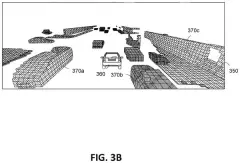
More in Automotive
All 377 Automotive patents →
Tesla
Tesla Patents a Faster Method for Teaching Its Self-Driving AI to Focus
Tesla
Tesla Patents a Vision System That Builds a Running Map of Still Objects Around Its Cars
Tesla
Tesla Files Patent for Autonomous System That Reads Intent Before Moving
Tesla
No comments yet