
Google Patent Reveals LiDAR-Synced Cameras for Sharper Low-Light Imaging
Waymo has filed a patent for a camera system that deliberately captures images at two different quality levels in the same moment, timed precisely to the pulses of its laser rangefinder, to get sharper pictures even in near-darkness.
How Waymo's camera-LiDAR timing trick works in plain English
You're riding in a self-driving car through a dark tunnel when it suddenly emerges into bright sunlight. The cameras on board have to handle both extremes almost simultaneously, and getting that wrong could mean a blurry or washed-out view of the road.
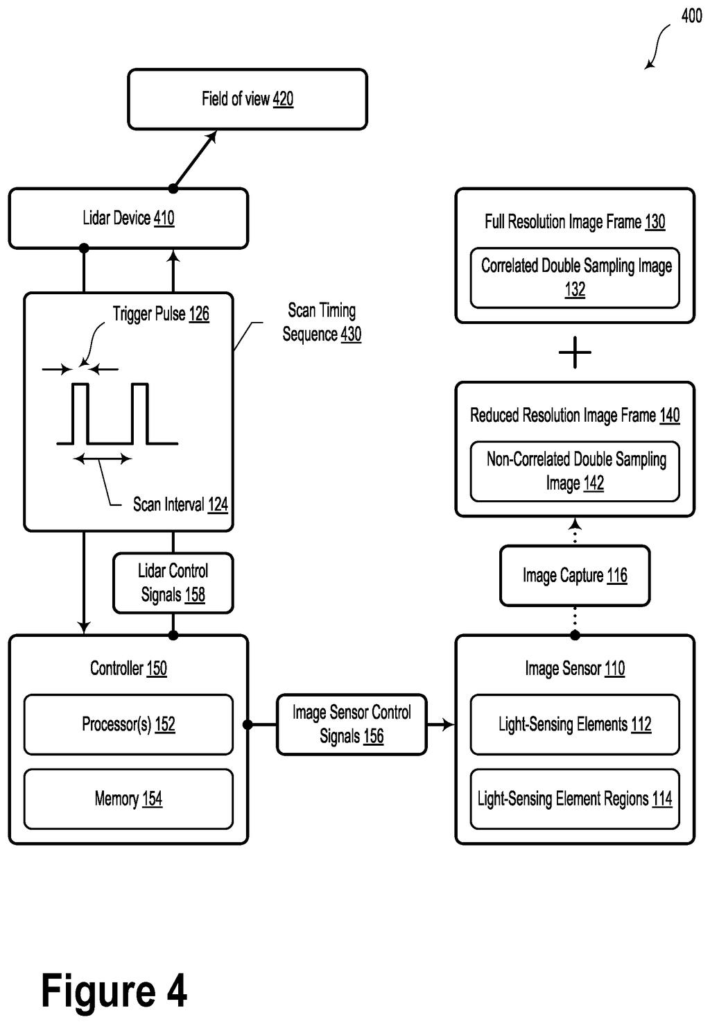
Waymo's patent describes a camera controller that shoots two kinds of images in a single, rapid cycle. One is a full-resolution image for overall scene awareness. The other is a lower-resolution image taken in a mode that's more sensitive to low light. The trick is that both shots happen inside the same tiny time window defined by the car's LiDAR (the spinning laser that measures distances), so the camera data and the laser data stay perfectly matched.
There's also a built-in noise-reduction step: the system captures a third "dark" frame with no light hitting it at all, then subtracts any electronic noise it finds there from the real image. The result is cleaner, more accurate picture data to feed into the car's decision-making system.
… causing the image sensor to capture a dark image frame with the second resolution; and performing a dark image subtraction between the second image frame and the dark image frame.
Translation: The camera takes a picture of pure darkness to identify and remove electronic noise from your actual photos.
How the sensor switches resolution between LiDAR pulses
The patent centers on an image sensor connected to a controller that takes its timing cues from a clock signal produced by the vehicle's LiDAR system. LiDAR (Light Detection and Ranging) works by firing rapid laser pulses and measuring how long they take to bounce back; that pulse rhythm becomes the master clock for the camera.
Within each clock interval (the gap between two LiDAR pulses), the controller tells the sensor to do three things in sequence:
- Capture a full-resolution frame that maps the whole scene in detail.
- Capture a reduced-resolution frame tuned for low-light sensitivity, likely by binning pixels together (combining neighboring pixels into one larger virtual pixel that can collect more light).
- Capture a dark frame, a shot taken while the sensor is shielded from light, to measure the sensor's own background electrical noise.
The controller then performs dark subtraction: it mathematically removes the dark frame's noise pattern from the low-light image. This is a well-established technique in astronomy and scientific imaging, applied here to automotive cameras.
The key engineering challenge being solved is synchronization. If the camera's internal timing drifts even slightly from the LiDAR's timing, the image data and the distance data no longer line up correctly in space and time, which makes sensor fusion (combining both data sources into one picture of the world) much harder. Locking the camera to the LiDAR clock prevents that drift.
This disclosure describes devices, systems, and methods that relate to obtaining image frames with variable resolutions in synchronization with a clock source.
Translation: The patent explains how a camera can coordinate its timing to capture images at different quality levels simultaneously.
What this means for self-driving cars in bad lighting
For a self-driving car, the camera and the LiDAR aren't separate systems, they're two halves of one picture. If the image frame and the laser scan don't correspond to exactly the same instant, the software fusing them together has to guess, and guesses introduce errors. This patent addresses that coordination problem at the hardware level rather than trying to correct for drift in software after the fact.
The low-light angle is also worth taking seriously. Most public discussions of self-driving sensors focus on object detection in daylight, but tunnels, parking structures, and night driving are exactly where camera performance degrades and where errors have the highest cost. The latest Big Tech patents in automotive perception show camera-LiDAR fusion moving from an algorithmic challenge to a hardware co-design problem, and this filing sits squarely in that shift.
This is the 52nd Google filing we've tracked since May in the self-driving sensing race, building on earlier applications like one predicting driver reaction time and one navigating sensor blind spots.
The core invention here is a camera that changes how it reads its own pixels depending on whether it has enough light, and it does so by taking timing cues from the vehicle's laser ranging system. Both of those underlying capabilities, adjustable camera readout and laser-based distance sensing, already exist in Waymo's vehicles today. That makes the path to shipping this relatively short.
The most likely route is a firmware or software update to the camera controller rather than new physical hardware, because the document describes coordinating two systems that are already present, not building either one from scratch. The main remaining work is validation: confirming that better-lit, better-resolved images in dim conditions actually help the car make fewer mistakes.
That is a testing problem, not a design problem, which is a meaningful distinction when estimating how long something takes to reach the road.
Get our take in your Top Stories
Liked this breakdown? Add Patentlyze as a preferred source on Google, and our plain-English take shows up more often in your Top Stories the next time Google patent news breaks.
There are more where this came from
We read every patent application Big Tech publishes and send you the ones worth knowing. Plain English, free, every week.
The drawings
10 drawing sheets from US 2026/0253177 A1 · click any drawing to enlarge


Want this weekly breakdown for a company we don't cover? Patentlyze Pro →
Be the first to weigh in