
Samsung Patents a Tri-Fold Phone That Cancels Accidental Touches When You Open It
Tri-fold phones have a unique problem: if you tap something on one panel and then open another panel a split second later, which input wins? Samsung's new patent answers that directly.
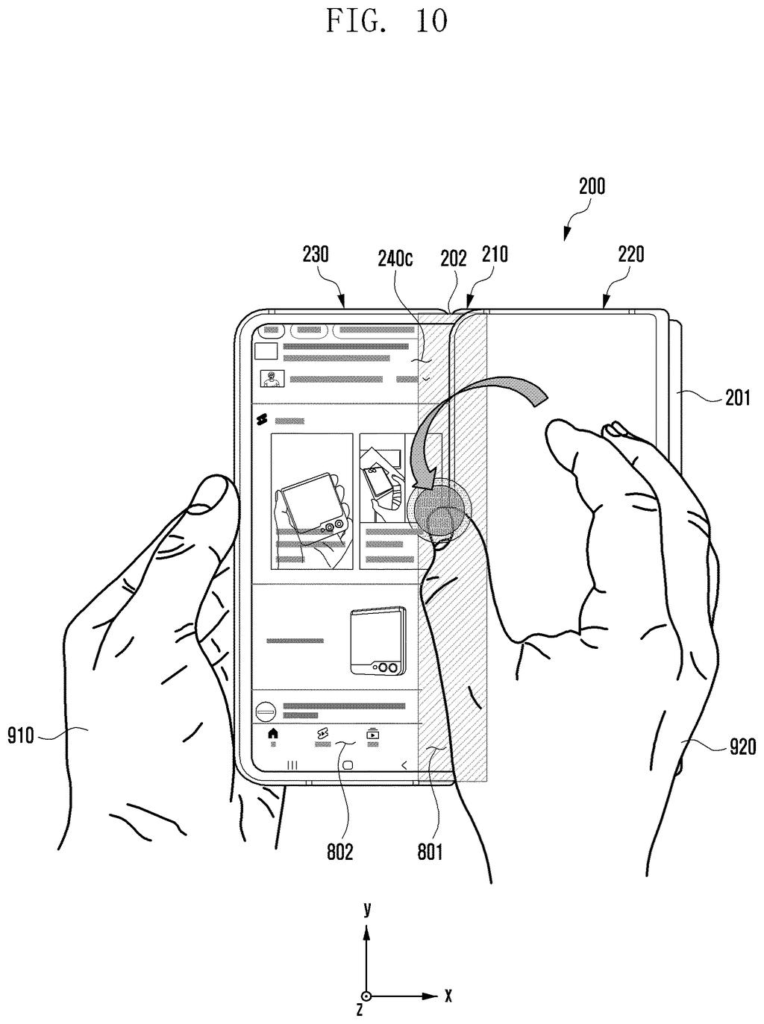
How Samsung's tri-fold handles touches mid-unfold
Today's foldable phones already make it tricky to know which part of the screen is "live" at any given moment. A phone with three separate folding panels multiplies that confusion considerably, because a user might touch one section of the screen while simultaneously beginning to unfold a different hinge.
Samsung's patent describes a specific fix for that scenario. On a three-panel phone where two panels are already open and a third is still folded, the device watches for the moment you start unfolding that third hinge. If it catches a hinge movement starting right after you've tapped something, it cancels that tap rather than acting on it. The logic is that the opening motion likely means you didn't intend the tap in the first place.
The result is that accidental touches during unfolding don't trigger unwanted actions, like launching an app or deleting a message, just because your fingers were resting on the screen while you opened the device.
… detect an unfolding movement of the first hinge assembly, and based on the unfolding movement of the first hinge assembly, deactivate the touch input on the first portion of the third display area.
Translation: It notices when you open the hinge and ignores any accidental touches happening on the screen while you do it.
How the hinge sensor kills the stale touch input
The patent describes a phone with three physical housings, each carrying a section of one continuous flexible display. Two hinges connect them: one between the first and second housing, another between the first and third. The device can be in various fold states at once, for example, the third panel open flat while the second panel is still folded closed.
The core claim covers a specific sequence of events:
- The device receives a touch input on the display area of the third (open) panel.
- After that touch lands, the device's sensors detect that the other hinge (the one connecting panels one and two) has started to move toward the open position.
- Based on that hinge motion, the device deactivates the earlier touch input, treating it as unintentional.
Each housing contains its own sensor, and those sensors feed into a processor that monitors hinge state in real time. The key insight is that hinge-opening movement is used as a signal to retroactively discard a touch, rather than simply ignoring future touches while the hinge moves. That retroactive cancellation is what the independent claim specifically protects.
A multi-foldable electronic device is provided. The multi-foldable electronic device includes a first housing including a first sensor, a second housing foldably coupled to a first side of the first housing and including a second sensor, a third housing foldably coupled to a second side of the first housing and including a third sensor …
Translation: The patent describes a device built with three connected sections that track their positions using built in sensors.
What this means for multi-fold phone usability
For anyone who has accidentally triggered something on a foldable phone just by gripping it while opening it, this is a practical quality-of-life fix applied to a more complicated device than any currently on sale. Tri-fold hardware is coming, and the interaction problems multiply with each added hinge. Getting touch arbitration right before the hardware ships matters more than it might seem.
The broader context is that Samsung is building out the software behavior layer for multi-fold devices at the same time as the physical engineering, and this kind of hinge-aware touch logic is part of that foundation. Other folding-phone patents covering similar display-management territory are among this week's Big Tech patents tracking how manufacturers are defining the rules for a new device category.
Samsung's latest application is the 54th we've tracked in our foldable phone patents watchlist since May, adding to earlier work like a corner magnet seal and a foam screen buffer.
Claim 1 locks in a very specific situation: a stray touch gets ignored because the device detected the hinge opening, while one screen is still folded shut. Any rival product that uses that exact sequence to cancel an accidental tap falls directly inside this patent's reach.
That specificity is a genuine asset. It covers the most common moment a finger or palm brushes the screen by mistake, the one-handed partial unfold. Any company building a three-panel folding phone and using the hinge movement as the "ignore that touch" signal would need to redesign carefully to stay clear.
Get our take in your Top Stories
Liked this breakdown? Add Patentlyze as a preferred source on Google, and our plain-English take shows up more often in your Top Stories the next time Samsung patent news breaks.
There are more where this came from
We read every patent application Big Tech publishes and send you the ones worth knowing. Plain English, free, every week.
The drawings
16 drawing sheets from US 2026/0246861 A1 · click any drawing to enlarge


Want this weekly breakdown for a company we don't cover? Patentlyze Pro →
Be the first to weigh in