
Qualcomm Patent Uses a 3D Graphics Trick to Improve Cars' Surroundings View
Qualcomm is borrowing a technique from 3D scene rendering to help cars build a sharper, more accurate map of everything around them, a map that driving software then uses to decide where to go.
What Qualcomm's overhead driving map system actually does
Imagine you're in a car that needs to know exactly where every other vehicle, pedestrian, and curb is, at all times. The car's cameras see forward, backward, and sideways, and a laser sensor bounces pulses off nearby objects. But stitching all that raw data into a clean, usable overhead map is harder than it sounds.
Qualcomm's patent describes a way to make that overhead map more detailed and accurate by borrowing a trick from 3D computer graphics. The system first builds a rough overhead picture from the cameras and the laser sensor, then drops in small, fuzzy blobs called Gaussian primitives, each one representing a detected object or surface. When these blobs are layered together, they fill in gaps and sharpen edges in a way that a straightforward pixel-by-pixel approach misses.
The end result is a richer overhead picture that the vehicle's driving software can use to make better decisions about steering, braking, and navigating around obstacles.
… generating Gaussian primitives using the initial BEV representation, the Gaussian primitives representing features of objects in the three-dimensional space; and combining the Gaussian primitives with the initial BEV representation using Gaussian splatting to form an enhanced BEV representation of the three-dimensional space.
Translation: The system creates 3D shapes from camera data and uses a rendering technique called Gaussian splatting to sharpen the view.
How Gaussian splatting sharpens the vehicle's aerial view
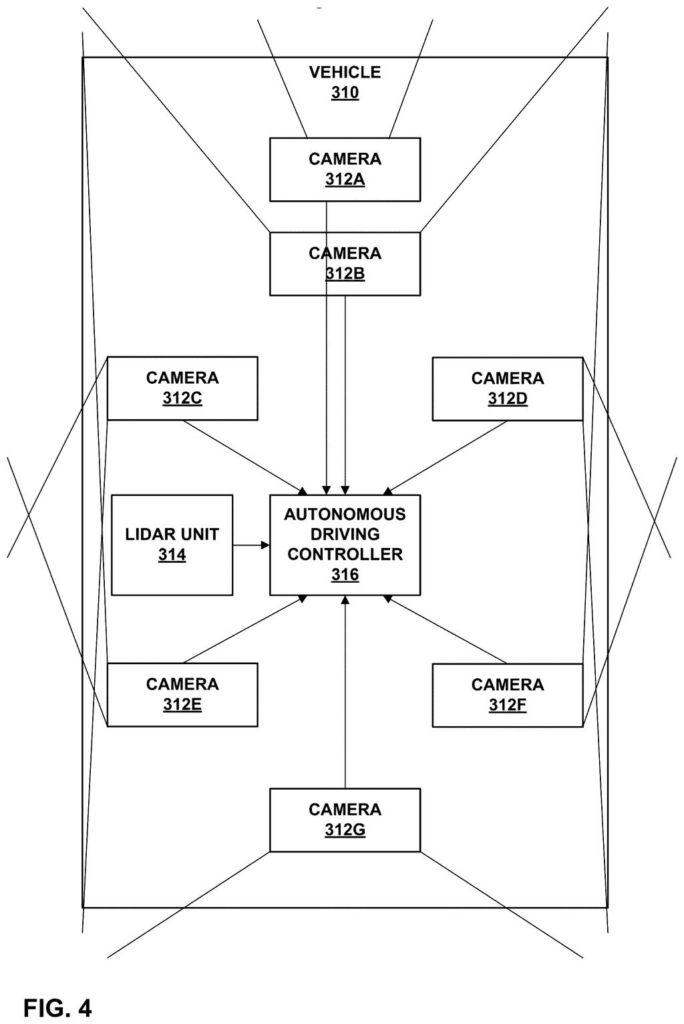
The patent describes a pipeline running on a vehicle's onboard processor, pulling data from two sources at once: a multi-camera system (several cameras mounted around the car) and a depth sensing unit (typically a LiDAR or structured-light sensor that measures exact distances by firing laser pulses).
From those inputs, the system builds an initial bird's-eye view (BEV) representation, essentially a flat, top-down map of the space around the car, similar to what you'd see on a satellite image but updated in real time.
The novel step is what happens next:
- The system analyzes the initial BEV and generates Gaussian primitives, mathematical blobs, each defined by a position, a size, a shape, and a color or feature value. Think of each blob as a soft paintbrush stroke placed on top of an object or surface.
- These primitives are then combined back into the map using Gaussian splatting, a rendering method borrowed from 3D scene reconstruction. Splatting works by projecting each blob onto the 2D map plane and blending overlapping blobs together, producing smooth, dense coverage even where sensor data is sparse or noisy.
- The output is an enhanced BEV representation with finer detail about object shapes, boundaries, and spatial relationships.
The approach is designed to run on Qualcomm's automotive chip platforms, where processing speed and power efficiency both matter for real-time driving applications.
An example device for generating a bird's-eye view (BEV) representation of objects through processing of media data, such as image data and point cloud data, includes a processing system configured to receive, from a multi-camera system of a vehicle, one or more images of a three-dimensional space around the vehicle …
Translation: The technology combines camera footage and depth sensor data to build a top-down map of the area surrounding a car.
What this means for self-driving perception hardware
For the person sitting in a self-driving or driver-assist vehicle, this patent addresses one of the quieter failure modes in automated driving: the moments when the car's internal map is blurry or incomplete and the system makes a hesitant or wrong call. A sharper overhead map means fewer phantom braking events, more confident lane changes, and better detection of objects that sit awkwardly between camera angles or at the edge of a LiDAR sweep.
Qualcomm supplies chips to many automakers and Tier 1 suppliers, so improvements to perception algorithms at the chip level can ripple across a wide range of vehicles rather than staying inside one manufacturer's ecosystem. Automotive perception is one of the more active areas covered among new tech patents, and this filing shows chipmakers, not just car companies, pushing the state of sensor fusion forward.
This is the 27th Qualcomm filing we've tracked in our self-driving sensing watch since July, building on earlier work like their mismatched-camera fix and their protruding-object spotter.
The clearest sign a car's perception system is working well is that you never think about it. No phantom braking, no missed pedestrian at the edge of a parking lot, no hesitation before a lane change that makes a smooth drive feel anxious.
Qualcomm is building a richer internal picture of the world around the vehicle by blending camera images with distance measurements, so the car develops a more confident sense of what surrounds it. That matters most when simpler systems get confused: a truck partially hidden behind a highway divider, a cyclist drifting in from an odd angle, a parked car the system isn't sure about.
The real test is whether this runs quickly enough on existing hardware without draining power needed elsewhere, but if it does, drivers would feel it as a car that acts with steadier, quieter judgment.
Get our take in your Top Stories
Liked this breakdown? Add Patentlyze as a preferred source on Google, and our plain-English take shows up more often in your Top Stories the next time Qualcomm patent news breaks.
There are more where this came from
We read every patent application Big Tech publishes and send you the ones worth knowing. Plain English, free, every week.
The drawings
5 drawing sheets from US 2026/0253310 A1 · click any drawing to enlarge


Want this weekly breakdown for a company we don't cover? Patentlyze Pro →
Be the first to weigh in