
Qualcomm Patents a Low-Power Sleep Mode for the Memory Inside Your Chips
Your phone's processor is packed with tiny memory banks that burn power even when they're sitting idle. Qualcomm's new patent describes a way to put those banks into a shallow sleep, cutting their voltage just enough to save power without erasing what's inside.
What Qualcomm's cache sleep mode actually saves
Every time you tap your phone awake, several memory banks inside the processor snap to attention, even the ones that aren't needed for what you're doing. Those idle banks still draw power, and over millions of phones over millions of hours, that adds up to real battery drain.
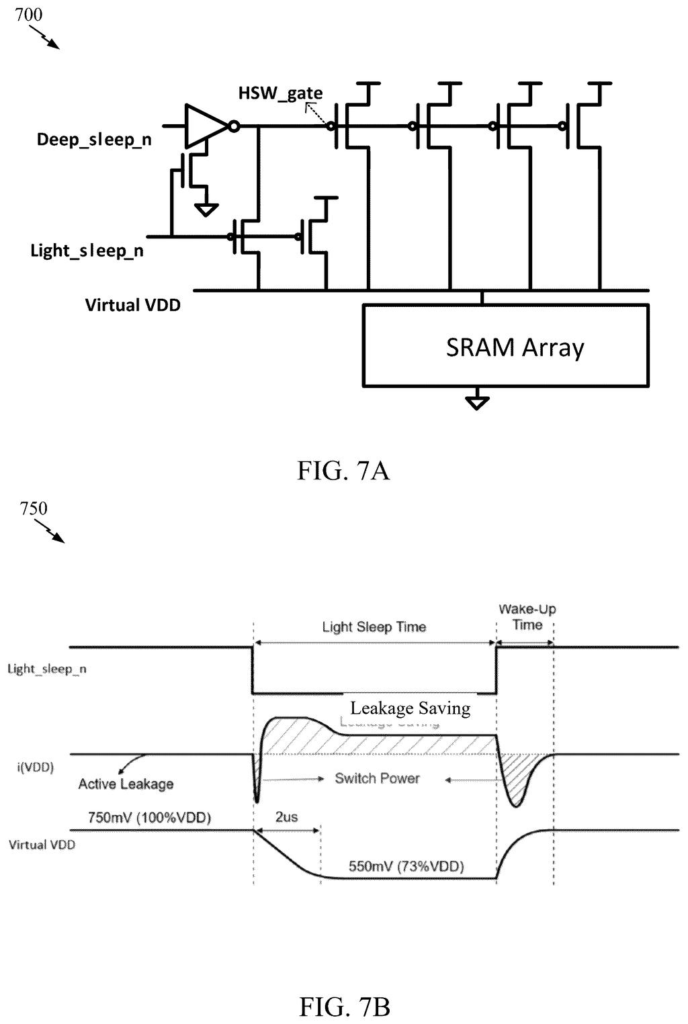
Qualcomm's patent describes a trick called light sleep: when a memory bank isn't being used, the chip suspends one of its electrical lines and dials down the voltage feeding that bank. The bank isn't fully off, so it doesn't forget what it was holding. It's more like a dimmer switch than an on/off switch.
The moment the processor needs that memory again, it wakes up quickly, rather than having to reload everything from scratch. For you, the ideal outcome is a phone that runs a little cooler and lasts a bit longer on a charge, without any slowdown you'd ever notice.
… placing a bit line of at least one sub bank of the memory instance in a floating state, and 2 ) adjusting a core bias to reduce a level of a supply voltage rail to the sub bank from an active level to a retention level …
Translation: The chip saves power by disconnecting the data lines and lowering the electricity sent to specific memory sections.
How the voltage drop keeps data alive while cutting power
The patent targets cache memory, the small, very fast storage that lives directly on a processor chip. Cache holds data the chip is likely to need again soon, so the processor doesn't have to fetch it from slower main memory every time. Modern chips divide cache into many sub-banks, discrete sections that can be managed independently.
Qualcomm's method puts idle sub-banks into a first low power state using two simultaneous steps:
- Floating the bit line: the wire that normally carries data reads and writes is left electrically disconnected, so it stops consuming current while nothing is happening.
- Adjusting the core bias: the supply voltage feeding that sub-bank is reduced from its normal active level down to a lower retention level, just high enough for the memory cells to hold their data without flipping to zero.
The key constraint is that the chip must bring the sub-bank back out of this state before any access is attempted, restoring full voltage and reconnecting the bit line. The patent describes this as a predictable, controlled handoff rather than an emergency wakeup.
The system targets SRAM (static random-access memory), the type of memory typically used in on-chip cache because of its speed. SRAM cells are stable but power-hungry, so any technique that reduces their idle consumption is directly useful for mobile chips running on a battery.
Certain aspects of the present disclosure provide techniques and apparatus for controlling a cache. According to certain aspects, at least one sub bank of a memory instance of the cache is placed in in a first low power state …
Translation: This patent describes a new way for a processor to put parts of its high speed memory into a deep sleep mode.
What this means for phone battery life and chip heat
For anyone using a phone or tablet powered by a Qualcomm chip, the payoff here is incremental but real: less heat and a modest improvement in how long the battery lasts during mixed workloads, the kind where the processor is doing some things but not everything at once. This is exactly the scenario that dominates everyday use, scrolling, background syncing, light apps running in parallel.
The engineering tradeoff is tight. Reduce voltage too far and the memory cells lose their data; reduce it too little and you save almost nothing. Qualcomm's approach of combining a floating bit line with a calibrated voltage drop is a specific answer to that tradeoff, and it signals that the company is pushing cache power management down to a finer grain than simple bank-level on/off switching. The latest Big Tech patents in chip power management show a clear pattern of companies racing to squeeze efficiency out of every idle millisecond inside mobile processors.
That makes this Qualcomm's 39th filing we've tracked since July in the AI chip wars, adding to work like faster memory calculations and merging models on chip.
This patent will not change how your phone feels to use in any obvious way. You will not notice a sub-bank of cache going into light sleep. What you might notice, over a long day, is the battery lasting a bit longer before you reach for the charger.
That's actually the most honest framing for power-management patents: they accumulate. No single technique saves 20% of your battery. Dozens of small techniques, each saving a fraction of a percent across different corners of the chip, combine into something a real user can measure by the end of the day.
Qualcomm is specifically targeting the gap between 'fully on' and 'fully off' for cache sub-banks, a gap that was previously wasted. The concrete payoff for the person holding the phone is a chip that burns less heat during the long stretches of moderate use that make up most of a day.
Get our take in your Top Stories
Liked this breakdown? Add Patentlyze as a preferred source on Google, and our plain-English take shows up more often in your Top Stories the next time Qualcomm patent news breaks.
There are more where this came from
We read every patent application Big Tech publishes and send you the ones worth knowing. Plain English, free, every week.
The drawings
9 drawing sheets from US 2026/0252160 A1 · click any drawing to enlarge


Want this weekly breakdown for a company we don't cover? Patentlyze Pro →
Be the first to weigh in