
Nvidia Patents Technology That Trains AI Models Faster by Sharing the Workload
Training a large AI model can take weeks and cost millions of dollars in computing time. Nvidia's new patent targets one of the slowest steps in that process, splitting the math across many chips so they all work at once.
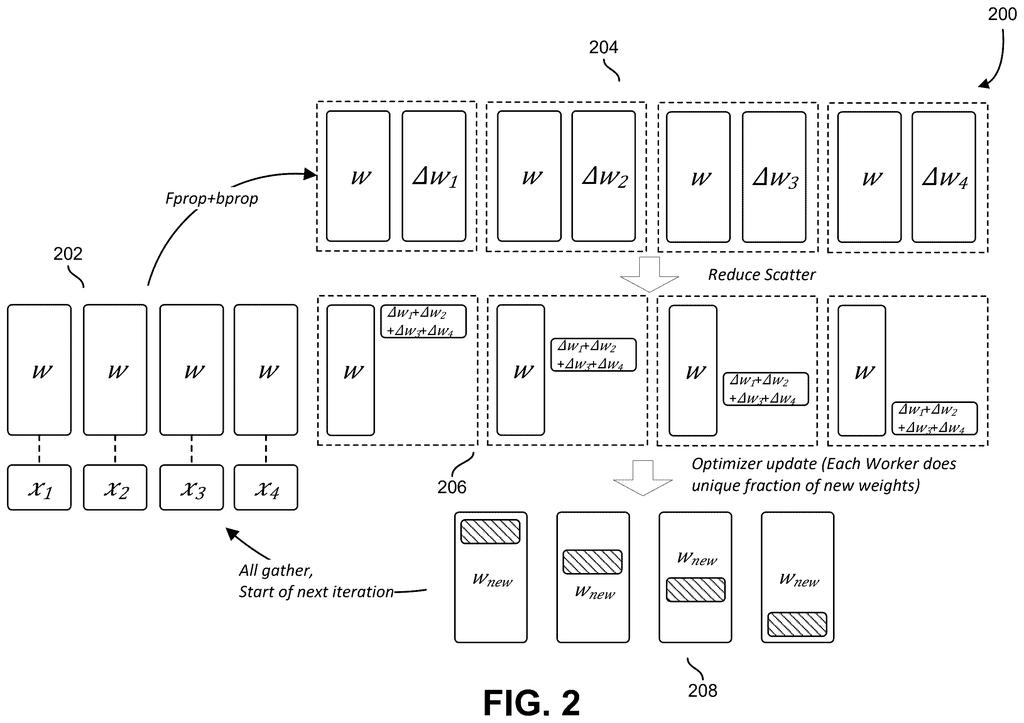
How Nvidia's chip-splitting trick cuts AI training time
Every time a company trains an AI model, the computer runs through the same grinding loop thousands of times: make a prediction, measure how wrong it was, then nudge every internal setting a tiny bit closer to correct. That last nudge, updating the settings the model uses to make decisions, is called a weight update, and on a big model it involves billions of tiny calculations done one after another.
Nvidia's patent describes a way to do all those nudges at the same time instead of one by one. The system sends slices of the calculation to different processors in parallel, each chip handles its own portion, and the results are combined into a finished update. You end up at the same destination, just much faster.
The practical upside is shorter training runs. A job that might take a week on a single processor could shrink considerably when the work is spread across dozens or hundreds of chips working in parallel. That matters most for the largest AI models, where training costs dominate everything.
Speed of training a neural network is improved by updating the weights of the neural network in parallel. In at least one embodiment, after back propagation, gradients are distributed to a plurality of processors, each of which calculate a portion of the updated weights of the neural network.
Translation: The system speeds up AI learning by splitting the math required to update the model across many different computer chips.
How gradients get split and recombined across processors
Neural networks learn by adjusting millions or billions of numerical settings called weights. The adjustment process works in two stages: a forward pass (the model makes a prediction) and a backpropagation pass (the model works backward through its own layers to figure out which weights contributed most to any errors). At the end of backpropagation, you have a set of gradients, numbers that tell you which direction and how far to move each weight.
Normally, computing the new weights from those gradients is a sequential bottleneck. Nvidia's patent breaks that bottleneck by distributing the gradients across a group of processors. Each processor receives a portion of the gradient data and independently computes the updated weights for its assigned slice.
The key steps the patent describes:
- Complete the backpropagation pass as usual to produce the full gradient set
- Divide and send portions of those gradients to multiple processors simultaneously
- Each processor calculates its share of the new weights in parallel with the others
- The updated weight values are collected and written back, ready for the next training step
Because the weight calculations for different parts of the network don't depend on each other, this parallelization is mathematically clean. The final result is identical to doing it sequentially, just arrived at faster.
What faster AI training means for Nvidia's data center push
AI training cost is one of the biggest constraints on how often companies can experiment with new model architectures. Faster weight updates mean more training runs in the same time window, or the same run at lower cost. For Nvidia, whose data-center GPU business depends on customers wanting to buy more chips, any technique that makes those chips more efficient at training is also a business argument for buying a bigger cluster.
This patent sits in a well-established area of distributed computing, but the steady accumulation of incremental efficiency patents is exactly where Nvidia has historically built its moat. Readers who follow AI infrastructure will find this filing alongside a broader wave of latest Big Tech patents focused on squeezing more training throughput out of the same silicon.
This is the 33rd Nvidia filing we've tracked since July in the AI chip wars, following one on splitting math across chip hardware and one on models that shrink and grow.
Splitting a calculation across many processors speeds things up, but it creates a coordination problem: every piece of the work has to be packaged, sent to the right destination, and collected again before anything useful comes out. That shipping cost is real, and on smaller setups it can cancel out the speed gains entirely.
The design assumes the user is running a very large system where the savings dwarf the coordination overhead. That assumption holds for Nvidia's biggest customers, but it means the technique may deliver little to someone running a modest setup, which is a meaningful constraint built into the approach from the start.
What the patent actually protects is a specific way of organizing and scheduling this distribution, not a new idea about how computers learn. The bet reads as worth it for large-scale buyers, but the honest cost is that the gains narrow sharply as the hardware shrinks.
Get our take in your Top Stories
Liked this breakdown? Add Patentlyze as a preferred source on Google, and our plain-English take shows up more often in your Top Stories the next time Nvidia patent news breaks.
There are more where this came from
We read every patent application Big Tech publishes and send you the ones worth knowing. Plain English, free, every week.
The drawings
51 drawing sheets from US 2026/0252889 A1 · click any drawing to enlarge


Want this weekly breakdown for a company we don't cover? Patentlyze Pro →
Be the first to weigh in