Get the newsletter
Nvidia · AI / ML · Filed Nov 24, 2025 · USPTO published Aug 27, 2026 · Aug 27 release

Nvidia Patents Technology That Trains AI Models Faster by Sharing the Workload

Training a large AI model can take weeks and cost millions of dollars in computing time. Nvidia's new patent targets one of the slowest steps in that process, splitting the math across many chips so they all work at once.
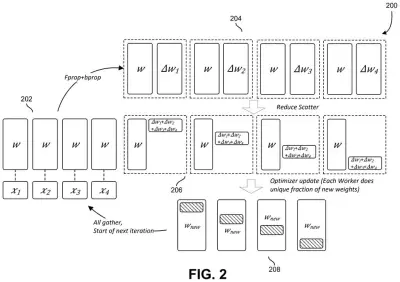
Distributed AI training workflow featuring reduce-scatter communication and worker weight updates. Drawing from patent filing US 2026/0252889 A1.
Distributed AI training workflow featuring reduce-scatter communication and worker weight updates.All 51 drawings ↓
Publication number
US 2026/0252889 A1(US20260252889A1)
Applicant
NVIDIA Corporation
Filed · Published
Nov 24, 2025 · Aug 27, 2026
Inventors
Sharan Chetlur, Natalia Gimelshein, Thor Mikal Johnsen, Simon Layton
Status when we published
Waiting for an examiner
Document
28 claims
US classification
706/25
Parent application
Continuation of 16/675,069 (filed Nov 5, 2019)(16675069)

How Nvidia's chip-splitting trick cuts AI training time

Every time a company trains an AI model, the computer runs through the same grinding loop thousands of times: make a prediction, measure how wrong it was, then nudge every internal setting a tiny bit closer to correct. That last nudge, updating the settings the model uses to make decisions, is called a weight update, and on a big model it involves billions of tiny calculations done one after another.

Nvidia's patent describes a way to do all those nudges at the same time instead of one by one. The system sends slices of the calculation to different processors in parallel, each chip handles its own portion, and the results are combined into a finished update. You end up at the same destination, just much faster.

The practical upside is shorter training runs. A job that might take a week on a single processor could shrink considerably when the work is spread across dozens or hundreds of chips working in parallel. That matters most for the largest AI models, where training costs dominate everything.

From the filing · THE ABSTRACT
Speed of training a neural network is improved by updating the weights of the neural network in parallel. In at least one embodiment, after back propagation, gradients are distributed to a plurality of processors, each of which calculate a portion of the updated weights of the neural network.

Translation: The system speeds up AI learning by splitting the math required to update the model across many different computer chips.

How gradients get split and recombined across processors

Neural networks learn by adjusting millions or billions of numerical settings called weights. The adjustment process works in two stages: a forward pass (the model makes a prediction) and a backpropagation pass (the model works backward through its own layers to figure out which weights contributed most to any errors). At the end of backpropagation, you have a set of gradients, numbers that tell you which direction and how far to move each weight.

Normally, computing the new weights from those gradients is a sequential bottleneck. Nvidia's patent breaks that bottleneck by distributing the gradients across a group of processors. Each processor receives a portion of the gradient data and independently computes the updated weights for its assigned slice.

The key steps the patent describes:

  • Complete the backpropagation pass as usual to produce the full gradient set
  • Divide and send portions of those gradients to multiple processors simultaneously
  • Each processor calculates its share of the new weights in parallel with the others
  • The updated weight values are collected and written back, ready for the next training step

Because the weight calculations for different parts of the network don't depend on each other, this parallelization is mathematically clean. The final result is identical to doing it sequentially, just arrived at faster.

What faster AI training means for Nvidia's data center push

AI training cost is one of the biggest constraints on how often companies can experiment with new model architectures. Faster weight updates mean more training runs in the same time window, or the same run at lower cost. For Nvidia, whose data-center GPU business depends on customers wanting to buy more chips, any technique that makes those chips more efficient at training is also a business argument for buying a bigger cluster.

This patent sits in a well-established area of distributed computing, but the steady accumulation of incremental efficiency patents is exactly where Nvidia has historically built its moat. Readers who follow AI infrastructure will find this filing alongside a broader wave of latest Big Tech patents focused on squeezing more training throughput out of the same silicon.

This is the 33rd Nvidia filing we've tracked since July in the AI chip wars, following one on splitting math across chip hardware and one on models that shrink and grow.

Source: US 2026/0252889 A1 at the USPTO (PDF). Full patent text and figures are in the official publication.

Get our take in your Top Stories

Liked this breakdown? Add Patentlyze as a preferred source on Google, and our plain-English take shows up more often in your Top Stories the next time Nvidia patent news breaks.

There are more where this came from

We read the new patents from Big Tech, carmakers and more and send you the ones worth knowing. Plain English, free, every week.

The drawings · 51 sheets

51 drawing sheets from US 2026/0252889 A1 · click any drawing to enlarge

Standard training workload distribution workflow, drawing sheet 1 from US 2026/0252889 A1
Sheet 1 Standard training workload distribution workflow
Distributed training workflow with split updates, drawing sheet 2 from US 2026/0252889 A1
Sheet 2 Distributed training workflow with split updates
Gradient states during reduce-scatter operation, drawing sheet 3 from US 2026/0252889 A1
Sheet 3 Gradient states during reduce-scatter operation
Alternative gradient states during reduction, drawing sheet 4 from US 2026/0252889 A1
Sheet 4 Alternative gradient states during reduction
Sequential gradient aggregation across nodes, drawing sheet 5 from US 2026/0252889 A1
Sheet 5 Sequential gradient aggregation across nodes
Step-by-step model training flowchart, drawing sheet 6 from US 2026/0252889 A1
Sheet 6 Step-by-step model training flowchart
Bandwidth-aware gradient distribution process, drawing sheet 7 from US 2026/0252889 A1
Sheet 7 Bandwidth-aware gradient distribution process
Dynamic worker task assignment flowchart, drawing sheet 8 from US 2026/0252889 A1
Sheet 8 Dynamic worker task assignment flowchart
Show the other 43 sheets
Nvidia Patents Technology That Trains AI Models Faster by Sharing the Workload patent drawing, sheet 9
Sheet 9
Nvidia Patents Technology That Trains AI Models Faster by Sharing the Workload patent drawing, sheet 10
Sheet 10
Nvidia Patents Technology That Trains AI Models Faster by Sharing the Workload patent drawing, sheet 11
Sheet 11
Nvidia Patents Technology That Trains AI Models Faster by Sharing the Workload patent drawing, sheet 12
Sheet 12
Nvidia Patents Technology That Trains AI Models Faster by Sharing the Workload patent drawing, sheet 13
Sheet 13
Nvidia Patents Technology That Trains AI Models Faster by Sharing the Workload patent drawing, sheet 14
Sheet 14
Nvidia Patents Technology That Trains AI Models Faster by Sharing the Workload patent drawing, sheet 15
Sheet 15
Nvidia Patents Technology That Trains AI Models Faster by Sharing the Workload patent drawing, sheet 16
Sheet 16
Nvidia Patents Technology That Trains AI Models Faster by Sharing the Workload patent drawing, sheet 17
Sheet 17
Nvidia Patents Technology That Trains AI Models Faster by Sharing the Workload patent drawing, sheet 18
Sheet 18
Nvidia Patents Technology That Trains AI Models Faster by Sharing the Workload patent drawing, sheet 19
Sheet 19
Nvidia Patents Technology That Trains AI Models Faster by Sharing the Workload patent drawing, sheet 20
Sheet 20
Nvidia Patents Technology That Trains AI Models Faster by Sharing the Workload patent drawing, sheet 21
Sheet 21
Nvidia Patents Technology That Trains AI Models Faster by Sharing the Workload patent drawing, sheet 22
Sheet 22
Nvidia Patents Technology That Trains AI Models Faster by Sharing the Workload patent drawing, sheet 23
Sheet 23
Nvidia Patents Technology That Trains AI Models Faster by Sharing the Workload patent drawing, sheet 24
Sheet 24
Nvidia Patents Technology That Trains AI Models Faster by Sharing the Workload patent drawing, sheet 25
Sheet 25
Nvidia Patents Technology That Trains AI Models Faster by Sharing the Workload patent drawing, sheet 26
Sheet 26
Nvidia Patents Technology That Trains AI Models Faster by Sharing the Workload patent drawing, sheet 27
Sheet 27
Nvidia Patents Technology That Trains AI Models Faster by Sharing the Workload patent drawing, sheet 28
Sheet 28
Nvidia Patents Technology That Trains AI Models Faster by Sharing the Workload patent drawing, sheet 29
Sheet 29
Nvidia Patents Technology That Trains AI Models Faster by Sharing the Workload patent drawing, sheet 30
Sheet 30
Nvidia Patents Technology That Trains AI Models Faster by Sharing the Workload patent drawing, sheet 31
Sheet 31
Nvidia Patents Technology That Trains AI Models Faster by Sharing the Workload patent drawing, sheet 32
Sheet 32
Nvidia Patents Technology That Trains AI Models Faster by Sharing the Workload patent drawing, sheet 33
Sheet 33
Nvidia Patents Technology That Trains AI Models Faster by Sharing the Workload patent drawing, sheet 34
Sheet 34
Nvidia Patents Technology That Trains AI Models Faster by Sharing the Workload patent drawing, sheet 35
Sheet 35
Nvidia Patents Technology That Trains AI Models Faster by Sharing the Workload patent drawing, sheet 36
Sheet 36
Nvidia Patents Technology That Trains AI Models Faster by Sharing the Workload patent drawing, sheet 37
Sheet 37
Nvidia Patents Technology That Trains AI Models Faster by Sharing the Workload patent drawing, sheet 38
Sheet 38
Nvidia Patents Technology That Trains AI Models Faster by Sharing the Workload patent drawing, sheet 39
Sheet 39
Nvidia Patents Technology That Trains AI Models Faster by Sharing the Workload patent drawing, sheet 40
Sheet 40
Nvidia Patents Technology That Trains AI Models Faster by Sharing the Workload patent drawing, sheet 41
Sheet 41
Nvidia Patents Technology That Trains AI Models Faster by Sharing the Workload patent drawing, sheet 42
Sheet 42
Nvidia Patents Technology That Trains AI Models Faster by Sharing the Workload patent drawing, sheet 43
Sheet 43
Nvidia Patents Technology That Trains AI Models Faster by Sharing the Workload patent drawing, sheet 44
Sheet 44
Nvidia Patents Technology That Trains AI Models Faster by Sharing the Workload patent drawing, sheet 45
Sheet 45
Nvidia Patents Technology That Trains AI Models Faster by Sharing the Workload patent drawing, sheet 46
Sheet 46
Nvidia Patents Technology That Trains AI Models Faster by Sharing the Workload patent drawing, sheet 47
Sheet 47
Nvidia Patents Technology That Trains AI Models Faster by Sharing the Workload patent drawing, sheet 48
Sheet 48
Nvidia Patents Technology That Trains AI Models Faster by Sharing the Workload patent drawing, sheet 49
Sheet 49
Nvidia Patents Technology That Trains AI Models Faster by Sharing the Workload patent drawing, sheet 50
Sheet 50
Nvidia Patents Technology That Trains AI Models Faster by Sharing the Workload patent drawing, sheet 51
Sheet 51
Patent filing page

More in AI training & infrastructure

All 324 AI training & infrastructure patents →
Watchlists this filing belongs to

All watchlists →