
Samsung Patents Tiny Glass Cuts That Stop Foldable Phone Screens From Cracking
Cracking glass is the nemesis of every foldable phone, and Samsung's answer is to engineer tiny, precisely sized gaps right into the glass itself so it can flex without shattering.
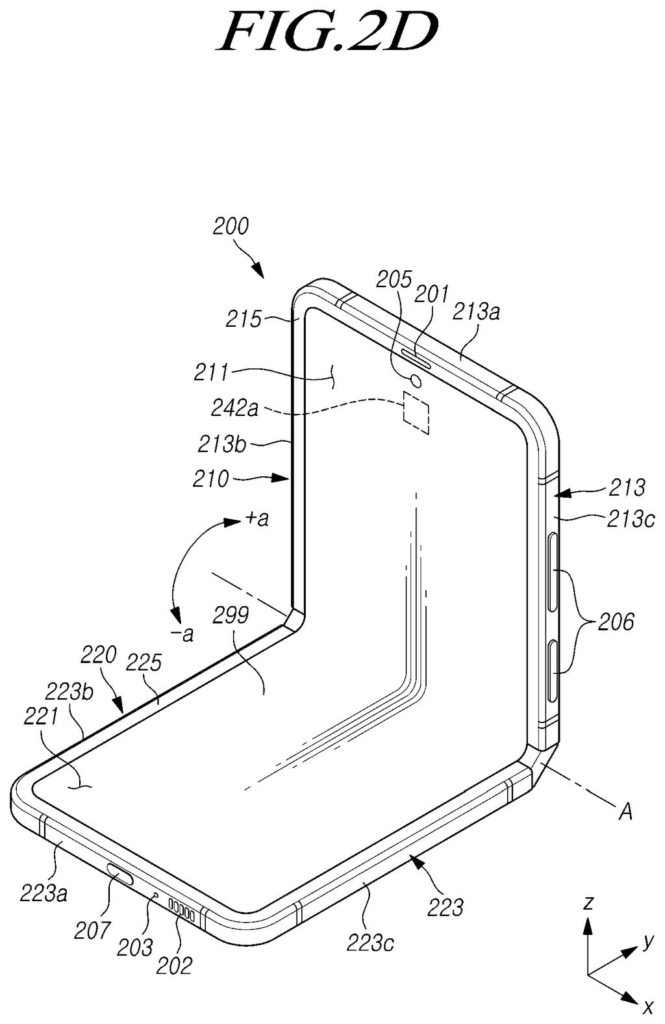
How Samsung's folding glass stays in one piece
Every time you fold your phone shut, the glass at the hinge has to bend around a curve that would snap an ordinary pane. That moment of stress, repeated thousands of times over a phone's life, is one of the hardest engineering problems in modern consumer electronics.
Samsung's patent describes a glass layer with a repeating pattern of slits (thin cuts running parallel to the fold line) separated by ribs (the solid glass strips between each cut). A soft polymer material fills each slit, and small connectors called bridges anchor the slits at each end. The key detail: the length of each slit is calculated based on how thick the glass is and how stiff the polymer filling is, so the structure bends as a tuned system rather than just hoping the glass holds.
The result is a fold zone that distributes stress across many small, controlled flex points instead of concentrating it in one line where a crack can start. It's the same principle behind perforated cardboard that folds cleanly at a scored line.
… a rib and a slit of a specific pattern repeatedly extend in a direction parallel to a folding axis in a glass layer included in the folding region …
Translation: The screen uses a repeating pattern of tiny cuts and glass strips that run along the fold to help the display bend.
How the rib-and-slit pattern controls bending stress
The patent covers the folding region of a flexible display, specifically the glass layer that runs through the hinge zone. Ordinary glass snaps because bending concentrates tension on one surface and compression on the other, eventually exceeding the material's limit.
Samsung's approach cuts a repeating pattern of slits through this glass layer, running parallel to the fold axis. Between each slit are ribs, the intact glass strips that carry structural load. At both ends of every slit, bridge connectors link the two ribs on either side, keeping the pattern from splaying apart.
The critical engineering decision is how long each slit should be. The patent specifies that slit length is determined by at least one of:
- The thickness of the glass layer (thicker glass needs different cut geometry to achieve the same flexibility)
- The modulus of the polymer filling the slit (modulus is a measure of stiffness; a stiffer polymer requires different slit dimensions to let the glass flex the same amount)
By tuning those two variables, the system ensures that when the phone folds, bending stress spreads evenly across many small flex points rather than spiking at one location. The polymer fill also prevents debris from lodging in the cuts and keeps the layer acting as one coherent piece rather than a collection of loose strips.
… a slit length corresponding to a distance between a first bridge corresponding to a start point of the slit and a second bridge corresponding to an end point of the slit is determined based on at least one of a thickness of the glass layer or a modulus of a polymer filling the slit …
Translation: Samsung calculates the exact size of these cuts based on how thick the glass is and the stiffness of the filler material.
What this means for foldable phone durability
Foldable phones have been available for several years now, but crease visibility and long-term hinge durability remain the two complaints that keep most buyers on the sidelines. A glass layer that can survive tens of thousands of folds without developing micro-cracks directly attacks both problems: a structurally sound fold zone holds its shape better and keeps the crease from worsening over time. For you as a buyer, that translates to a device that looks and feels closer to a conventional phone for longer.
Samsung has more foldable models on the market than almost any other manufacturer, so improvements here feed directly into its Galaxy Z Fold and Z Flip lines. The level of specificity in this filing, tuning slit geometry to both glass thickness and polymer stiffness, signals that this is production-engineering work rather than exploratory research. Patentlyze publishes plain-English patent summaries across the full range of foldable display filings from Samsung and its rivals, where this kind of materials-level detail is becoming a defining competitive frontier.
This is the 61st Samsung filing we've tracked on our foldable phone designs watchlist since May, joining work like a sliding screen audio fix and a fold crack support.
Glass that cracks at the fold is the reason most people who want a foldable phone still do not own one. The hesitation is rational: a screen that breaks from ordinary use, on a device that costs more than a laptop, is not a minor inconvenience.
What this patent addresses is the geometry of how stress travels through glass when it bends, designing the cuts and bridges in the material so that no single point absorbs all the strain. The dimensions are calculated from how stiff the filler material actually is, which matters because it means the design can be tuned as materials improve rather than fixed permanently.
Whether this survives the daily reality of drops and cold weather is still to be proven, but the problem it targets is large enough that even a partial solution changes the calculus for millions of buyers sitting on the fence.
Get our take in your Top Stories
Liked this breakdown? Add Patentlyze as a preferred source on Google, and our plain-English take shows up more often in your Top Stories the next time Samsung patent news breaks.
There are more where this came from
We read every patent application Big Tech publishes and send you the ones worth knowing. Plain English, free, every week.
The drawings
29 drawing sheets from US 2026/0252146 A1 · click any drawing to enlarge


Want this weekly breakdown for a company we don't cover? Patentlyze Pro →
Be the first to weigh in